Thursday, November 29, 2007

Ancestry Slow Today!

If you thought Ancestry.com was slow today (Thursday), you're not alone. Starting some time after 11:00AM Ancestry become, at times, slow to the point of uselessness. As of the time of this posting, the site seems to have returned to normal. If you have further problems tonight, check back here for updates.

Also today mysterious ribbons appeared on three of the Ancestry navigation buttons. Someone expressed concern that clicking the buttons didn't seem to do anything different than before. Be assured, nothing is wrong with your computer. The ribbons illuminate areas of the website where purchases can be made. You may find, as I did, that meaningful gifts can be created or purchased in these areas. (Shhh! Don't tell anyone. I'll tell you more after Christmas, but I don't want to ruin any surprises right now.)

Updated 10:30PM

I spoke too soon. When I started trying to use Ancestry Member Trees, I found they were still suffering from problems. The Family Tree view doesn't work. If you add or change information about a person, the Ancestry Hints "Searching..." never completes. If you try to attach an OWT match, the browser suddenly jumps to the home page. Anyone with an HTTP sniffer can see that this is Ancestry's current response to a 500 error. That means a fatal exception prevented the page from being composed for display. Ancestry Member Trees used to handle 500 errors with a special page. I think it said something like, "something went wrong. Would you like to use RootsWeb or one of our other sites instead."

I wonder if part of the problem this morning was that the home page itself was causing 500 errors. The website handled the exception by sending the user back to the home page, which quickly blew up again. Thus, the behavior caused an endless cascade of errors until the user gave up and closed their browser or went to some other website. Granted, the old 500 error handling page shouldn't have been sending users off to RootsWeb for a once-in-a-blue-moon error. But unceremoniously dumping the user back to the home page is not only a confusing user experience, technically, it can cause an endless escalation of errors. Take my example above. I tried to attach an Ancestry Hint matching record. I would rather I get a message explaining that the operation had failed. Give me a chance to try it again or to go to the home page. The page used to and still should explain that the error had been logged and reported (which actually happens).

Stay tuned...

Wednesday, November 28, 2007

Tonight's Software Disasters

What an awful evening! I had simple plans; write a little review of my positive experience with Ancestry's new passport database. I found an ancestor's brother's file had signature, photograph, birth certification—even his income tax return! But I saw an advertisement for Footnote.com and thought I'd stop by my local Family History Center (FHC) to see if they had access yet.

The first machine I tried (a Windows 98 SE machine) asked me to select a certificate from an empty list. Thirty minutes. No LANDesk. Move on.

Second machine. Expired certificate. Footnote.com wanted newer Flash player. Multiple install failures. Success via 2nd window, but Footnote now gets stuck "Loading" images. Thirty minutes. Move on.

Third machine. Repeat experience of second machine. Repeat thirty wasted minutes.

Back to plan A; write review. Try to connect to Ancestry via my laptop. Can't get through FHC firewall. Thirty more minutes. This happens sometimes and if the staff cycles the power on the firewall, then my laptop gets a lower IP address that works. But why rock the boat? Certainly I could find something else useful to do.

Back to machine #3 which still has IE6 as its browser. Log on to Ancestry. Boy that new footer looks ugly with IE6. And ads were showing up too far to the right. And the "More Options" popup when editing vitals in an Ancestry Tree is partly off-screen. I hope we start testing with IE6. If I remember correctly, we still have about 35% of our users on IE6. And I hope we fix these problems.

John Pitcher arrived in New York on 7 Oct 1869 on the Manhattan. I thought I'd try and find what day he left Liverpool. Ancestry identified the Manhattan as part of the Guion ship line. I tried Googling various combinations of Guion, Manhattan, the date, etc. and gave up after half-an hour when a near miss on the New York Times archives website crashed their search engine. That was after locking up trying to view a PDF document on their site.

(Have you ever met one of those people that can't wear a watch because their body is magnetic or something? That's what I am, only for software. I can locate bugs in anything. But I digress...)

Then it hit me. Why not try searching newspapers on Ancestry? Duh!

I clicked the Search button at the top of the page. In the Browse Records sidebar... But wait. What is this odd advertisement on the far right? Just a picture of mother and daughter with no words. Why? Intrigued, I hover. Nothing. I click. Nothing. I bet that's a bug too. (I find later it is.)

Meanwhile, with time running out before the center closes, I scroll down to the Newspapers & Periodicals section of the Browse Records sidebar and click on Historical Newspaper Collection. "Guion" is a pretty unique word; I should be able to do an Exact Matches Only search for it as a keyword with the year set to 1869 and find what I'm looking for.

I get 139 matches in the New York Herald, 30 in the Edinburgh Evening Courant, and 5 in the New York Times. That's encouraging. I try Edinburgh first. I click the link for one of the dates and nothing happens. I try another and another. Still nothing. Another and another. What is it about this evening that is conspiring against me? Why was the Ancestry Search engine failing on me?

I view the source for the page and discover the bug. Gigantically long URLs are causing the browser to fail. I fiddle for another 30 minutes and give up searching. Time to do it the old fashion way.

I browsed.

Intelligently, of course. Start at Historical Newspaper Collection. At the bottom of the page, click on New York state. I notice the New York Herald has coverage for 1869, so I select it. I again scroll down to browse by date. I select 7 Oct 1869. I start browsing page by page, hoping the information, if present, isn't on page. 24. On the 2nd image, I find page number 6. Great. Another bug. This isn't the first time I've found a newspaper in Ancestry's collection that has the newspaper pages scrambled. I continue. Image 3 is page 9. Image 4 is page...

Wait! A headline that reads "Shipping News." Down a little ways, subheadings reading "Arrivals. Reported by the Herald Steam Vegies." (I might have misread the last word, but I'm getting too excited to care!) Second paragraph starts, "Steamship Manhattan..." I read, "Liverpool Sept 22..." Yahoo! My evening isn't totally wasted! I'll just attach this page to John Pitcher as the source for his Liverpool departure date...

I click on Save and...

and...

And the Save Options popup is missing the option to save to an individual in my tree!

Rats! Another bug thwarts my last attempt at productivity! I've been told this shouldn't be called a "bug" but a feature request.

Whatever. It's late and I'm going to bed.

Monday, November 26, 2007

Cool Stuff in the Works

The Ancestry team is preparing a holiday gift for you. Of course, I can't tell you what it is. Renee Zamora got an early look at the new feature. While she couldn't disclose what it is, Zamora wrote that

It was the best item I have personally ever tested for [Ancestry]. I am really excited to see this new enhancement become available on their site. So look forward to exciting things from Ancestry.

I can't tell you when it's coming. But from all the signs, I expect it soon. So start checking back often and expect to see it some time before Christmas.

Ancestry Will Soon Unveil a New Enhancement
Original animated GIF courtesy www.democrats.org

I love working at Ancestry. We do some really cool stuff, and we do it as quickly as we can. We mess up sometimes; don't hate us.

The great thing about free enterprise is that it is a closed-loop feedback system. (The Ancestry Insider must be channeling Randy's engineering background again.) Ancestry acts. The market reacts. Ancestry provides products and services. The market pays for them. Money talks. More money is positive feedback and less money is negative feedback. (Although in engineer-speak, positive feedback is negative and negative feedback is positive. Engineers... Go figure...)

Others Doing Cool Stuff

Ancestry isn't the only one doing cool stuff. Two extremely significant developments have occurred recently.

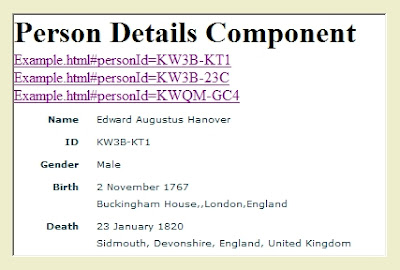
On his blog, Dan Lawyer of FamilySearch Labs demo'ed a simple mashup using the new FamilySearch API. Click one of three links and the component makes an API call to New FamilySearch and displays details about the associated person. Imagine mixing and mashing components from multiple sources to create your own optimized web application. If the general public is allowed access to the FamilySearch APIs, this could be the most significant genealogical technology development of the year.

Simplified rendition of Lawyer's New FamilySearch Mashup

WorldVitalRecords.com (WVR) released a Facebook application which appears to be their FamilyLink.com website packaged as a Facebook app. Properly architected, this is a powerful paradigm. Imagine a website being able to deploy as an application in multiple portals such as Facebook, Yahoo and Google. Enter your data once and leverage it across multiple universes for multiple purposes. This is another significant genealogical technology milestone.

We Relate is World Vital Record's Facebook application

Ya' gotta love technology! Who can predict where all this will lead to!?!Stay tuned!

Sunday, November 25, 2007

FamilySearch Rollout Update

It's a busy time of year, but I'll steal a few minutes to say hello to everyone and let you now I'm still kick'n.

New FamilySearch trademarkI've added Perth to my list of Temple Districts Using New FamilySearch.

In a previous life I built a development organization that released simultaneously in a half-dozen languages, including Japanese. It adds to the cost and date of the English release, but decreases the overall cost and shortens the overall schedule. FamilySearch seems to have taken a similar approach to the development of the New FamilySearch (NFS) website. This type of process would seem to be ideal for the international needs of FamilySearch owner, the Church of Jesus Christ of Latter-day Saints (the Church). The website currently supports German, English, Spanish, French, Portuguese, traditional Chinese, Japanese and Korean.

Whether behind-the-scenes pieces of New FamilySearch have followed this same approach is hard to tell. The actual rollout to temple districts has first verified English, where the majority of temple work occurs, followed by Spanish, which has or soon will become the predominant language of Church members.

New FamilySearch Japanese home pageA spokesperson for FamilySearch revealed that rollout to a temple in Japan will come soon.This is great news. Verifying that all the behind-the-scenes pieces of NFS work for a 16-bit language is a major milestone. Japanese is one of the world languages that have more letters or symbols than will fit in the 256 different combinations possible in the 8-bits of one byte. To implement Japanese, Chinese, Korean and other languages with large sets of written symbols, one must use 16-bit characters or double byte characters (a mixture of 8- and 16-bit characters).

As if to maintain the ying and yang balance of the universe, the spokesperson also informed me that the New FamilySearch (NFS) rollout schedule is lagging a bit. Utah likely won't see it until later in 2008.

Thanks, Generations Network

The Generations Network logoI mentioned in my series on employee/employer blogging that the Generations Network (TGN) employee Hector intended to blog about his work environment. Since then, he's followed through. In a posting he titled "My Employer: The Generations Network," Hector states,

This is the first truly family-friendly, where they mean what they say, company that I have worked for. Everybody else has given lip service to this philosophy, but TGN lives and breathes it. I truly thought these sort[s] of companies were a myth, and was shocked when I found they were for real.

I can verify that TGN really is family friendly. I suppose it took Hector's comment to make me appreciate how rare such companies can be. So on this Thanksgiving weekend, let me say to my employer, "Thank you." Our corporate mission is to unite families across space and time.

It's nice that TGN starts in the homes of its own employees.

Monday, November 12, 2007

Australian NFS Reports Make 20

New FamilySearch U.S. Rollout as of November 2007

Since yesterday, I've received confirmation for Las Vegas and Bismarck. I've also learned of Boston, the 2 Hawaii temples and 2 Australian temples, Melbourne and Sydney. See the latest list at Temple Districts Using New FamilySearch. Others have also produced maps and lists that you might enjoy. See the table at Renee's Genealogy Blog and Miles Meyer's Google Map.

Sunday, November 11, 2007

Dozen more to get New FamilySearch

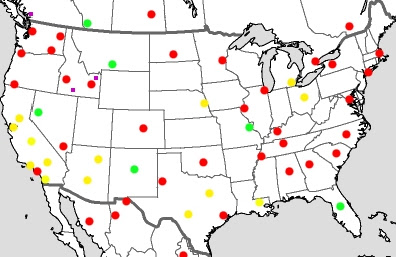
New FamilySearch U.S. Rollout as of November 2007While FamilySearch has maintained its official policy of public silence about the continuing rollout of New FamilySearch (NFS), the online LDS Genealogy community was buzzing last week as members of about a dozen districts shared their excitement at receiving word they would get the New FamilySearch within 90 days.

The map above shows in green the six districts already using New FamilySearch: St. Louis, Reno, Billings, Orlando, Albuquerque, and Alberta Cardston.

In yellow are the districts that we think have been announced, although the lack of official announcements makes the list somewhat uncertain. Red indicates districts that have not yet started the conversion process. Utah districts, known to be last, are not shown. (For the latest list, click here.)

Questionable Districts

I find it unlikely that the California Newport Beach district, for which I've heard no reports, will not roll out at the same time as the surrounding districts. The entire state of California may, indeed, be within 90 days of being on NFS. This will hit the new system with a huge amount of traffic.

I've also shown Las Vegas and Bismark in red. Despite reports that NFS had been announced for these districts, I've not been able to confirm these. Likewise, Spokane, which reportedly was going to be #11 to go online, is shown in red. Baton Rouge may be in the same category, although I showed it in yellow. If any consultants (besides FHC directors) from these districts have received the notification email, please let me know!

Purple squares indicate announced temples in the United States and Canada.

Complete States

If Las Vegas and Newport Beach are in the rollout process, then by sometime in February all the temples in these Western states will be online: California, Arizona, Nevada and New Mexico. Several states with only one temple are online or will be online by that time: Louisiana, Missouri, Nebraska, Montana, Ohio, Michigan and Florida.

Saturday, November 3, 2007

FamilySearch vs. Ancestry.com

Halloween Happenings

What good is a secret if you can't share it with someone?!? Halloween night I was itching to brag about my secret identity. I just had to tell somebody! But who? I decided, before reading Renee Zamora's blog for the day, to share it with an old spook at the City/County building. He's helped me with some client research, so I kind-of owed him.

So who should call up this morning to tell me she knew my secret identity? Yep. Just don't tell anybody else, Renee, or I'll send my friend home with you again! ;-)

Happy Birthday, Paul Allen!

Employees at The Generations Network (TGN) were reminded of Paul Allen's early role at the company this week when the TGN Treehouse website on myfamily.com sent out a reminder of upcoming birthdays.

Allen's current project is WorldVitalRecords.com, which he says is doing well. Happy Birthday, Paul!

E-mail announcing Allen's birthday
E-mail reminding employees of Allen's upcoming birthday.

Highland Utah Stake Gets New FamilySearch

Document ID: 102052
Published: 6-Sep-2007

Problem: The Highland Utah Stake is not listed as being in a temple district that is now live or in the rollout process.

Resolution: Members of the Highland Utah Stake have been given permission to register with the new FamilySearch even though their temple district is not live. If they have problems or questions, it is all right to assist them.

FamilySearch Indexing by the numbers

FamilySearch Indexing (FSI) recently hit a new one day record of 24,718 batches submitted in one day. (Source)

FamilySearch Cooperation

The famous Salt Lake Temple
Copyright 2007, Intellectual Reserve, Inc.

The seeds of FamilySearch's cooperation with 3rd party affiliates were sown in the 19th century by a prophet/president of the Church of Jesus Christ of Latter-day Saints (the Church). (I imagine you're all aware that FamilySearch is owned and operated by the Church.)

Upon the completion of the famous Salt Lake Temple, President Wilford Woodruff offered a dedicatory prayer that Church members accept as the word of God. Part of the prayer supplicates,

As Thou has inclined the hearts of many who have not yet entered into covenant with Thee [that's those who are not members of the Church] to search out their progenitors, and in so doing they have traced the ancestry of many of Thy Saints [members of the Church], we pray Thee that Thou wilt increase this desire in their bosoms, that they may in this way aid in the accomplishment of Thy work. Bless them, we pray Thee, in their labors, that they may not fall into errors in preparing their genealogies; and furthermore, we ask Thee to open before them new avenues of information, and place in their hands the records of the past, that their work may not only be correct but complete also. (Emphasis added.)

The Church and FamilySearch are working to fulfill Woodruff's plea to "open ... new avenues of information [to the many outside the Church] and place in their hands the records of the past." In light of Woodruff's prayer, it makes sense that the Church would, to the extent they can afford it, give their records away to those outside the Church.

FamilySearch vs. Ancestry

So where does Ancestry fit in? I used to think I understood the relationship between FamilySearch and Ancestry. As I've learned more, I've come to appreciate that all but a hand-full of people judge one or the other with very few of the relevant facts.

Sure, I'm disappointed that FamilySearch doesn't interpret Woodruff's prayer as a mandate to give Ancestry all their records for free. :-) Still, comments from Ancestry's Sullivan and FamilySearch's Rencher give me faith that the two parties can find ways to cooperate that advance the different goals of each party and—more importantly to you and me—benefit the genealogy community as a whole.

Sunday, October 28, 2007

Concerns in FamilySearch/NARA partnership

The National Archives The National Archives and Records Administration (NARA) and the Genealogical Society of Utah, doing business as FamilySearch, announced the completion of an agreement this past week. In general, I'm supportive of this type of agreement and this one in particular. While I don't know that Ancestry has such an agreement in place, I know that they've published between 150 and 200 NARA record collections and are working on more.

However, when I read the draft agreement, clause 3.3 gave me heartburn.

3.3 GSU hereby assigns to NARA all copyright that GSU does or may own in and to the Digitized Images by virtue of having created digital copies of original documents in the public domain. ... GSU will own all copyright and other intellectual property rights to the Digitized Materials (the Digitized Images with the associated metadata).

I find it highly troubling that FamilySearch claims copyright in digitized images of public domain documents and if this clause made it into the final agreement, by signing the agreement NARA implicitly acknowledges that doctrine.

What About Ancestry?

Does Ancestry make the same claim? I'm neither a lawyer nor an Ancestry spokesperson. Ancestry's owner, The Generations Network, has posted its Copyright Policy and in it they claim copyright on "content ... created by us, or by third parties as work for hire, or where the copyright has been assigned to us." I hope that since the policy doesn't explicitly make claim to copyright in digitized public domain documents, that that is a reflection of the corporation's policy on the issue.

Copyright is not the only way to protect intellectual property. Discussions on Ancestry's Terms and Conditions after the Internet Biographical Collection fiasco focused solely on their copyright claims, ignoring the remainder of the terms. The Terms and Conditions is a license—a contract—wherein you are given access to content in exchange for a legal obligation not to copy it except as specified.

I might be in left field legally, but I view this analogously to a library or private institution that holds valuable publications or works of art for which the copyright period has expired. They protect the intellectual property in these public domain works by contractual agreement. You can view the works, but you can't take photographs or make photocopies.

But I digress...

NARA's Chief Public Domain Advocate

Max J. Evans of NARA At an FGS conference a couple of years ago I had a heated discussion with Max J. Evans, executive director of NARA's National Historical Publications and Records Commission. We were both so passionate in our positions that it was not until near the end that I realized we were both advocating the same thing. Copyrights should expire and the works pass into the public domain, and stay in the public domain.

If clause 3.3 survived into the final agreement, then it's a grand irony that Evans, who may be NARA's chief proponent for keeping public domain documents in the public domain, is leaving NARA to work for the Family and Church History Department of the Church of Jesus Christ of Latter-day Saints.

While we're on the subject of Mr. Evans, let me digress onto another subject that I hope to write about. In a 2004 Ford symposium Evans asked what archives might learn from Amazon.com. The question resonated with me since at Ancestry I tried to evangelize a community model that I call the Amazon.com model. Some managers at Ancestry get it, some don't. Wikipedia gets it. eBay gets it. FamilySearch is showing hopeful signs. Stay tuned.

The Press Release

Here is the entire text of the press release, in case you missed it.

Press Release October 23, 2007

National Archives and the Genealogical Society of Utah (GSU) Announce Digitizing Partnership

Washington, DC

Archivist of the United States Allen Weinstein and Wayne Metcalfe, vice president of the Genealogical Society of Utah, today announced a five-year partnership agreement to digitize case files of approved pension applications of widows of Civil War Union soldiers from the National Archives. GSU has many years of experience microfilming historical records at the National Archives and throughout the world and in recent years has moved to providing digital capture and publishing services. Digitization makes possible unprecedented access to the unique historic documents in the custody of the National Archives.

This partnership will begin with a pilot project to digitize, index, and make available the first 3,150 of the pension files. Upon successful completion of the pilot, GSU, doing business as FamilySearch, in conjunction with Footnote.com, intends to digitize and index all 1,280,000 Civil War and later widows’ files in the series. These records, of great interest to genealogists and others, are currently available only at the National Archives Building in Washington, DC. The widows’ pension application files, a rich source of information about ordinary American citizens of the time, include supporting documents such as affidavits, depositions of witnesses, marriage certificates, birth records, death certificates, and pages from family bibles.

“For a number of years we have had a very productive relationship with FamilySearch,” said Professor Allen Weinstein. “This agreement expands our relationship to enable online access to some of the most popular and voluminous records in our holdings. It is an exciting step forward for our institutions and for the American people,” he added.

“There is an unbelievable treasure trove of genealogical information housed in the records of the National Archives; the vast majority of which genealogy enthusiasts have never seen,” said Wayne Metcalfe. “The growing digital collection and indices that will stem from this relationship will be a priceless resource for countless family historians and researchers.”

FamilySearch will make the digitized materials available for free through www.FamilySearch.org and in 4500 family history centers worldwide, or on a subscription-based web site operated by a third party, subject to National Archives approval. They will also be available at no charge in National Archives’ research rooms in Washington, DC, and regional facilities across the country. In addition, FamilySearch will donate to the National Archives a copy of all the digital images and the associated indexes and other metadata that they create.

This agreement is one of a series of agreements that the National Archives has reached or will reach with partners to digitize portions of its holdings.

# # #

For Press information, contact the National Archives Public Affairs staff at 202-357-5300.

Wednesday, October 24, 2007

New FamilySearch Version 0.91 Coming Soon

The FamilySearch logo

Rumor has it that an updated release of New FamilySearch (NFS), internally called version 0.91, will soon hit the New FamilySearch website. New New FamilySearch will contain minor but helpful improvements to most key tasks. The release is expected before the end of the year. The schedule for the affiliate software beta test runs through November 14, so I wouldn't expect it before then.

The new release is said to make it easier to search, combine and enter data. I've been told that the silly "Finalize Your Choices" page (below) has been improved, making it look like it's really supposed to be there. A source inside FamilySearch confirms that the page was really a placeholder for some functionality that hasn't made it into NFS yet. When it does, there will be rhyme and reason to choosing between "Yes, combine" and "Yes, combine, but some information is different."

The Silly Finalize Your Choices page

By the way, did you know that when comparing two records if you hover over a spouse, parent or child's name, NFS will highlight all names on the page that belong to that person (see illustration below), even if some are on the left hand side and some are on the right. This is helpful knowing that someone (maybe you) has already combined the relative's record. It makes it quite likely that the two records refer to the same person.

Hover your cursor over a name and the same individual is highlighted in both the left and right records

Claim Your Contribution

Perhaps the most exciting enhancement for me is the ability to claim Ancestry File (AF) and Pedigree Resource File (PRF) contributions. Many users know that some of the information they've submitted in the past was wrong. Correcting AF data required writing letters and submitting floppies and sometimes years of waiting. With the advent of PRF, FamilySearch advised users to submit corrections by duplicating their AF submission with a corrected submission to PRF. PRF submissions were corrected by duplicating the submission to PRF with the corrections. Some individuals made it an annual process. Hundreds of thousands of duplicate records were produced. But I digress...

With NFS it is not only possible to correct data you enter into NFS, it is also possible to claim all your old AF and PRF submissions and correct them also.

Version Numbering

Spokespersons for FamilySearch have stated that the "0.9" nomenclature references the early versions of NFS reserved for members of the Church of Jesus Christ of Latter-day Saints (the Church). The "1.0" nomenclature refers to a future release open to the general public. The priority of the 0.9 release is collaboration and cooperation among Church members to avoid duplication of ordinances in the Church's 124 temples. Once this need has been addressed then the software can be upgraded for the needs of genealogists in general.

It has been reported that at least some staff members of Family History Centers (FHCs) who are not members of the Church have been able to get accounts for NFS and are reportedly helping train Church members to use the new software. Since the registration process requires a membership identification number, the special process that must be followed is explained on pp. 5-6 of the NFS FHC Directors' packet. (Source)

Monday, October 22, 2007

NEHGS and Ancestry.com Announce Partnership

NEHGS AND ANCESTRY.COM ANNOUNCE NEW MEMBERSHIP BENEFITS AS PART OF COLLABORATION

Two Genealogy Industry Leaders Offer Special Pricing and New Member Benefits

Boston, MA & Provo, UT– October 22, 2007 – The New England Historic Genealogical Society (NEHGS) and Ancestry.com, part of The Generations Network, Inc., today announced the availability of special membership pricing that allows members of both organizations and those wishing to join to take advantage of some of the most important family history information available anywhere. Beginning Monday, October 22, special discounted pricing is open to NEHGS members, Ancestry.com members and those interested in joining both.

Those interested in signing up for NEHGS and an Ancestry.com U.S. Deluxe membership can now do so for the single price of $155.40, a combined savings of $75. This subscription provides annual memberships to both organizations and gives subscribers access to some of the most valuable and important genealogical research information anywhere. Current NEHGS members wishing to join Ancestry.com, or Ancestry.com members wishing to join NEHGS, can also do so for a special low price. In addition, as part of the agreement, Ancestry.com will publish on its site indexes of the leading NEHGS publication, The New England Historical and Genealogical Register (1847-2002).

“We want this collaboration to give people an opportunity to engage in genealogy at a level that they maybe haven’t before,” said D. Brenton Simons, NEHGS President and CEO. “Ancestry.com is an extraordinary online resource and we are thrilled to be working with them on this. We hope this provides the groundwork for future opportunities.”

Since 1845, NEHGS has been one of the leading genealogical resources in the country. And while NEHGS does have a rich collection relating to early colonial American history and genealogy, the organization also offers access to other regions throughout the country, including New York State. Members of NEHGS also have access to its staff of expert genealogists, which includes leading genealogists in American, English, Irish, Scottish and Canadian research. NEHGS also produces some of the most important publications in genealogy, including The New England Historical and Genealogical Register, published continuously since 1847, and the member magazine New England Ancestors. Other NEHGS collections include:

  • Mass Vital Records (1841-1910)
  • Early Mass vital records to 1850
  • New York Probate Records (1787-1835)
  • The New England Historical and Genealogical Register online (1847-2004)
  • More than 1,650 cemeteries and burial grounds transcriptions from all of the New England states, New York, and Eastern Canada
  • Town Records
  • The Great Migration Begins: Immigrants to New England (1620-1633), Volumes I-III
  • Early American Newspapers (1690-1876)
  • The Search for Missing Friends: Irish Immigrant Advertisements Placed in The Boston Pilot (1831-1920)
  • Special collections and manuscripts from the Archives of NEHGS
  • Premium Database - Early American Newspapers, (Series I) (1690-1876)
  • Premium Database - The 19th Century U.S. Newspapers database provides access to approximately 1.7 million pages of primary source newspaper content from throughout the 19th century

With more than 5 billion names and 24,000 searchable databases and titles, Ancestry.com is the world’s largest online resource for family history information. Free services on Ancestry.com offer individuals the opportunity to create online family trees and share them with others. Members can upload photos, add stories to their tree – even record oral histories. The membership option available within the joint NEHGS and Ancestry.com package includes an Ancestry.com U.S. Deluxe subscription, which provides access to all U.S. historical records available on the site such as:

Trees
  • More than 3.8 million Ancestry.com family trees with more than 330 million names included
Census
  • The only complete online U.S. Federal Census Collection (1790-1930)
  • U.S. State and territorial census records including Iowa (1836-1925), Kansas (1855-1915), Minnesota (1849-1905), Wisconsin (1895 & 1905), Mississippi (1792-1866) and more
  • U.S. Indian Census Schedules (1885-1940)
Immigration
  • The most comprehensive online collection of U.S. passenger lists (1820-1960) from over 100 different U.S. ports including New York (Castle Garden and Ellis Island), Boston, Baltimore, Philadelphia, New Orleans, and San Francisco, among others Border crossings from Canada to the U.S. (1895-1956) and Border crossings from Mexico to the U.S. (1903-1957)
Military
  • The largest online compilation of U.S. Military records with more than 90 million names from the 1600s through Vietnam, including more than 24 million World War I draft registration cards
Vital Records
  • 20th century vital records from California, Texas, Florida, Ohio, North Carolina and more
Newspapers
  • More than 16 million pages of U.S. historical newspapers from the 1700s through 2003
Maps and Photos
  • The largest online collection U.S. historical land ownership maps (1850-2000) encompassing nearly 50,000 from across the country Access to over 3.5 million mostly vintage photographs uploaded by Ancestry.com users

“This partnership allows members of both organizations the ability to search U.S. and New England records from one location – their home computer,” said Drew Izzo, Vice President of Marketing for Ancestry.com. “NEHGS offers its members the unique opportunity to closely examine their New England roots. With a U.S. Deluxe membership to Ancestry.com, members can expand their family history research into other parts of the country.”

Other aspects of the special collaboration include member discounts on select services and products. To learn more, visit NEHGS Web site at: http://www.NewEnglandAncestors.org/tgn_collaboration.asp or call 1-888-296-3447.

About NEHGS

The New England Historic Genealogical Society, founded in 1845, has more than 20,000 members nationally, making it the oldest and largest non-profit genealogical organization in the country. The NEHGS library, located in Boston, includes more than 28 million items, such as manuscripts, letters, periodicals, books, documents, photographs, and other rare and valuable items. These collections provide genealogists of all levels and expertise immeasurable access to their own family histories and stories. The NEHGS staff includes some of the most respected and experienced genealogists in the country, specializing in American, English, Irish, Scottish, and Canadian research.

NEHGS also publishes several publications including The New England Historical and Genealogical Register. Published since 1847, the Register is considered by many to be the leading source of early American research. Under the NEHGS and Newbury Street Press imprints, NEHGS also publishes a number of books on family and local history.

About Ancestry.com

With 24,000 searchable databases and titles and more than 800,000 paying subscribers, Ancestry.com is the No. 1 online source for family history information. Since its launch in 1997, Ancestry.com has been the premier resource for family history, simplifying genealogical research for millions of people by providing them with many easy-to-use tools and resources to build their own unique family trees. The site is home to the only complete online U.S. Federal Census collection, 1790-1930, as well as the world's largest online collection of U.S. ship passenger list records featuring more than 100 million names, 1820-1960. Ancestry.com is part of The Generations Network, Inc., a leading network of family-focused interactive properties, including MyFamily.com, Rootsweb.com, Genealogy.com and Family Tree Maker. In total, The Generations Network properties receive 8.2 million unique visitors worldwide and over 429 million page views a month (© comScore Media Metrix, August 2007). For more information, visit www.ancestry.com.

Media Contacts

Tom Champoux, Marketing Director
New England Historic Genealogical Society
617-226-1211
tchampoux@nehgs.org

Mike Ward, Public Relations Director
Ancestry.com
Part of The Generations Network, Inc.
801-705-7099
mward@tgn.com

Friday, October 19, 2007

Inside Scoop On Ancestry Acquisition

If life continues to be so busy, this is going to be a weekly column rather than a weekday column. Holy Cow! Fortunately, the world has no shortage of excellent genealogy blogs.

Can I say that I'm thinking in a prior life I was Randy Seaver? I think we share engineering backgrounds that lead our brains down the same paths. Or maybe he has my office bugged. When I come up with a subject I wish to cover, at least half the time he covers it in his Genea-Musings blog before I can get to it. Which isn't all bad, given the limitations on my time. As long as I don't mind him getting all the glory, this could be a wonderful partnership. I'll continue to come up with great topic ideas and he can continue doing a great job writing them up.

I don't mean to start a list here, but you good genealogy bloggers, you know who you are. <smile> I try and keep my personal reading down to... hang on let me count... 40 blogs! Holy Cow! No wonder I don't have time to write!

Bloglines Feed Reader

And may I say again how impressed I am with Bloglines. During this acquisition week there's no way I could have kept up without it. You see, I broke down last Saturday and got a cell phone with Wi-Fi and Windows Mobile. (If anyone accuses me of putting my old phone through the wash, I'll deny any involvement. I'm totally, ah... clean. ) Now I can read blogs from anywhere in the house (when it's working. I refuse to pay for a Data Subscription. I have Wi-Fi at work and at home. You'd think the phone would be happy. But the stupid phone and/or stupid Windows Mobile doesn't like being operated without a data subscription. Grrrr! Has nobody out there done this before?!? But I digress...)

I was delighted to find that on my mobile phone Bloglines has special handling making it remarkably usable even in a 1.75 " by 1.75 " browser window. Feeds can be marked to display complete posts or summaries and can be completely excluded from the mobile reader. Clicking through to original blog posts, Bloglines invokes skweezer.net technology so even the original blogs are reformatted for the tiny screen.

The Acquisition

Using all this newfangled technology, I've been able to keep up with the hundreds of postings about the sell of Ancestry.com's parent company, the Generations Network (TNG). There have been some inaccuracies out there and I'd like to address them.

Inaccuracy: "Morale at the company is low"

We're in a great job market and if this were true, there would be higher levels of turnover. If anything, the recent layoff hit some groups harder than others because they weren't experiencing any turnover. I suppose you can find the usual small number of workers that are greatly dissatisfied and the expected great number of workers with small dissatisfactions.

And we also have those that remember that when the company was smaller it was more fun. I've seen that before, also, and consider it normal. Some people enjoy the less-restrictive, higher-productivity and greater-interactivity of smaller companies. But it says something that they've stayed with the company this long.

It's true that all of us have hated the layoffs. You'd have to be inhuman not to. I was an executive of a large technology company and had to affect several layoffs. I used to return after hours and cry at the desks of my former employees. Knowing what I did was the best thing for the company and its owners was little solace to me because I knew it would be of no solace to the newly unemployed families.

Inaccuracy: "A few months ago the CFO was laid off"

There are several places where a fact-checker could see if this were true before publishing it. The TGN Management Team page of the company website shows David H. Rinn is the CFO. The Press Release Archives for 2004 shows he's held that position for over three years.

Inaccuracy: "Conditions at the company are bad"

In all fairness, the author goes on to specify that it is the condition of affiliate relations that are bad. Since the author is professionally involved in affiliate marketing, she may be right on this point. I just wanted to make it clear that conditions "at" or inside the company are just fine, thank you.

TGN Blocking Newspaper Girl?

Inaccuracy: "Employees at Ancestry.com read my blog"

I made that last one up. What Newspapergrl, Janet Meiners, actually said was, "Ancestry.com employees read my blog." And this is true. Meiners used to work at Ancestry, so it's only natural. But I found something weird the last time I tried to read her blog while at Ancestry. I could read the post just fine in Bloglines, but when I attempted to click through to her website, I got a browser error stating the name did not exist. Two fellow workers verified the same result at that time and a week later.

Is TGN blocking employee access to Meiners website? Is Meiners website blocking readers with TGN's IP address? Could this be inadvertent on one of the parties parts? She looks like a nice girl. She and I have a 3rd-degree LinkedIn relationship through 50 of my contacts. She posted a link to my website, so she must be a good person.

That's It For Tonight

Well, it's late, so that's it for tonight. In parting, let me make it clear that this acquisition is simply one owner buying out other owners as a financial investment. Spectrum is not an expert in genealogy or Internet social networking. They are experts in investing. They must have faith in our business model. They've gotta' believe in our management team. As experts in finding companies whose value will grow at a rate faster than the market, the last thing they want to do is introduce risk, upsetting the apple cart in any substantial way.

Wednesday, October 17, 2007

TGN and Ancestry.com Sold

FOR IMMEDIATE RELEASE


The Generations Network, Parent Company of Ancestry.com, to be Acquired by Spectrum Equity Investors


Investment Will Support and Accelerate Company’s Strategic Direction and Growth Plan


PROVO, UTAH – October 17, 2007 – The Generations Network, Inc., today announced that Spectrum Equity Investors will lead an investment of $300 million to purchase a majority interest in the company. Spectrum, a private equity firm based in Menlo Park and Boston, has been a shareholder in The Generations Network since 2003. Following the transaction, Vic Parker and Ben Spero from Spectrum will serve on the company’s new board of directors, along with Tim Sullivan, President and CEO of The Generations Network. Additional terms of the transaction were not disclosed.  The acquisition is subject to customary regulatory and closing conditions and is expected to close in 2007.


The Generations Network’s portfolio of sites and products includes Ancestry.com and seven international Ancestry sites, myfamily.com, Rootsweb.com, Genealogy.com, Family Tree Maker® and Ancestry Magazine. The company’s current management team will continue to lead the company.


“As an investor in The Generations Network for the past four years, we have watched the company revolutionize the family history category by leveraging the power of the Internet to make it more accessible and easy for anyone,” said Vic Parker, Managing Partner, Spectrum Equity Investors. “Ancestry.com and myfamily.com are clear category leaders in the growing and rapidly evolving family history and family networking markets. We are excited to partner with The Generations Network management team to continue growing this truly unique company that has the power to impact users at a very personal and emotional level.”


The Generations Network properties have more than 900,000 paying subscribers and receive 8.2 million worldwide unique visitors per month (© comScore Media Metrix, August 2007). In the last 18 months, the company has solidified its position as one of the largest and most profitable subscription businesses online with success in several areas:


  • Ancestry.com is the world’s leading online family history resource, with more than 5 billion names from historical records, unmatched and proprietary search technologies and an engaged and passionate community of more than 2.5 million active members.


  • A redesigned Ancestry.com experience has transformed an online research tool into a platform for aggregating the world’s family history memories. Since late July 2006, more than 3.8 million family trees have been created on Ancestry.com, over 330 million names added to Ancestry Family TreesTM, and more than 3.5 million individual photos, stories, or scanned documents have been uploaded by members.


  • Ancestry.com now boasts the only completely indexed online U.S. Federal Census Collection (1790-1930), the most comprehensive online compilation of U.S. ship passenger lists (1820-1960), the largest online collection of African American historical documents and the most comprehensive online collection of U.S. military records.


  • Beyond the United States, the Ancestry global network now includes local country sites for the United Kingdom, Canada, Australia, Germany, Italy, France and Sweden.


  • The recent launch of DNA.ancestry.comTM now extends the Ancestry service into the rapidly growing field of genetic genealogy.


  • AncestryPressTM, a digital publishing platform integrated into Ancestry.com, now gives every family the ability to create completely unique, professionally printed family history books.


  • Family Tree Maker® 2008, the No. 1-selling family history software package, is now available online and in major retail stores throughout North America and Europe.


  • The redesigned myfamily.com site now has new features, providing families everywhere a safe, private, and free family home on the Web.


“Spectrum Equity has been an incredibly supportive and strategic-minded investor in our company for several years, so I am thrilled to have them acquire this majority interest in The Generations Network,” said Tim Sullivan, company President and CEO. “2007 has been the company’s most successful and profitable year to date, and 2008 looks even more promising as we grow our core businesses further, expand our global presence, and innovate with new products and services that help us realize our mission to connect families across distance and time. I appreciate Spectrum’s vote of confidence in our direction and vision, and I am excited to work even more closely with Vic Parker and Ben Spero to continue to transform this amazing and unique business into a truly great company.”


Lehman Brothers acted as financial advisor to The Generations Network, Inc. in the transaction.


About The Generations Network, Inc.

The Generations Network, Inc., founded in 1983, is the leading online network connecting families across distance and time. The Generations Network, Inc. provides people the content, community, and technology to empower them to find the people most important to them -- and discover and share their unique family stories. The Generations Network operates eight Ancestry websites, including www.ancestry.com (United States), www.ancestry.co.uk (United Kingdom), www.ancestry.ca (Canada), www.ancestry.com.au (Australia), www.ancestry.de (Germany), www.ancestry.it (Italy), www.ancestry.fr (France), and www.ancestry.se (Sweden) as well as www.myfamily.com, www.genealogy.com, and www.rootsweb.com. The company also publishes Family Tree Maker®, the No. 1-selling family history software, Ancestry Magazine and more than 50 book titles. For more information, visit www.thegenerationsnetwork.com.


About Spectrum Equity Investors

Spectrum Equity Investors is a private equity firm focused on investing in profitable, growing services businesses. Founded in 1994 with offices in Menlo Park and Boston, Spectrum manages over $4 billion in capital across five funds. The firm’s investment team has deep experience in information services and online media, including investments in Demand Media, Interbank FX, iPay Technologies, NetQuote, Mortgagebot, RiskMetrics Group, Seisint (acquired by Reed Elsevier PLC.) and WorldCheck.  For more information, visit www.spectrumequity.com.


Media Contacts

Julia Burgon

Coltrin & Associates for Ancestry.com

212-221-1616 ext. 124

julia_burgon@coltrin.com


Tola St. Matthew-Daniel

Coltrin & Associates for Ancestry.com

212-221-1616 ext. 101

tola@coltrin.com


Friday, October 12, 2007

Employees: Don't Get Hit by the Train — Part 4

Click to enlarge on Featurepics
Don't Miss the Train.
© Josef F. Stuefer

This is the last in a four part series examining the use of blogs to open communications between consumers and genealogy companies. In part one we introduced the Cluetrain Manifesto. In part two we presented the Manifesto's key theses. In part three we examined the official blogs of Ancestry and FamilySearch. Today we talk about employee bloggers and the problems they face. I'll present the short list of known employee bloggers at Ancestry and FamilySearch and their parent companies.

Blogging's Unintended Consequences

Wikipedia notes that bloggers have faced numerous unforeseen consequences including defamation and liability lawsuits, criminal prosecution, imprisonment (in Singapore) and deportation (from the Sudan). One innocent blogger became the target of threats so vicious she was afraid for her life.

Don't Get "Dooced"

There's an additional concern for those who blog about their work.

Heather B. Armstrong is a 1997 graduate of Brigham Young University who rose to national prominence when she was fired from her job because of her blog, Dooce. Armstrong says,

I was fired from my job for this website because I had written stories that included people in my workplace. My advice to you is BE YE NOT SO STUPID. Never write about work on the internet unless your boss knows and sanctions the fact that YOU ARE WRITING ABOUT WORK ON THE INTERNET.

Sympathetic bloggers now use the term "dooced" to refer to losing one's job because of one's blog. Horror stories of dooced bloggers are strewn across the Internet. (See articles at NYT, BBC News, Telegraph, NPR, Bangalore Times, SF Chronicle.)

I Love, er... Loved My Job

My job is a dream come true. I love genealogy, computers and the Internet. I love Ancestry and company. I love working there. I love all the fantastic people I work with. I think our executive management team is top notch.

But employees are finding that loving one's job and employer will not save them when they inadvertently cross the unseen line that separates acceptable and unacceptable blogging.

Seal of the Central Intelligence Agency Christine Axsmith got axed from the CIA.

I love the CIA. I love the mission. I love the people. It's such a great place to work.

Her mistake? On a blog inside the CIA only accessible by readers with top secret clearance she followed up a well-received post on the poor food in the cafeteria with one reviewing the Geneva Convention's rules about torture.(Source)

The Evil Empire

Robert Scoble is the prominent blogger credited with "single-handedly (at first) giving the EVIL EMPIRE (Microsoft, who else?) a 'Human Face' thanks to his Blog." The Economist described Scoble similarly:

Microsoft logoImpressively, he has also succeeded where small armies of more conventional public-relations types have been failing abjectly for years: he has made Microsoft, with its history of monopolistic bullying, appear marginally but noticeably less evil to the outside world.... Bosses and PR people at other companies are taking note.

I suppose Ancestry's reputation is what drove me to blog (with the encouragement of my former VP). While management has purged the company of the repugnant practices that produced their previous reputation, their past public persona persists.

How to Not Get Dooced

Cover of Naked Conversations In Scoble's book, Naked Conversations: How Blogs are Changing the Way Businesses Talk with Customers (coauthored with Shel Israel), he dedicates an entire chapter to the topic of blogging without getting dooced. He should know. While a blogger for Microsoft, he sometimes criticized Microsoft's problem areas—even praising its competitors' strengths—without getting fired. Here's my take on the seven danger areas Scoble advises employee bloggers avoid:

  1. Leaking financial or other confidential information.
  2. Breaking news in advance (see #1) or otherwise generating unexpected work for the PR team.
  3. Not matching up with the PR image. Companies spend a lot of time and money to build a particular brand image.
  4. Disrupting the workplace by angering your co-workers or bosses.
  5. Exposing dirty laundry, or in any way hurting people’s careers (See #4 again).
  6. Increasing legal liabilities. Companies generally don’t like getting sued.
  7. Damaging a company’s relationships with partners, competitors or other entities that affect its standing.

When violation of these issues take employers or employees by surprise, trouble results. Employers must recognize that effective blogging policies and fair disciplinary actions must address all the danger areas. Employees must recognize that each company and each area within a company will have different blogging tolerance levels, which can vary over time. Scoble and Israel advise,

Good bloggers have to be good employees, if companies are going to not only tolerate, but encourage blogging.

Companies Benefit

Scoble goes on to explain the benefits that employers derive from employee bloggers.

On the part of company decision-makers, they need to keep in mind that the sentiment of the blogosphere is decidedly opposed to the broadcast marketing and corpspeak that dominates other communication channels. Employee cheerleading [works and] only works credibly when employers tolerate their [occasional] criticism.

The best course for employers is to give employees guidelines under which they will have the freedom and incentive to become world class bloggers. Make clear that you trust your employees to blog smart. Define the taboos in your company.

Then step back and let them say what they want. Yes, from time-to-time, some will be critical of company products or policies—and they’ll do it right out there in the open where your customers, competitors and the media can see it. And all of those people will see the openness and tolerance of your company culture. ... That is good for [your company image].

And your customers, competitors and the media will more readily believe positive statements about your company coming from them than coming from you.

FamilySearch Employee Bloggers

Here are the few blogs of FamilySearch and TGN employees that I know of. Perhaps there are others. I'll start with FamilySearch and parent company, the Church of Jesus Christ of Latter-day Saints (the Church).

  • Dan Lawyer. Taking Genealogy to the Common Person. March 2006. Product manager at FamilySearch Labs. Infrequent posts. Blogs about work. http://eatslikeahuman.blogspot.com/
  • Larry Richman. ldsWebguy. July 2006. The Church Internet Coordination Group Director. Frequent postings. Blogs about work. Not genealogy-centric. http://www.ldswebguy.com/
  • Jason Lynes, et. al. NorthTemple. August 2006. A group of designers from the Church. Frequent posts. Blogs about work. Not genealogy-centric. Scroll to see postings. http://www.northtemple.com/

The Generations Network Employee Bloggers

Here are some blogs from employees of Ancestry.com and parent company, The Generations Network (TGN).

Wrap Up

Fall is Coming by Sean Malone
"Fall is Coming" from Sean Malone's blog.

I have learned a lot researching this series. This last article, in particular, has put the fear in me.

Have I learned enough that I can provide useful and interesting information to you, my readers, while showing my employer that my blog benefits the company also?

Stay tuned...

Friday, October 5, 2007

Don't Miss the Train - Part 3

Click to enlarge on Featurepics
Don't Miss the Train.
© Josef F. Stuefer

This is the third in a four part series examining the use of blogs to open communications between consumers and genealogy companies. In part one we introduced the Cluetrain Manifesto. In part two we presented some of the Manifesto's theses. Today we examine the official blogs of Ancestry and FamilySearch. In the fourth and final installment, we'll talk about employee bloggers.

100,000 of My Closest Friends

Have you heard the Steve Martin bit where he personally thanks each and every audience member for coming to his show? He launches into a long, long series of staccato "thay'que, thay'que, thay'que, thay'que, thay'que, thay'que, thay'que—gasp for breath—thay'que, thay'que, thay'que, ..." Similarly, a friend at Ancestry.com told me

I remember well my first project which "rolled live" to Ancestry.com. One moment the page wasn't there and in the blink of an eye the next person saw it. And the next. And the next. In just moments thousands of people had viewed the page and several acted on the offer.

It was amazing! I can't even tell you what it felt like.

The magnitude of traffic on a major website like Ancestry.com is truly mind-boggling. Imagine inviting 100,000 of your closest friends to a party. Each party goer attends with the implicit belief that he or she will receive some personal attention from the host. I can imagine decision makers at high-traffic website companies have the same intrepidation around setting such an expectation among website users.

TGN Dips a Toe

Logo from 24/7 Family History Circle

The first group from The Generations Network (TGN) into the blogging waters was Ancestry Publishing. Their 24/7 Family History Circle blog debuted way back on the last day of March 2006. It's a great genealogical newsletter regularly carrying articles from some of today's top genealogical writers (except for the Insider. What's up with that?). But for those of us wanting a two-way, natural conversation, March went out like a lamb that year. You can find 24/7 Family History Circle at http://blogs.ancestry.com/circle.

The RootsWeb Newsroom tested the waters next. They came online in September of 2006. They pushed the boundary of natural-voiced conversation a little further than the publishing group. Visit the RootsWeb Newsroom at http://bigfile.rootsweb.com/newsroom.

 

Click to see the photo and the fun notes on flickr
The MyFamily.com Blog links to a
flickr pool. Click on this photo to
see notes about some MyFamily.com
staff members.

Next in the waters was the MyFamily.com 2.0 group in November of 2006. TGN CEO, Tim Sullivan (at the far left in the photo to the left) established an independent team in Bellevue, Washington to produce the 2.0 version of MyFamily.com. Perhaps their distance from corporate headquarters has also produced some distance from typical corporate culture. Their blog is just what you'd hope for in a corporate blog, with Sean Malone speaking in a natural, human voice and responding to comments as often as reasonable. The MyFamily.com 2.0 Blog can be found at http://blog.myfamily.com.

Ancestry

As 2007 wore on, a couple of other managers at TGN created blogs for their groups. Kelvin Hulet of Ancestry Press, the self-publishing group, created the Ancestry Press Beta Blog in April of 2007 at http://ancestrypresscom.wordpress.com/.

Kathie Knoll, formerly of Relative Genetics, established the DNA Ancestry Beta blog on 5 September 2007 at http://ancestry.typepad.com/dna. The blog and her entry, now gone, began

5 Sep 2007 by Kathie Knoll

DNA Ancestry has indeed emerged. On August 28, our beta site was rolled out to the public. We are excited to be a part of the genetic genealogy world. Ancestry.com is recognized as the industry leader in providing services to family ...

The blog promptly disappeared and surfaced again two days later at http://dnaancestry.typepad.com. An edited version of Knoll's original message appeared over the signature of Brett Folkman, VP of DNA Ancestry.

Last week on 25 September 2007 the official public communications group at Ancestry established the official Ancestry.com blog at http://blogs.ancestry.com/ancestry. Within days the content of the Ancestry Press Beta blog and the DNA Ancestry Beta blog were transferred to the Ancestry.com blog and placed into categories. On the 28th of September, a Family Tree Maker blog was added, although it too is implemented as a category.

Unfortunately, the blog's current design doesn't display the category of each post so one can not easily tell the category of messages in the default view. For example, on the 4th of October the posting on the home page of the Ancestry.com blog began, "Greetings from the Development Team!" It was not until several sentences into the post that one could figure out which development team was greeting us. No doubt as Ancestry gets more experience with blogging technology they will work these kinks out.

L to R: Joe Martel, Jason Butterfield, Grant Skousen, Dan Lawyer and Judy Rice
FamilySearch Labs team L to R:
Joe Martel, Jason Butterfield,
Grant Skousen, Dan Lawyer
and Judy Rice.

FamilySearch

The first official blog from FamilySearch seems to have been the FamilySearch Labs blog which launched in October 2006, originally at www.familysearchlabs.org/blog. This blog has a great, human voice as the team photograph to the right suggests. This blog can be accessed at http://labs.familysearch.org/blog.

In January of 2007 the parent company of FamilySearch, the Church of Jesus Christ of Latter-day Saints (the Church), established the LDS Church Technology Blog. I include it in this list of FamilySearch blogs because it includes a FamilySearch Forum. This blog and forum have, frankly, been a disappointment. If anyone from FamilySearch hangs out here, they're lurkers only. Moderators are, themselves, outsiders.

Church CIO, Joel Dehlin

This is a bit disappointing, considering the existence and open atmosphere of the blog of Church CIO, Joel Dehlin. I'm guessing Dehlin reports through the Church's Aaronic Priesthood and has little influence over the blogging policies of the FamilySearch department, which I'm guessing reports through the Church's Melchizedek Priesthood.

These are the only official FamilySearch blogs I'm aware of, although FamilySearch employees are known to lurk on various public Yahoo groups, sometimes posting with or without identifying themselves as such.

FamilySearch is experimenting with a private Yahoo group. The LDSFHCTech Group is "dedicated to facilitating the communication between Family History Center technical staff and FamilySearch Support." Click here for instructions on applying for membership in this private group. Only 3 messages were posted to the group in each of May and June of this year. July saw 10; August, none. At that point I had little hope for the experiment. Then September exploded into a flurry of 37 messages. Conversations are a bit wooden, but you must understand this is a highly technical group. For some technicians, I imagine the conversations are down right exhilarating.

Last month FamilySearch also began beta testing use of a wiki to answer genealogy research questions. The wiki, which can be found at http://www.familysearchwiki.org/, advertises the ability to contribute content and participate in discussion groups so is rightly included in this list.

Conclusion

Both TGN and FamilySearch have come a long way in the past twelve months. Yet both are still fighting the deep-seated fear corporations have about turning their decision makers lose to freely and publicly converse with their markets.

Still, a few short weeks ago when I began this series of articles, I would not have predicted that Ancestry would have moved so quickly in opening these important communication channels. This is an extremely positive move. Let's hope those in the corporate office can overcome corporate fear and follow the lead of their Bellevue counterparts.

FamilySearch communication policy is tethered not only by a large bureaucracy of paid employees who have brought the fears of corporate America with them, but also the unique religious objectives for FamilySearch's products. While it is obvious that an Ancestry.com should seek out and learn the desires of its consumers, a Church and religion's prime motivation might be to seek out and learn the desires of their God.

It may well be that FamilySearch faces bigger challenges than TGN as the two struggle to find the proper role of open, personal and natural conversation with their users in the bold new world of the Internet.