Saturday, March 29, 2008

Cyndi's List Highlights Free Stuff

Cyndi Howell announced this week the creation of a new category in Cyndi's List of Genealogy Sites on the Internet, "Free Stuff." The new category can be found at www.cyndislist.com/freestuff.htm. Links in the category are divided into these groups:

  • General Resource Sites
  • Charts & Forms to Print or Download
  • Databases
  • Getting Started
  • Software
  • Translation Tools
  • Trial Subscriptions
  •  

    There are just under 120 links in the general resource and charts groups. Many of these are census transcription forms. About 70 links are given to free databases. There are 17 links in the remaining groups.

    Of the free databases, the introductory material explains,

    Many databases online are free to search. Some are completely free. Some will return limited results and require that you subscribe for a fee in order to view the complete results or record. Some will supply you with free results, but you will have to pay to order the original source records. Some will require that you register your name and e-mail address in order to view the results. It would be cumbersome for me to list all of the free databases in this section, especially since they are already listed elsewhere on Cyndi's List under the appropriate category headings. [Here] you will find a brief highlight of some of the more popular free databases to get you started online.

    You can show your support for Cyndi's List by using these links. Even though the links lead to free resources, using some of them provides financial support to Howell, who works daily maintaining this wonderful resource which she provides free to the genealogical community.

    Thursday, March 27, 2008

    You Will Hate Ancestry's New Search, Not!

    Did you learn WordPerfect and then make the grueling switch to Word? Are you a "classic" Family Tree Maker (FTM) user drowned by the undertow of the new FTM user interface? Were you one of the Ancestry users irked back in July 2006 when Ancestry split its Search form into four tabs?

    If you fall into the latter category, hold on to your hats 'cause Ancestry's at it again. Although judging from his blog article, Ancestry's Search Product Manager, Kendall Hulet, has learned his lessons.

    Back in 2006, subscribers woke up one day to find the old search interface gone and the new one thrust upon them. This time select subscribers asked to try out the new search interface have the ability to switch back and forth between the old and new interfaces.

    And this time the change is rolling out gradually, user feedback is being solicited and the UI (user interface) is being tweaked weekly according to the feedback.

    In some ways the new search interface is a return to the beloved old one that went away back in 2006. The separation into four tabs has gone away; once again one search searches all databases. The 2006 changes moved the advanced search from the main search form onto a page of its own. Advanced search has now migrated back into the main search form.

    However, if you hate change, you will hate this. In many, many ways the new search interface bears little resemblance to its pre-2006 ancestor. The Search team seems to have had the same epiphany that I experienced Christmas shopping online. The excellent techniques used by online resellers to refine and narrow your gift searches can also be employed to finding ancestors.

    Ancestry has also made it much easier to evaluate search results by including Hover-Previews, photograph thumbnails and newspaper image snippets.

    My initial experiences with the new Search?

    Being the suspicious type, any search that resulted in zero results was suspect. I spent a lot of time switching back to the old interface and re-trying failed searches, each time finding that the old search couldn't find any results either.

    I wouldn't be long in the old interface before I longed for features of the new. I always found myself switching back to the new search UI.

    Ancestry still gives lots of ridiculous results. I wish Ancestry would allow use of date and geographic filters in record searches as they do in the new card catalog. That would go a long way in clearing out the flotsam.

    Searching databases with OCR indexes still stinks and search is still matching on initials. This makes it impossible to find newspaper articles about people with given names starting with A or I. But the image snippets make it possible to avoid most of these rat holes. Too bad they don't have them for family and local history books also.

    Al-in-all, I think Ancestry has a winner on its hands. To see for yourself, click here to see screen shots and a detailed description of the new Search UI.

    Tuesday, March 18, 2008

    Two Ancestry Presidents Contrasted

    The two keynote speeches at this year's BYU Computerized Family History Conference gave attendees the unique opportunity of seeing two of Ancestry.com's CEOs side by side. Paul Allen was Ancestry's first CEO and Tim Sullivan is the current CEO of Ancestry's parent company, the Generations Network (TGN).

    Paul Allen

    Paul Allen began by pointing out the fallacy that genealogy is second only to pornography in Internet usage. "We’re lucky if genealogy is in the top 50," said Allen. "We haven’t even scratched the surface of getting more people involved."

    Allen presented an interesting retrospective on his history, the establishment of Ancestry.com, and what he has done since, including current projects, WorldVitalRecords.com and FamilyLink.com. (For a similar recitation, watch Allen's Entrepreneur Lecture last fall at BYU.) Until just recently Ancestry and FamilySearch were the only organizations investing in this market. World Vital Records recently hit 1 billion names online and have another billion in the pipeline. "I'm happy to be back," said Allen.

    "FamilySearch Indexing is the most positive disruption in the genealogy industry," said Allen. While he went on to explain that disruption was something that provided increased value at decreased cost, no doubt Allen is well versed in Harvard Business School's Clayton M. Christensen and his ideas around disruptive technologies.

    Allen mentioned four problems that need to be addressed to allow genealogy to be more widely adopted. Genealogy is too expensive. It takes too much time to do. It needs to be easier. And it’s not fun enough for young people.

    "Social networking is the biggest key to extending the reach of genealogy beyond those currently doing it," Allen said. "Let's share really cool stories and pictures." We can get millions more interested in family history.

    Tim Sullivan

    Ancestry's CEO, Tim SullivanVery few people attended Tim Sullivan's key note, but those that did were treated to an unprecedented look inside the Generations Network (TGN), according to session host, Kory Meyerink.

    "How do commercial players advance genealogy?" asked Sullivan rhetorically. "Very simply; by spending lots of money." Sullivan said TGN invests over $100 million a year providing services and growing the number of people involved in genealogy.

    Commercial players help get original records digitized and online according to Sullivan. At current rates, it will take over 2,000 years to digitize all of NARA's holdings. (The New York Times) Records throughout the world are perishing. In the past 10 years TGN has spent, not counting indirect costs, almost $70 million acquiring, imaging and indexing content and continues to spend over $10 million annually.

    Sullivan said that TGN will spend over $40 million in 2008 around the world trying to get more people involved in genealogy. More people not only means more revenues for commercial companies, it means more collaboration, more user-uploaded content and more indexing volunteers.

    Anticipating the question, Sullivan pledged to keep RootsWeb free despite inclusion of ancestry.com in RootsWeb's domain name.

    Asked about full availability of Ancestry in Family History Centers (FHCs), Sullivan noted availability in the regional FHCs and acknowledged ongoing discussions. "I hope we can get it available again."

    "We think what FamilySearch has done is fantastic," Sullivan said in response to a question about his company's recent volunteer indexing announcement. He didn't add any details beyond those in the short announcement.

    Friday, March 14, 2008

    Computerized Family History and Genealogy Conference

    [While I'm not a fan of train-of-thought writing, you may never hear about my attendance at this conference if I don't take a shallow dip into it.]

    I’m here at the conference. I’ve got laptop power but no Internet. I’ve got syllabus, but no CD. Maybe that was an extra cost item. They’ve announced they have 700 attendees. I’m seeing lots of familiar faces, but as usual I can’t remember who they are. Well, Alan Mann I know. Alan is Manager of Information Services at the Family History Library.

    They tell me I can exchange by printed syllabus for a CD! Paul Allen is the keynote speaker this morning and Tim Sullivan is this evening. I'll try and post on their presentations later.

    Well, it’s lunch time. Renee Zamora was good enough to watch my laptop for me while I ran out and grabbed a bite to eat. (Thank you, Renee.) She, along with the other smart people, had brought a lunch. With the Morris Center gone (along with most of Deseret Towers—I used to live in V-422) the line at the creamery was humongous.

    The New FamilySearch track was held in the basement auditorium of the Bean Museum, which probably seats less than 220. I suppose they put the NFS track there because they feared no one would bother to cross the parking lot for any track of lesser interest. But last fall they filled the 500 seat conference center auditorium for some NFS classes. Many were turned away from Jim Greene’s class this morning. The room had no wireless Internet for attendees nor wired access for presenters.

    Gordon Clarke acknowledged my post on PAF's mostly dead status and asked that I quote him as saying, "I kind of see new life as being breathed into PAF. I don’t think PAF is dying, I think it is getting a second life." Clarke, consider yourself quoted. I'll explain more in a later article. I think the headline will be, "FamilySearch's Gordon Clarke announces the resurrection." (Teasing genes run deep in my family.)

    P.S. If you subscribe to my column via FeedReader, you may not have received the two articles I posted Wednesday. If not, you may wish to read

    Thursday, March 13, 2008

    RootsWeb moved onto Ancestry.com

    Tim Sullivan, CEO of the Generations Network today posted the following notice on the RootsWeb blog:

    As you know, The Generations Network has hosted and funded the RootsWeb online community since June 2000, thereby maintaining RootsWeb as the world’s oldest and largest free genealogy website. TGN remains committed to this mission and believes that RootsWeb is an absolutely invaluable and complementary resource to Ancestry.com, our flagship commercial family history site. We believe in both services and want to see both communities prosper and grow.

    As part of this goal, we have decided to “transplant” RootsWeb onto the Ancestry.com domain beginning next week. This move will not change the RootsWeb experience or alter the ease of navigation to or within RootsWeb. RootsWeb will remain a free online experience. What will be different is that the Web address for all RootsWeb pages will change from www.rootsweb.com to www.rootsweb.ancestry.com. Again, the RootsWeb experience is not changing.

    The decision to host RootsWeb on Ancestry.com is being made for one primary reason: we believe that the users of each of our two main websites can be better served if they have access to the best services available on both. Simply stated, we want to introduce more Ancestry.com users to RootsWeb and vice versa.

    Today, despite the fact that Ancestry.com and RootsWeb.com are the two most frequently visited family history sites on the Web, only 25 percent of visitors to Ancestry.com visited RootsWeb in January 2008, while only 20 percent of visitors to RootsWeb visited Ancestry.com (according to Comscore Media Metrix). We think we will serve our users best by doing a better job of letting them know what is available on both Ancestry.com and RootsWeb. Hosting RootsWeb on Ancestry.com is the first step towards making this happen, but we will absolutely look for more and better ways down the road to advance this goal.

    Hosting RootsWeb on Ancestry.com will also make it easier for us to make changes and improvements to the RootsWeb experience in the future.

    All old RootsWeb URLs will continue to work, whether they are bookmarks or favorites, links to or from a hosted page or URLs manually typed in your Internet browser. We will have a redirect in place so that all old URLs will automatically end up on the appropriate new RootsWeb URL. You will never need to update your old favorites or links unless you want to. We have worked to make the transition as seamless as possible for our users, and this change should have a minimal impact on your experience with the site.

    RootsWeb will remain a free online experience dedicated to providing you with a place where our community can find their roots together. If you have questions regarding this change please email them to feedback@rootsweb.com.

    Thanks,

    Tim Sullivan
    CEO
    The Generations Network, Inc.

    Wednesday, March 12, 2008

    Richard Turley steps down as head of FamilySearch

    The Church of Jesus Christ of Latter-day Saints (the Church) announced today the appointment of Richard E. Turley, Jr. as assistant Church Historian and Recorder. Turley has been serving as managing director of the Church's Family and Church History Department and the president of the Genealogical Society of Utah (GSU). The Church's family history organizations are collectively known as FamilySearch.

    Turley is a noted historian and author who has tackled controversial subjects such as the Mountain Meadows Massacre and Mark Hoffman's fraudulent Church history documents.

    Turley will serve as assistant to Church Historian Marlin K. Jensen. The positions of church historian and assistant are ecclesiastical positions while managing directors are staff positions. Staff positions are subordinate to ecclesiastical positions. Through much of history, the church historian has also been a member of one of the Church's ruling ecclesiastical councils. Jensen continues this trend, serving in the Church's First Quorum of the Seventy.

    No word was made about Turley's replacement.

    PAF is only mostly-dead

    Gordon Clarke read an official statement at the FamilySearch Developers Conference today announcing future migration paths available to users of the venerable PAF genealogy software. Once New FamilySearch (NFS) is fully available, PAF users will have several migration options available. Users can perform a one-time transfer of their data to NFS, which like PAF, will be free. Or users can purchase a commercial genealogy program, many of which are currently developing support for NFS. Also at the conference, it was announced that a group of developers has created an extension to the PAF database file format allowing continued use of PAF files with the new capabilities of NFS. Commercial programs equipped with this extension will be able to support existing PAF files while simultaneously providing the advantages and new features of NFS.

    The announcement is essentially an end-of-life announcement for PAF and puts to rest rumors that PAF was dead already as well as rumors that FamilySearch would make one more release of PAF with New FamilySearch support.

    The first annual FamilySearch Developers Conference continues today through 5:30pm at Brigham Young University (BYU). Tomorrow BYU hosts the Family History Technology Workshop followed by the Computerized Family History and Genealogy Conference on Friday and Saturday.

    Thursday, March 6, 2008

    And now, the story can NOT be told...

    You're tired of me whining about the pitfalls of employee blogging, I know. If it gets too thick for you, just skip this article.

    I won't break my employment agreement. It prevents disclosure of company trade-secrets and proprietary information. But is it a gray area when publicly available information comes to me through proprietary means? For example, several months ago Ancestry started selling DNA test kits to the general public though the website indicated DNA-Ancestry was still in beta. I was one of the lucky employees invited to participate in the test for free.

    Several participants outside the company wrote about their experience. I had a very positive experience and wished to write about it also. Ancestry had yet to announce their entry into the DNA space, so it was hot news.

    I felt I could write about the experience, regardless of my employment status, had I gone to the website while at home on my own computer, on my own time and on my own dime. That would place me on equal footing with outside participants.

    But my participation was entirely connected to my employment. I felt like I had to get a release before I could benefit Ancestry with my glowing review. Our PR director had no previous employee blogging policy to work from. He ultimately decided to treat me as any other outside writer. And he reminded me of my obligations to the company. Ironically, in that situation his decision left me at a disadvantage compared to outside writers.

    I never have purchased a DNA Ancestry Test Kit. And I've never been comp'ed a reviewer's copy. So to this day, that glowing review has never been published. My revenge is thinking that some days my blog outperforms Ancestry's. He, he, he.

    Wednesday, March 5, 2008

    Where are the results of indexing projects?

    Insider,

    I have a question that perhaps you can answer, and forgive me if you already have somewhere, or if the information is on the FamilySearch website and I have missed it.

    My question is whether the results of already completed indexing projects are now in some way accessible through the IGI or the general FamilySearch search form. They do not seem to be. As this is a database question, and not one relating to software, it would not seem to be a feature of New FamilySearch, unless part of that is access to an expanded database(s).

    Thanks, Mike

    Dear Mike,

    You ask a good question. Until the design of New FamilySearch is extended to include Record Search, the results of previous indexing projects is available temporarily at labs.familysearch.org. Click on Records Search and then on Register to use Record Search. If setting up accounts is still a manual process (see this post) then it may take a business day or two before your account becomes active.

    Some indexed databases have associated images (like the censuses you helped index) and some do not (like the Social Security Death Index). The currently available indexed databases are:

    • Census and Lists
    • 1850 United States Census (Mortality Schedule) *
    • 1850 United States Census *
    • 1850 United States Census (Slave Schedule) *
    • 1880 United States Census
    • 1895 Argentina Census
    • 1900 United States Census
    • Court and Legal Records
    • Freedman Bank Records 1865-1874
    • England, Cheshire, Register of Electors 1842-1900
    • Migration
    • New York Passenger Arrival Lists (Ellis Island) 1892-1924
    • Vital Records
    • Freedmen's Bureau Virginia Marriages ca. 1815-1866
    • Cheshire, Church of England Christening Records 1538-1907 *
    • Cheshire, Church of England Marriage Records 1538-1907 *
    • Cheshire, Church of England Burial Records 1538-1907 *
    • Georgia Deaths 1914-1927
    • Ontario Deaths 1869-1947
    • Ohio Deaths 1908-1953
    • Utah Death Certificates 1904-1956
    • Texas Death Index 1964-1998
    • U.S. Social Security Death Index *

    Other records have been photographed (digitized) and the images placed online. These collections have been divided into small groups of images that can be browsed to find desired records (speaking in the genealogical sense, not the database sense).

    • Census and Lists
    • 1850 United States Census (Mortality Schedule) *
    • 1850 United States Census *
    • 1850 United States Census (Slave Schedule) *
    • 1900 United States Census
    • 1905 Wisconsin State Census
    • 1930 Mexico Census
    • Court and Legal Records
    • Maryland, Cecil County Probate Estate Files 1851-1940
    • Land and Property
    • Vermont Land Records, Early to 1900
    • Military
    • United States, World War II Draft Registration Cards, 1942
    • Vital Records
    • Germany, Brandenburg and Posen, Civil Transcripts of Parish Registers, 1800-1874 *
    • England, Diocese of Durham Bishops' Transcripts ca. 1700-1900
    • Czech Republic, Litomerice Regional Archive Church Books 1552-1905 *
    • France, Coutances Catholic Diocese 1802-1907 *
    • Illinois, Diocese of Belleville, Catholic Parish Records 1729-1956 *
    • Virginia, Fluvanna County Colbert Funeral Home Records 1929-1976

    * Databases with a star have been updated in the last 30 days.

    Collections (databases) may not be complete. Click on the name of the collection. The description page indicates incomplete ("early access") collections. For example, currently 98% of the 1900 United States Census index is available. All that is lacking are the Armed Forces and the Indian Territory indexes.

    So, Mike, dive in and enjoy the fruits of your labors. You indexed my ancestors and I indexed yours. We are both richer for our efforts.

    Sincerely,

    The Ancestry Insider

    Sunday, March 2, 2008

    I Felt Two Hands

    This is another in the Ancestry Insider's series called Serendipity in Genealogy.

    Hildo Rosillo Flores of Piura, Peru started his family history with just a four-generation pedigree chart. He started in the usual way, interviewing his parents and relatives.

    "To find the death dates of my maternal great-grandparents, I traveled to the town of Zorritos, in northern Peru, where they had been buried," says Flores.

    This Pisco, Peru Cemetery illustrates the mixture of older, below-ground burials and the above-ground vaults used for new interments.
    This Pisco, Peru Cemetery illustrates a
    mixture of older, below-ground burials
    and the above-ground vaults  used for
    new interments. Image © Alex Seeley.

    The cemetery, on the outskirts of town, primarily contained vaulted compartments. After an initial search, Flores was not able to locate his great-grandparents vault, so he went into town to confer with a cousin. She assured him they were interred in that cemetery, so he returned determined to find their final resting place.

    "I returned to the cemetery and began a methodical search, walking down every vault aisle and reading every inscription." Still, nothing. He knelt and prayed, then repeated his thorough search pattern. For a third time, he was unable to find them and now it was getting late. He would have to leave without finding them. He turned toward the front gate, ready to leave the cemetery when something wondrous happened.

    "Just as I took my first step, I felt two hands take hold of my head from behind and turn it towards a certain spot. My eyes rested on a small, dirty headstone that was level with the ground. I looked behind me to see who had grabbed my head, but no one was there. I walked to the headstone, lay on the ground, and cleaned off the inscription."

    Isidro Garcia Rosillo, died August 1, 1934.
    Francisca Espinoza Berrú, died January 31, 1954.

    To his amazement, it was the very marker Flores was searching for!

    Adapted from "Who Turned My Head?" Hildo Rosillo Flores, Ensign, October-2007, p. 72.

    Wednesday, February 27, 2008

    New FamilySearch Delayed

    The possible rollout delay for New FamilySearch (NFS) that I reported last time has materialized into a major shutdown of the rollout.

    On February 21st, Judy Thomasson of the Melbourne, Australia district reported receiving this e-mail:

    The new FamilySearch has been implemented in several temple districts. At this point, there are a few issues that need to be resolved before adding more temple districts onto the system. As a result, the implementation date for your temple district has been postponed. You will be notified as soon as a new implementation date is determined.

    We apologize for this delay and encourage you to continue your preparations to use the new FamilySearch when it becomes available. (Source)

    While no reason has been announced, one rumor has it that the problem lies not with the website portion of NFS but with the software that runs inside each temple. However, there have been no reports of temples already active with NFS needing to take precautionary actions or supplemental procedure.

    Others speculate that the 700 server NFS system in Ashburn, Virginia has already hit its limits and needs to be expanded before additional users are added. Several users have complained that performance of the website has gradually declined until using the system has become painful.

    It is entirely possible that various anomalies seen in several districts earlier this month can be attributed to the rollout freeze. Consultants in Colorado found they can get on NFS, despite not receiving any announcement. The rollout of the Washington, D.C. temple was announced to the staff, but not members of the district. The Hague, Amsterdam received the rollout DVD media, but nothing else.

    Coincident with the freeze, the expected release of NFS version 0.92 did not happen on 15-February. Perhaps the release was always planned for the end of the month. Or perhaps the two delays are connected.

    Regardless of the reason for the delay, it is expected to last for at least four weeks. Stay tuned.

    Tuesday, February 19, 2008

    NFS Rollout News for Presidents' Day

    I wish I had some cute tie-in between the New FamilySearch (NFS) rollout news and Presidents' Day, but I don't. In fact, it isn't even Presidents' Day. Not even Presidents' Day weekend. So if my headline built you up too much, my apologies. On with the news...

    I've been keeping the tables in my article, Temple Districts Using New FamilySearch updated. You can usually check there anytime for what is currently known about the release schedule. But after 2 weeks, as you can see I've finally updated my rollout map.

    • Since my last map update NFS has been deployed in 8 temple districts! Both Arizona temples, the Oakland temple (which leaves just 2 California temples), Boston and Detroit temples, the 2 Hawaii temples and Asunción Paraguay.
    • I've added lots of European temples to the table of districts in transition: Frankfurt, Freiberg, Helsinki, London, Stockholm and Swiss. Stateside I've added Chicago. I don't know the official announcement dates for most of these. Do you? How long were they told the transition would take? Are they still being told 4 months?
    • I've added a release date for Dallas, and approximate dates for the Australia temples.

    I've not heard any more about Washington, D.C. and Denver. Has anyone in those districts been informed that they are being transitioned?

    The Great November Announcement

    Do you remember the Great Announcement of 8-November-2007? Nearly 2 dozen temple districts were announced nearly simultaneously. (See this post followed by this one.) Since that time, FamilySearch has been working their way through these districts.

    At this point, only a few remain. Las Vegas and Redlands California are scheduled for next Tuesday, the Australian temples for March and Dallas for 11-March-2008.

    That leaves Bismarck. Has anyone heard when Bismarck will be going live?

    Other districts I think will be going live soon are Buenos Aires, Costa Rica, Houston and maybe Newport Beach.

    Other FamilySearch News

    • NFS 0.92 is scheduled to go live this month. The beta was released 25-January and has already ended. This is a regularly scheduled quarterly update. These will continue until, well, until the work is declared finished. The head engineer over NFS has said that by two years from now the program will have a completely different look than it has today.  (Source)
    • Rollout to all temple districts is expected by the end of 2008. The Wasatch Front will be last.
    • Someone has said that an issue has arisen that will delay the stated rollout. If the rumor is true, poor Las Vegas won't get New FamilySearch next week as planned. (Source)
    • One of the most looked for features in NFS 0.92 is on the Summary view. When a data field has a drop-down menu arrow you can select the data that you believe is most correct without adding a redundant opinion.
    • Other improvements in NFS 0.92 clearly separate deleting and disputing information, easily allow navigation through more than 10 combined records, indication of disputed data on the Combined Records view, clarified format display of possible duplicates, a warning on the Contribute GEDCOM page about duplication of data and improved name part identification when adding or editing names. (See beta notes.)
    • FamilySearch Labs would like to get feedback from the general public on their new Family Tree design. Previously, only those with New FamilySearch accounts could use and provide feedback on Family Tree. See Dan Lawyer's post for more information.
    • The latest test of the FamilySearch Wiki is up. It can be accessed at https://wiki.familysearch.org. This version uses MediaWiki which was developed for Wikipedia.
    • As more and more Family History Consultants along the Wasatch Front are able to get New FamilySearch accounts, FamilySearch has provided the ability to print ordinance cards. Take your FOR to the Salt Lake Family History Library.

    Tuesday, February 12, 2008

    Google Views Ancestry & FamilySearch Streets

    Google announced today that Salt Lake City along with 8 other areas has been added to Google Map's Street View, which displays street level photographs of supported cities. While Salt Lake City is mentioned in particular, coverage extends up and down the Wasatch front, including offices of both Ancestry and FamilySearch. The blue area in the map below shows where Street View is supported.

    Blue shows Street View coverage along the Wasatch Front
    Blue shows Street View coverage along the Wasatch Front

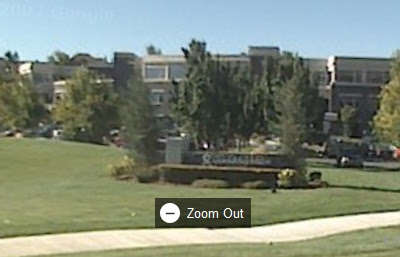
    The offices of both Ancestry and FamilySearch are included in Street Views. Here is a view of The Generations Network (TGN), parent company of Ancestry.com. You can see the sign out front with the company name. Zoom in to get a better view... Wait a minute. When I zoom in, the "Generations Network" logo is replaced with "Google." What does that mean? You can click the arrows going North to see the seedy side of Ancestry.

    Google's name over the top of TGN logo
    Google's name over the top of TGN logo

    Click this link to see the offices of FamilySearch and parent, the Church of Jesus Christ of Latter-day Saints. I believe FamilySearch has some offices in the Joseph Smith Memorial building (the white building on the left with the small dome—a beehive—on the left) and some offices in the Church Office Building (the tower on the right). In between you can see the Salt Lake Temple. Try moving completely around this block. See if you can find the Family History Library. It is directly West of your starting point.

    Privacy concerns follow Google Street View where ever it shows up. One TGN employee found photos of his wife and child in front of their house. When Google launched Street View last year an editorial in the Salt Lake City Deseret News said,

    George Orwell got a lot of things right about the future in his novel "1984." The thing he missed, however, is that wholesale intrusions today come from [the Internet], not his fictional government-imposed "big brother."

    Should you come across a photo that you believe invades your privacy or is otherwise inappropriate, click the "Street View Help" link above the image and in the resulting popup window, click the "Report inappropriate image" link at the bottom.

    The Google Car

    Click to enlarge on flickr
    Car with camera,
    © All rights reserved

    Perhaps you saw Google's specially equipped vehicles driving around taking these pictures. An alert iPhone owner snapped the shot to the right as the car approached Salt Lake back in September 2007. Click on the thumbnail to the right, as well as this gallery of Google Cars and this link.

    Here are some more views from our neighborhood for you to explore:

    • A southern view of TGN.
    • Slightly different closeup of the TGN sign.
    • The "seedy field" behind TGN.
    • This view shows the Salt Lake Temple on the left and the Joseph Smith Memorial Building (JSMB) on the right. A statue of Brigham Young stands between them.
    • Try moving a little South; the view looks like this.
    • Or go East in front of the JSMB to see the chandeliers through the windows.
    • The JSMB used to be the Hotel Utah, so it has a grand exterior.
    • The Family History Library. Let me know if you are one of the people or know one of the people standing out front.
    • An interesting juxtaposition of horse-drawn carriage and limousine in front of the Church Office Building. See how close you can get to the limousine.
    • Mt. Timpanogos from the Squaw Peak road. You can almost spit on our offices at TGN from this spot.
    • Further down the road you can see Mt. "Timp" on the right and Utah Lake on the left.
    • Bridal Veil Falls, up Provo Canyon, is much prettier than this photograph can show.
    • Entrance to Robert Redford's Sundance Resort. Drive past the couple on the road and take a look at the lady's hiking shoes. Continue up the road and look off to the left to see the buildings and parking lot of the resort with Mt. Timpanogos towering above. Google missed the gorgeous fall colors along this road by just a couple weeks.
    • Here are some hikers googling at the odd, camera-bearing vehicle. At least they have sensible shoes.
    • In the early '60s our station wagon bearly made it pulling our trailer to Timp Lodge for a family reunion. Grandpa wore a wig and played the fiddle. I hoped I was adopted.
    • At the trail head to Stewart Falls, the Google driver stops to google a young hiker paying her forest service use fee. She's not really going to hike to the falls in those sandals, is she?
    • A multi-car accident in Phoenix.
    • Move past this fender bender to see behind the car.
    • Here is where one of my ancestors lived in 1850. (BTW, if you know who I am, please keep it to yourself. There are those who have and are determining my identity through the various clues dropped over time. Send me an email to my non-Ancestry Insider email address explaining how you determined my identity and I'm happy to confirm your deduction. Asking an employee of Ancestry or FamilySearch is cheating, since I've been open with these two organizations. Once you've determined my identity, please do not disclose it to others!)

    Paula Stuart-Warren explored the genealogical uses of Google Street View in a recent article on Ancestry's 24/7 Family History Circle.

    Thursday, February 7, 2008

    Myra Vanderpool Gormley

    This is one in a series of encyclopedia articles describing people, products and companies in the genealogy industry. When you hear a noted genealogist's name, do you find yourself thinking, "I know I know that name," but you can't quite get the ol' noggin to access the data? I'm right there with you! For that reason, these articles are.

    Myra Vanderpool Gormley

    Myra served as the editor of the RootsWeb Review from its inception in 1998 until her retirement at the beginning of 2007. See a biography here.

    Myra began doing genealogy as an eleven year old, when she went to the local library and did research that disproved a family legend about Jesse James. But it wasn’t until she was in her thirties that she began consistently researching. After experiencing a measure of success doing her own genealogy, Myra proposed writing a column on genealogy to the local newspaper editor. It took several years for Myra to convince him that genealogy had a wide appeal, but from the moment her column, “Shaking the Family Tree,” launched in July of 1983, it experienced tremendous success. Soon the column was picked up by the Los Angeles Times syndicate and passed to other newspapers and readers around the nation. Myra continued writing the column for nineteen years.

    Some of Myra’s other accomplishments as a genealogist include spending nine years writing a column and answering genealogy questions for Prodigy, an early Internet Service Provider, publishing numerous magazine articles and three books on family history, and helping to found the International Society of Family History Writers and Editors. (Source)

    Her website is here, which includes her email address.

    From the archives of Genealogical Computing, vol. 22, no. 2, Oct/Nov/Dec 2002.

    Wednesday, February 6, 2008

    Buick Heritage Sweepstakes

    Buick Heritage Advertisement To commemorate African American History Month and in conjunction with the release of African American Lives 2, Buick and Ancestry.com have teamed up to offer you the Buick Heritage Sweepstakes.

    Ten lucky winners will receive a complete Ancestry DNA Test Kit. One thousand lucky winners will receive a Family History Kit consisting of Family Tree Maker Essentials software, a DVD of African American Lives and a hardcover copy of In Search of Our Roots: How 19 Extraordinary African Americans Reclaimed Their Past.

    To enter, go to the African American Lives 2 (AAL2) website. While there, the 7 minute promo for tonight's premier is a must watch. It looks like Dr. Gates has done his usual superb job. After watching the preview, click on the Buick logo at the bottom of the page.

    Or, if you see the ad to the right anywhere on the Internet, click on it.

    When you get to the Buick Heritage Sweepstakes website, take a moment to view one or more of the videos. They are all quite short and you have the time. The contest doesn't end until the end of March.

    Tuesday, February 5, 2008

    NFS Rollout News for Super Tuesday

    New FamilySearch Rollout Map for 4-Feb-2008

    The 24 US states holding presidential primaries may not be the only thing making today super. If Mesa, Oakland and Snowflake successfully go live with New FamilySearch (NFS) today, 21 temples will be using the new program.

    I've made the following updates to the map, above, and to the tables at Temple Districts Using New FamilySearch.

    • Four temples have gone live since the last map update: Los Angeles, Colonia Juárez, Guadalajara and Columbus Ohio.
    • Denver is shown half red/half yellow. Consultants are able to register despite the lack of an e-mail announcement.
    • The Washington, D.C. temple staff have been informed that the announcement for their district has been made, although no one in the district has received the e-mail as yet. I wonder if the e-mails were delayed so they would not be a distraction from Gordon B. Hinckley's funeral services last Saturday.
    • I've added red dots for the Utah temples. I'm guessing that the outliers in Utah will get New FamilySearch before the heavy-volume Wasatch Front temples.
    • I've added a red dot over the top of the Rexburg temple which will be operational after dedicatory services starting Saturday.
    • I've added lots of international temples to the tables: Adelaide, Asuncion, Brisbane, Buenos Aires, Copenhagen, Madrid and Preston.
    • I've added a target date of 26-Feb-2008 for Las Vegas and Redlands, CA.

    Sunday, February 3, 2008

    Unbelievable Name Count Claims

    What are we to understand by genealogy vendors name count claims? When WorldVitalRecords.com claims "872,278,874 Names in 5,389 Databases," aren't we led to believe these are counts of people names? But WorldVitalRecords.com claims 337,484 names in Lippincott's Gazetteer of the World, 1895. This is a gazetteer! Yeah, yeah; many places are named after people. But the database information notes there are only 125,000 place names on 2,895 pages. The claim of 337,484 names amounts to, on average, 2.7 names per place and 117 names per page!

    Ancestry.com claims 2,112 in Lippincott’s Gazetteer of the World, 1913. A little experimentation shows the book has grown to 2115 pages, which means Ancestry claims about 1 name per page.

    Page 1000 from Lippincott, 1913

    I picked a page from the 1913 edition at random to examine. Page 1000 is about half-way through the book. (Click on the adjacent image to see it yourself.) I pulled it up and started looking for names. I ignored people-place names such as Baltimore, St. Louis and Clay County. The only name I found was Albus Dumbledore. Oops, Albertus Magnus. A sample of one is hardly scientific, but I find the claim of 117 names per page in a gazetteer quite incredulous.

    I don't think WorldVitalRecords.com is all alone. I know Ancestry has some isolated problems as well. I call upon genealogy vendors to provide transparency with published name counts. Consumers have a right to know when counts are exact and when they are estimates. Vendors should disclose basic definitions and methodologies. Only transparency will provide consumers the information necessary to make intelligent purchase decisions with their limited funds in an increasingly competitive market.

    Friday, February 1, 2008

    Why make it hard to volunteer for FamilySearch Indexing?

    Why does FamilySearch make it so hard to find the FamilySearch Indexing site? Yes, yes, I know that FamilySearchIndexing.org ought to be easy enough to remember. Yet still, many patrons at my Family History Center raise a hand, confused that the FamilySearch Indexing website no longer has the links they want. I walk over and find they are on FamilySearch.org.

    Do you realize there are no links to FamilySearchIndexing.org on FamilySearch.org, New.FamilySearch.org or LDS.org? At least no obvious ones. You'd think if FamilySearch wants everyone to index, they'd make it a little easier to get there.

    The signup page has bigger problems. It is, literally I think, easier to do actual indexing than it is to successfully navigate the sign-up-to-volunteer page. First off, the Enter key seems to execute the "Sign On" link near the top left of the page rather than the "Continue" button at the bottom right. If you haven't signed up before (which most users haven't!), you think you have successfully submitted the form and are now being asked to sign on with your new user name and password. Wrong! Up goes the hand.

    "Brother Incisor, can you help me?"

    Then, almost everyone chooses a user name that has already been used, but they are not told until they fill out the entire form and submit it. They go back and try one or more times to find an available user name. By the time they do, the password they chose has been cleared, so they have to enter it again—twice...

    ...Only to find that they've chosen an invalid password. No one sees the password restrictions, even though they are right there in plain sight. FamilySearch needs to make the password instructions more visually prominent.

    It would be pretty trivial to check the validity of the password as soon as the user moved to the next field. Don't wait until they submit the form. While you're at it, FamilySearch, it would only be a little more difficult to add some AJAX script to check the user name as well.

    How about it, FamilySearch?

    Thursday, January 31, 2008

    Where have all the Mailing Lists Gone?

    Way back in the frontier days when we circled the wagons at the end of the day and hooked up our 300 baud modems, mailing lists were one of the first electronic tools we used for genealogy. As far as mailing lists are concerned, FamilySearch was late in and today they announced they would also be one of the first out.

    Users of their mailing list system received notification today. "Effective 13 February 2008, the Collaboration E-mail List feature on the FamilySearch.org web site will be discontinued." Users who wished to remain in contact with one another were advised to exchange e-mail addresses.

    RootsWeb Mailing Lists

    It is only coincidence that today the Utah Valley PAF User Group (UVPAFUG) used RootsWeb's mailing list system for the last time. List members received a message that began, "A Final Message to All Participants in this Mailing List." UVPAFUG has used RootsWeb's system since July 2000 to announce their monthly meetings. UVPAFUG (no, I don't know how they pronounce that) is abandoning RootsWeb's system in favor of a blog and FeedBlitz subscriptions.

    The Ancestry Insider has been hearing rumors of dissatisfaction from several groups with the RootsWeb mailing list system. Ignored for many years by RootsWeb owners—the Generations Network (TGN)—the Insider was told that TGN switched the software used for the mailing lists several months ago and list administrators are not happy with the loss of some key features.

    HTML E-mail Formatting

    While other solutions allow HTML formatting, or rich text as it is sometimes called, TGN has invested very little in upgrading RootsWeb-related e-mails. Mailing lists are still plain text. The RootsWeb Review became available in HTML just last week.

    Message board notifications are another ugly step child. In yet another coincidence, at least some of today's notifications went out with bad links. Here's a representative message showing the ugly formatting as well as the link error.

    My Notifications

    Board : Boards > Surnames > Rencher
    Subject : Nancy Rencher, daughter of John Nelson
    Author : BMarshall0572
    Date : 29 Jan 2008 4:24 AM GMT

    http:///mbexec/msg/an/nEB.2ACE/86

    Board : Boards > Surnames > Rencher
    Subject : Re: Nancy Rencher, daughter of John
    Author : brencher
    Date : 29 Jan 2008 5:20 AM GMT

    http:///mbexec/msg/an/nEB.2ACE/86.1

    Board : Boards > Surnames > Rencher
    Subject : Re: Nancy Rencher, daughter of John
    Author : BMarshall0572
    Date : 29 Jan 2008 5:31 AM GMT

    http:///mbexec/msg/an/nEB.2ACE/86.1.1

    The Message Board Administration Team

    It may be that mailing lists powered by genealogy companies may one day soon disappear entirely.

    Monday, January 28, 2008

    New FamilySearch offered to all consultants

    FamilySearch has announced availability of New FamilySearch accounts to any consultant that finishes a 1 hour course. Said the announcement,

    FamilySearch Support is pleased to announce that they will be offering all registered Family History Consultants and Priesthood Leaders an opportunity to obtain a new FamilySearch account early. To take advantage of this opportunity we ask that you attend one 1 hour class entitled, "How Consultant's Support the new FamilySearch." After your attendance to the class you will be notified that your account is activated allowing you to register, participate in on-line training and become acquainted with the system.

    There are currently 9 times scheduled for the class running from Thursday, 7-February-2008 until the Thursday prior to General Conference weekend. Classes are held on Temple Square in Salt Lake City. You can see the list of available times and register for one by clicking here.