Friday, October 3, 2008

FamilySearch Indexing Update

FamilySearch Logo FamilySearch released this message today:

FamilySearch Indexing Update

3 October 2008

Over 29 million new names were posted this past week on the FamilySearch Record Search pilot. Kudos to the FamilySearch volunteer indexers for their monumental contributions! The chart below lists the current indexing projects and their completion status. Volunteers can help any time by registering or downloading a current project at www.familysearch.org (click on Index Records>Volunteer or Start Indexing) or www.familysearchindexing.org.

Project Spotlight: United Kingdom, Cheshire Poor Law

The United Kingdom, Cheshire Poor Law indexing project is currently 82% complete. We would like to finish this project by the end of next week, 10 October 2008. If volunteers have time to donate before October 10th, try doing at least a batch or two (or more) from this project. (To download a batch from a specific project, click the Download From… button in the My Work section of the indexing application’s start page, select the project from the list, and click Download.)

The Cheshire project includes several types of records kept by the workhouses in Cheshire County, including the Chester Union Workhouse at Hoole, from 1848-1967. Some of the poor in the community would go to the workhouses for only a short time. Some ended up spending the rest of their lives there.

We are indexing birth and baptism records, death and burial records, admission registers, and creed registers. The information gathered depends upon the record type and includes the names of those admitted, admission dates, religion, names of children, names of parents, birth dates, baptism dates, names of the deceased, death and burial dates.

These are not all of the Poor Law records but a significant portion of them. It is estimated that these records include 500,000 names. [The population of Cheshire County during the time period of these records is uncertain, but the population in 2001 was 673,781—so a significant portion of the community is represented in these records.]

Current Projects, Record Language, and Percent Completion Status

Alabama - 1920 US Federal Census

English - 1920

79%

Argentina Censo 1869 - Buenos Aires

Spanish - 1869

66%

Brandenburg Kirchenbücher

German - 1789-1875

8%

California - 1920 US Federal Census

English - 1920

28%

España Lugo Registros Parroquiales

Spanish - 1530-1930

6%

Florida 1945 Census

English - 1945

24%

France, Coutances, Paroisses de la Manche

French - 1792-1906

7%

Guanajuato Censo de Mexico de 1930

Spanish - 1930

56%

Guerrero - Censo de Mexico de 1930

Spanish - 1930

35%

Illinois - 1920 US Federal Census

English - 1920

15%

Massachusetts - 1920 US Federal Census

English - 1920

15%

Morelos - Censo de Mexico de 1930

Spanish - 1930

68%

New York - 1870 US Federal Census

English - 1870

55%

Nicaragua, Managua Civil Records

Spanish - 1879 - present

8%

Quintana Roo - Censo de Mexico de 1930

Spanish - 1930

88%

Trento, Italy Baptism Records

Italian - 1784-1924

7%

UK - Cheshire - Poor Law

English - 1848 -1967

82%

Venezuela Mérida Registros Parroquiales

Spanish - 1654 - 1992

0.3%

Extras in the Ancestry.com New Card Catalog

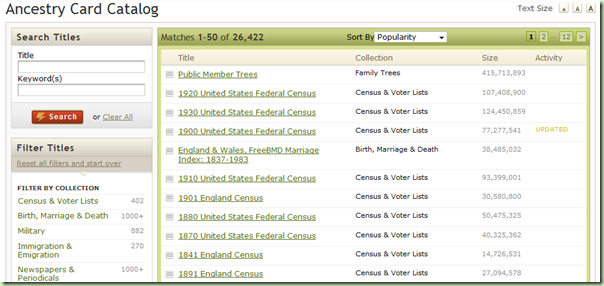
The New Ancestry Card Catalog is not only useful for finding titles of interest, it conveys an amazing amount of information. To search for a title, enter important words from the title or one or more keywords in the Search Titles box in the upper-left corner. Alternately, one can browse a list of titles shown on the right side of the page. Ancestry.com has historically used the term databases, but with the addition of book and newspaper images, title is a better way to talk about their databases. (Oops. I can see it's going to take me a while to break that habit.)

The new card catalog conveys an amazing amount of information

When you first come to the card catalog, the number of matches indicates the number of titles (databases) on Ancestry.com. At the time of the screen shot above, there were 26,422.

The list can be sorted a number of interesting ways. You may sort by Date Added and see the most recent new databases (I mean titles). You may sort by Date Updated to have updated titles added to the list of new titles.

Unlike the recent database list, some aspects of the card catalog are not updated in real-time. For example, an odd book titled "not listed" was published during the day of 1-Oct-2008 and was not yet in either old or new catalogs. (That's a bug. Once Ancestry.com removes that database, the link might not work any longer. At that point, try searching the catalog for the most recent database.)

I also noticed that database size was set to zero for all book titles going back from 1-Oct-2008 (the day I'm writing this part) back to 30-Aug-2008. Either that's another bug, or they have a process that updates name counts once a month for books.

Sort by popularity and see what are the most popular titles on Ancestry.com. As of the time of the illustration above, they were

  • Public Member Trees
  • 1920 United States Federal Census
  • 1930 United States Federal Census
  • 1900 United States Federal Census
  • England & Wales, FreeBMD Marriage Index: 1837-1983
  • 1910 United States Federal Census
  • 1901 England Census
  • 1880 United States Federal Census
  • 1870 United States Federal Census
  • 1841 England Census

Sort by Record Count and you can see the largest databases. On the day I tried it, they were

Title

Size

Ancestry World Tree

467,671,004

Public Member Trees

415,713,893

U.S. Phone and Address Directories, 1993-2002

626,564,248

British Phone Books, 1880-1984

278,407,920

OneWorldTree

192,141,453

1930 United States Federal Census

124,450,859

Private Member Trees

109,439,127

1920 United States Federal Census

107,408,900

1910 United States Federal Census

93,399,001

New York Passenger Lists, 1820-1957

82,888,619

Having sorted by record count, one would assume that the Size column shows the number of database records. Notice, however, the anomalously large size of "U.S. Phone and Address Directories, 1993-2002." That appears to be a name count, rather than a record count. Divide it by two and you'll get the record count. (Don't worry, I'll explain why in the future.) The other databases appear to have one name per record, so after converting the counts to record counts, they are sorted in record count order, as requested.

I assume this will also get fixed once it is noticed. One article, three bugs. When I was an Ancestry.com employee, I would have reported these directly to the responsible individual who often would have them fixed before my article "went to press." Sorry, ol' friends; I'll have to air a little dirty laundry now. Hopefully you're following my column and will have these bugs fixed before half my audience gets around to seeing if they still exist.

Wednesday, October 1, 2008

NFS Rollout Update: An Even 100

New FamilySearch Rollout Map for 30-Sep-2008

I'm happy to provide an updated New FamilySearch (NFS) rollout map and announce that Elvis has left the building! And since the last map update six temples have gone live, bringing the total number of temples using NFS to an even 100! Lastly, we've learned the release dates for the last two non-red-zone temples.

The six temples that went live were

  • 23-Sep-2008: Saskatchewan, Seattle and Washington D.C.
  • 30-Sep-2008: Medford Oregon, Memphis and Spokane

The schedule for the remaining non-red-zone temples is

  • 7-Oct-2008: Anchorage, Montreal, Oklahoma and Portland
  • 14-Oct-2008: Nigeria and New Zealand
  • 16-Nov-2008: Mexico City temple is rededicated.

As for the red zone, you'll remember my feeling that if the red zone (Utah, Idaho and Vegas) were to get NFS in 2008 that we would receive word soon after the release of version 0.94. Since no one received word, I assume that version 0.94 did not "patch" the IOUS issue well enough to allow the release to the red zone. The next release, 0.95, if scheduled as normal, will be mid-February 2009.

I suppose I should pass on a rumor floating around the Internet. It states that the red zone will not get NFS until the version known as Family Tree on labs.familysearch.org is available. Will there be a release of FamilySearch Family Tree before the end of the year? Will it allow the red zone to enter the transition phase of the roll out? Stay tuned...

Day to day updates will be posted on Temple Districts Using New FamilySearch as they occur. As always, if you hear anything, give me a shout at AncestryInsider@gmail.com

Papeete Tahiti Apia Samoa Nuku alofa Tonga Suva Fiji Johannesburg South Africa Aba Nigeria Accra Ghana Anchorage Alaska Edmonton Alberta Cardston Alberta Kona Hawaii Manila Philippines Hong Kong China Taipei Taiwan Seoul Korea Fukuoka Japan Tokyo Japan Cebu Philippines Hamilton New Zealand Melbourne Australia Adelaide Australia Perth Australia Brisbane Australia Sydney Australia Laie Hawaii Santiago Chile Montevideo Uruguay Buenos Aires Argentina Asunción Paraguay Porto Alegre Brazil Curitiba Brazil Campinas Brazil São Paulo Brazil Recife Brazil Cochabamba Bolivia Lima Peru Guayaquil Ecuador Bogotá Colombia Caracas Venezuela Manaus Brazil Santo Domingo Dominican Republic Guatemala City Guatemala San Jose Costa Rica Panama City Panama Quetzaltenango Guatemala San Salvador El Salvador Tegucigalpa Honduras Mérida México Villahermosa México Tuxtla Gutiérrez México Oaxaca México Veracruz México México City México Guadalajara México Tampico México Monterrey México Hermosillo Sonora México Colonia Juárez Chihuahua México Ciudad Juárez México Madrid Spain Bern Switzerland The Hague Netherlands Preston England London England Frankfurt Germany Freiberg Germany Kiev Ukraine Copenhagen Denmark Stockholm Sweden Helsinki Finland Vancouver British Columbia Regina Saskatchewan Halifax Nova Scotia Montreal Quebec Toronto Ontario Palmyra New York Boston Massachusetts Manhattan New York Washington D.C. Louisville Kentucky Memphis Tennessee Nashville Tennessee Raleigh North Carolina Columbia South Carolina Atlanta Georgia Birmingham Alabama Orlando Florida Detroit Michigan Kirtland Columbus Ohio Chicago Illinois Nauvoo Illinois St. Louis Missouri Winter Quarters Nebraska St. Paul Minnesota Bismarck North Dakota Oklahoma City Oklahoma Lubbock Texas Dallas Texas Houston Texas San Antonio Texas Baton Rouge Louisiana Denver Colorado Billings Montana Boise Idaho Twin Falls Idaho Rexburg Idaho Idaho Falls Idaho Albuquerque New Mexico Snowflake Arizona Gila Valley Arizona Gilbert Arizona Phoenix Arizona Mesa Arizona Spokane Washington Columbia River Washington Seattle Washington Portland Oregon Medford Oregon Reno Nevada Las Vegas Nevada Fresno California Sacramento California Oakland Californai Redlands Californai Los Angeles California Newport Beach Californai San Diego California St. George Utah Monticello Utah Vernal Utah Logan Utah Manti Utah Provo Utah Mount Timpanogos Utah Draper Utah Salt Lake Bountiful Utah Ogden Utah Jordan River Utah Oquirrh Mountain Utah

Tuesday, September 30, 2008

FamilySearch Investment Presets

WARNING: This article is largely off topic. If you don't want to learn about FamilySearch employee investment options, stop reading now.

In the news we hear of investment companies going under because of bad mortgage loans. Democrats blame republicans for decreasing regulatory oversight. Republicans blame company CEOs and are taking steps to prevent CEOs from escaping with golden parachutes. The Dilbert cartoon strip for 10 June 2008 is eerily prophetic of the current news. The individual shown at the podium is the company CEO.

Dilbert.com

FamilySearch 401 K Preset Options

My mom always taught me, never invest any money in stocks that you can't afford to lose. Mutual funds mitigate some of the risk, but not all of it. Risk is lowered by diversifying. No asset class does well in every economic environment. And in bad economic times, not all asset classes do as poorly as the worst performers. Risk is also lowered by staying in the market long term. Downturns have always been temporary, and if you can wait them out, the stock market as a whole does well over longer time frames. Bond funds don't spike as high or as low as stock funds. In general, the greater the possibility for gain in a particular asset class, the greater the possibility for loss. The risk for large gains or large losses of large-cap, mid-cap and small-cap stocks are medium, higher and highest, respectively.

FamilySearch employees are offered a 401K plan with several different preset mixes. I've eliminated the percentages from the FamilySearch preset mixes, since they might be considered propriety information. But I'd like you to see the general breakdowns shown by the pie charts below.

WARNING: The information contained herein is for educational and comparison purposes only and may not apply to your individual financial situation. You should consult with your own financial advisor before making financial decisions.

If you're within 5 years of retirement, the FamilySearch short term preset mix looks like this. The investments have lower yields, but also less risk.

Allocation strategy for 5 year term

If you're within about 10 years of retirement, you can be less conservative.

Allocation strategy for 5 to 10 year term

If you're over 10 years away from retirement, you can place even more at risk.

Allocation strategy for terms over 10 years

Employer matches for your contributions to a 401 K plan are one of the best risk mitigations. For example, if your employer matches 100% of your contribution up to $1,000 and you invest $1,000, then you've already doubled your money. The market could drop a whopping 50%--lose half its value--and you would still break even. It almost always makes sense to save up to the point where your employer stops kicking in free money.

Monday, September 29, 2008

Ancestry.com's Card Catalogs

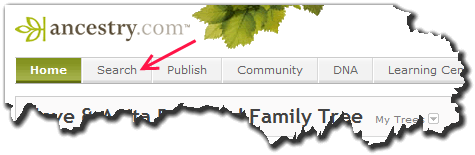
One of Ancestry.com's hidden gems is its card catalog. Today we'll look at how to get to the card catalogs, old and new. In later posts we'll explore them in more detail. From the Ancestry.com home page, first click on the Search tab.

Click the Search tab

Ancestry.com's old search and new search implement completely different card catalog experiences. We'll try them both and you can see what you think.

Old Search

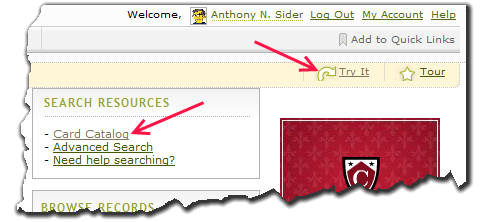
The upper-right corner of the old search interface looks like the example below. You'll know it is the old search if there is a message on the upper-left (not shown below) that says "Try out the New Ancestry Search" and two links on the right-hand side labeled "Try It", which you can click to try the new search and new catalog, and "Tour", which you can use to learn about the new search.

To use the old search card catalog, look for the Search Resources box on the right-hand side and click the top link, "Card Catalog."

For old search, click Card Catalog under Search Resources

New Search

The new search interface looks like the example below. You know it is the new search because of the message near the upper-left that says "Thanks for trying the New Ancestry Search." Should you wish to switch back to the old search, click the link towards the upper-right labeled "Switch back to old search experience." To use the card catalog, in the Featured box on the left-hand side, click on "Go to the Card Catalog."

For new search, click Go to the Card Catalog in the Featured box

Friday, September 26, 2008

What is a record?

For Ancestry.com databases, sometimes we speak of database records. The concept of a record differs a little bit between database programmers and genealogists, so it would probably be a good thing to help you understand what an Ancestry.com database record is.

A record is the smallest displayable unit of a database. That seems easy enough, but let's show some particular examples.

Database Type A record is Names per record Example
Vital records One event, such as a birth, marriage or death One vital event typically names several people England & Wales, FreeBMD Birth Index: 1837-1983
Newspaper (images) One page Estimated The New-York Times, 15 April 1865
Book (images) One page Estimated ANZAC Memorial, 1914-1918
Folio One folio (paragraph) Estimated Virginia Colonial Soldiers
Photograph One photograph Estimated Public Member Photos
Map One map Estimated Lewis & Clark's Journey
Table-style One row One or more WWI Civilian Draft Registrations
Table and image One row One or more 1880 US Federal Census
Image with special name handling I'm not clear if it is one name or one image Not clear Who’s Who in Australia, 1921-1950 ? Yearbooks
Tree One individual One Public Member Trees


The table shows a database type of "folio." You may be aware that Ancestry.com was an outgrowth of Paul Allen's earlier company, Folio, which produced electronic books wherein the smallest searchable unit was a "folio" which typically was a paragraph. Many of the old databases from the early days of Ancestry.com give me the distinct impression they were either converted from Folio format, or Folio's technology was originally used in some fashion to publish the database on Ancestry.com.

Tuesday, September 23, 2008

Misadventures in Indexing

Fine. I admit it. My indexing numbers are nowhere as big as Renee Zamora's. That's not to say I don't find it as meaningful. In fact, my problem is that sometimes I find it too meaningful. Take last week. I made the mistake of taking a batch of Louisiana Death certificates. Soon I was so drawn into these people's lives, that it took all week to get one batch done.

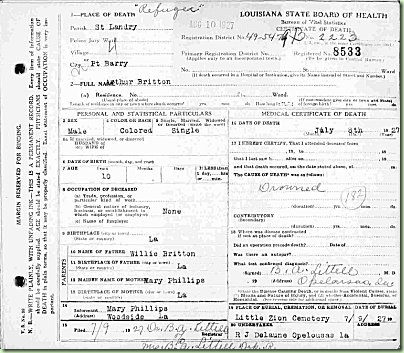
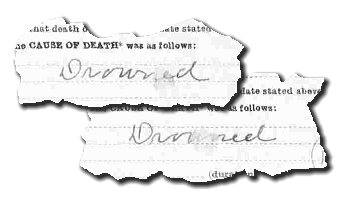
I started on the first certificate. Cause of death? Drowning. How sad. How old was this person? A ten year old boy. Wow; that is sad. Why did someone write "refugee" at the top?

Death certificate of drowning victim

Next certificate. Also said "refugee" at the top. Cause of death? Drowning! Wait a minute. Same name? No, this one was North Hudson's five year old name sake. Same date? Yes, 8 July 1927. Both in Port Barre, St. Landry Parish. Wow. Opelousas is crossed out and Porte Barre written in. Wonder what happened.

Second certificate, 12 July 1927 in Port Barre, St. Landry Parish.

Third and fourth certificates. Also refugees who drowned on 8 July 1927. Both named Hudson. North Hudson was here again, as informant. Does that mean he had to identify the bodies?

Another two drowning victims

Fifth, sixth, seventh. All children of Delphine Thornton, ages 13, 9 and 5. All 8 July 1927 in Port Barre. Oh, my goodness. She lost three children in whatever happened.

What did happen? It didn't take very long before Google had uncovered the Great Flood of 1927. The Mississippi had overflowed her banks during the spring runoff.

1927 flood at Moreauville

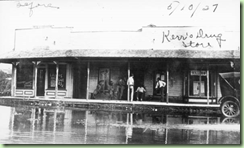
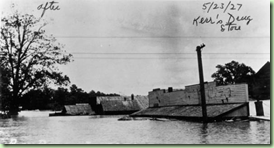
The two photos, below, show Kerr's Drug Store in Port Barre early in the flooding and 13 days later.

Kerr's Drug Store 10 May 1927   Kerr's Drug Store 23 May 1927

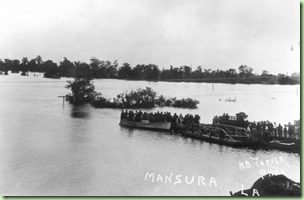
Displaced "refugees" were evacuated to neighboring communities.

Avoyelles Parish residents fleeing to high ground

I'm still unclear of all the goings on, but the floodwaters seem to have lasted for months. On 8 July 1927 I think the levee protecting Port Barre failed. It fell to the medical examiner in Opelousas to perform the terrible last reuniting of lost family members. I found myself feeling awkward, standing in the back, an unbidden guest, witnessing this pervasively private moment.

Then I thought that perhaps, if caring members of these families ever come looking for them, my indexing will easily bring them to this very same spot, let them see what I am seeing. I will have quietly slipped out the back, letting loving family unite again across time. And grieve. And remember.

Friday, September 19, 2008

I *heart* your blog award

I *heart* your blog award People are so nice. Renee has awarded me an "I Love Your Blog" award. Thank you. And here's right back at you, Renee.

The rules for the award are:

1. Can put the logo on his/her blog

2. Must link to the person who gave the award

3. Must award 7 other blogs and link to them

4. Must leave a comment on each of the nominated blogs

I used to think that part of the service of my blog was to monitor a zillion Ancestry.com and FamilySearch related blogs so you wouldn't have to, passing the news about Ancestry.com and FamilySearch.org on to you. In practice, I've found I'm too opinionated and have too much to say to spend much time in the news amalgamation role.

But I still enjoy reading all those blogs. Let me share some favorites with you. These are the blogs I check everyday. There are hundreds more that I check more infrequently, depending on their Ancestry.com or FamilySearch coverage.

I hereby award the "I Love Your Blog" award to (in alphabetical order):

  1. 24-7 Family History Circle — Owned and hosted by Ancestry.com, editor Juliana Smith is the real draw here along with regular columnists: George G. Morgan, Michael Neill, Megan Smolenyak Smolenyak, Maureen Taylor, Paula Warren and Sherry Irvine. Also a good weekly wrap-up of new databases on Ancestry.com.
  2. All Things Kendall and Caroline — Ancestry.com director of product management Kendall Hulet and wife Carolina. She's a hoot. As for Kendall, he better keep his day job.
  3. Ancestry.com Blog — With a catchy title like that, you know it's the official, corporate blog.
  4. Ancestry.com Recent Genealogy Databases — This is a news feed version of Ancestry's What's New page. Why they don't offer an RSS feed of that page is beyond me. But someone figured out how to create one from the page.
  5. Arlene H Eakle's Genealogy Blog — Professional researcher. Pragmatic. Straight shooter. Knows her stuff. Often mixes in some good, western, rural philosophy.
  6. Cyndi's List — It's been forever since she posted, but it's nice to see news once and again about Cyndi's famous list.
  7. DearMYRTLE — DearMYRTLE, aka Pat Richley is a noted author, lecturer and genealogist. Her blog is an excellent news source. She's well connected in the industry. She's a great teacher and has a gift for mentoring. Her grandmotherly byline aside, "Myrt" is a technical pioneer, taking genealogy into emerging technologies from Q-Link, AOL and chat rooms to Internet radio, podcasting and the Second Life virtual world.
  8. DNA Ancestry.com — How does DNA get away with their own blog when everyone else has to use the corporate one? Don't ask; don't tell.
  9. Eastman's Online Genealogy Newsletter — The Johnny Carson of genealogy bloggers, he was doing it before it had a name.
  10. FamilySearch Labs Blog — "Future Tools to Dig Up the Past." Official FamilySearch blog.
  11. Genea-Musings — I want to be Randy Seavers when I grow up. I used to think that he could read my mind, because every time I thought of a good article subject, he'd write about it the next day.
  12. Genealogy and General Subjects Blog — She had me the minute she used "genealogy" and "gadgets" in the same sentence.
  13. Genealogy Insider — by Diane Haddad, et. al. Talented writers, all. I was devastated when I didn't make her top seven. <sniff>
  14. Genealogy Roots Blog — News about online vital records.
  15. Leland
  16. Megan's Roots World — While she's mostly over in Facebook-land, she occasionally comes back to the blog-o-sphere to update us.
  17. Nate Skousen — The Generations Network employee blogger. "I love my job." Go Nate!
  18. Paul Allen (the lesser) — Not a genealogy blog, per se, but Internet entrepreneurship. Founder of MyFamily.com/Ancestry.com. Thoughtful. Low quantity, high quality. Just the way I like it.
  19. Renee's Genealogy Blog — New FamilyLink/WorldVitalRecords.com employee. Excellent source for Utah Valley and LDS genealogy news. If the product managers for New FamilySearch and FamilySearch Indexing aren't hanging on every word of her "Adventures" series, they should be.
  20. Rootdig — Michael John Neill's genealogy site. Researcher, author and speaker.
  21. RootsWeb Newsroom — Official RootsWeb.com blog. Sorry—RootsWeb.Ancestry.com—blog.
  22. Shoebox Genealogy — Professional Salt Lake genealogist. Makes me so mad, I could spit. Subtitled "Genealogy with an attitude." That's putting it mildly.
  23. Taking Genealogy to the Common Person — Dan Lawyer, Product Manager at FamilySearch.
  24. The Genealogue — The Dave Barry of genealogy bloggers, Chris doesn't know it, but he gave me my first big break. My numbers were inconsequential until he quoted a story I published.
  25. Think Genealogy — "Mark Tucker is a software architect by day and a family historian on as many nights and weekends as possible."
  26. Upstate New York Genealogy Blog — Dick Hillenbrand is reason enough, but I'm also working a dead-end in, you guessed it, upstate New York.
  27. Utah Valley PAF Users Group - Press Releases — If you live in Utah Valley, a subscription will remind you of what's coming in the next meeting. If not, hope for one of Renee's detailed minutes/reports of past meetings.
  28. What a WONDERFUL Thing to live Today! — Someone who hopes to be a FamilySearch Missionary doing book scanning at Allen County Public Library. Very infrequent posts.

I guess I exceeded seven a little. Hey, at least it was a multiple.

Judging from the sudden eruption of high-school quality acne on my face, I've got a reunion to attend this weekend, so it may be a day or so before I fulfill requirement number 4. Can you do a favor for me? If you check out any of these blogs, leave them a comment. Mention I sent you and tell them they're winners in my book.

Meanwhile, I have some awards of my own to collect. Most hair loss... Most weight gained... Most likely to be laughed at...

Thursday, September 18, 2008

Eric Shoup, of eBay, now Ancestry.com VP of Product

Eric Shoup, Former General Manager for eBay Stores, Joins The Generations Network as Ancestry.com's Vice President of Product

Management Leader to Play Key Role in Bay Area Growth of Ancestry.com

PRNewswire
PROVO, Utah

PROVO, Utah, Sept. 18 /PRNewswire/ -- The Generations Network (TGN), parent company of Ancestry.com, today announced the hiring of Eric Shoup as vice president of product for the Ancestry.com business unit. As a new management leader, Shoup will be responsible for the product strategy, product definition and design for the global platform of Ancestry.com, the world's largest online family history resource. He will lead the product management and user interface design teams. Bringing more than 15 years of product marketing and general management experience, he will be based in the company's San Francisco office.

"We're thrilled to have Eric Shoup join Ancestry.com during this time of accelerated growth," said Andrew Wait, senior vice president and general manager of family history for Ancestry.com. "Eric is key to the continued expansion of Ancestry.com and to our company's increasing presence in San Francisco and Silicon Valley. His impressive background and strong leadership skills make him the best person to lead this effort while nicely complimenting our team in Utah."

Prior to joining TGN, Shoup was at eBay for five years, where he focused on growing several of eBay's growing businesses, most recently as the general manager for the eBay Stores and ProStores business units. In a previous position, Eric assembled and led eBay's first global mobile product team. During his eBay career, Shoup also played key product leadership roles over different areas such as eBay Stores, Shipping and Merchandising.

Prior to eBay, Shoup drove key product marketing and management initiatives at Commerce One, a leading provider of global e-commerce solutions for businesses. While at US Interactive, Shoup designed and managed consumer ecommerce and marketing Web sites for established companies such as Lexus and Wellcome Supermarkets (Hong Kong).

As a new member of the management team, Shoup will work closely with a strong team of professionals in Ancestry.com's new San Francisco office, including Cheyenne Richards, recently promoted to vice president of marketing and a former executive with Avenue A Razorfish, as well as co-workers recently hired from Yahoo, Apple, Organic, CNET, Zenith Optimedia and Expedia.

About the Ancestry Global Network

The Ancestry global network of family history Web sites is wholly owned by The Generations Network, Inc. It consists of nine Web sites -- http://www.ancestry.com/ in the U.S., http://www.ancestry.co.uk/ in the UK, http://www.ancestry.ca/ in Canada, http://www.ancestry.com.au/ in Australia, http://www.ancestry.de/ in Germany, http://www.ancestry.it/ in Italy, http://www.ancestry.fr/ in France, http://www.ancestry.se/ in Sweden and http://www.jiapu.cn/ in China. Ancestry members have access to 7 billion names contained in 26,000 historical record collections. Tree-building and photo upload are free on all Ancestry websites. To date, Ancestry.com users have created more than 7 million family trees containing 675 million profiles and 11 million photographs. Nearly 5.4 million unique visitors logged onto Ancestry.com in July 2008 (comScore Media Metrix, Worldwide).

SOURCE: Ancestry.com

CONTACT: Sara Black of PainePR, +1-213-996-3812, sblack@painepr.com, for
Ancestry.com

Web site: http://www.ancestry.com/

Bravo Ancestry.com

Yesterday afternoon Kenny Freestone of Ancestry.com announced that yesterday evening their tree serivce would be down for about 30 minutes. (See Ancestry Trees Service Will Be Down Tonight) What's notable is not the service interruption but the fact that they told us about it beforehand. When I was at Ancestry I stuck my neck out a couple of times and announced here on these pages a planned outage.

I don't think Ancestry.com was ever opposed to you knowing about planned outages, I just think that prior to their blog, they just had no easy way of informing you. And perhaps because there was no easy way of informing you, product managers weren't in that mode of thinking.

My how times have changed since I started this blog--desparate for candid vendor/market communications. Bravo, Ancestry.com

NFS Rollout Update for 16-Sep-2008

It's late, so I'll make this quick.

I've updated the map and tables for this week's changes. See Temple Districts Using New FamilySearch.

Here's where we stand outside the U.S. and Canada

  • Europe: Complete, including England!
  • South America: Complete. New FamilySearch rolled into Bolivia just as the foreign Mormon missionaries rolled out.
  • Australia/South Pacific: Just New Zealand left. At the UGA conference I kind lady from New Zealand mused whether they might be holding because of the variety of languages in use there. She's going to try and check for us and let me know.
  • Africa: Just Nigeria left.
  • Mexico: Just Mexico City (under renovation) left.
  • The Orient: No change; no word.

Here's where we stand outside the red-zone:

  • Sep 9 rolled live: Atlanta, Columbia River Washington, Louisville, St. Paul. Thanks to Mike, I got Louisville moved to the right location on the map. You can see its dot jump back and forth as the map animates.
  • Sep 16 rolled live: Denver
  • Sep 23 to roll: Saskatchewan, Seattle, Washington D.C.
  • Sep 30 to roll: Memphis, Spokane. Yesterday Renee announced that Medford Oregon would go live on this date.
  • That doesn't leave many more to do in October: Anchorage, Montreal, Oklahoma and Portland. Heck, they could all be done in a week. Or maybe it will take two.

No word yet on the red zone. When I have more time I'll share some of the thoughts I shared with the group at my session at UGA last Saturday. Thanks to all that came. It was great to be there with you. I know it was disappointing for you to find out I was some guy you'd never heard of before. No, I'm not Paul Allen, but you must admit, I'm close. <wink> <wink>

Tuesday, September 16, 2008

Belfast Telegraph: What if Mormons are right?

Photograph of boxer, Harry Tracy I hesitate to share this article with you, but if you are a member of the Church of Jesus Christ of Latter-day Saints (the Church), you will probably enjoy it. After all, the article defends the Church's practice of gathering records and performing baptisms for the dead. Titled "What if Mormons are right and Catholics and Protestants wrong?" one could wonder if the author, Eamonn McCann, was on the verge of conversion to Mormonism.

Not likely. McCann seems to be the Howard Stern of the Belfast [Ireland] Telegraph. McCann is a pro-gay,  pro-abortion activist; anti-Catholic, anti-Protestant, radical antichrist, outspoken atheist; a prominent card carrying Socialist Workers Party member; and a left-of-the-left Trotsky-Marxist. More likely, the author's real intent is to ridicule Christianity by pointing out intolerance among Catholics, Protestants, Jews and Mormons.

Christ and Children from around the World. © 1997, IRI.
Christ and Children
from around the World.
© 1997, IRI.

Members of the Church may find the article persuasive and logical, even entertaining. I know I did. But once I was aware of McCann's beliefs, I re-read the article. Now I find it petty and baiting, prejudicial and demeaning. I find it manipulative that the author draws Jews and Protestants into his world view where there is no god and religions are intolerance incarnate.

Mr. McCann, you're wrong. Intolerance is a choice God leaves up to individuals. You almost got me, but I choose tolerance.

Monday, September 15, 2008

New FamilySearch 0.94 Released

I just noticed that New FamilySearch 0.94 has rolled live! I'm on my lunch break, so I'll have to be brief.

This is nerve wracking. As I told the attendees of my presentation at the UGA conference Saturday, we (the public) should know quickly whether this release will be sufficient for any of the temples on hold to go live. I imagine notifications could go out as early as tonight. If no one in Idaho, Utah or Vegas hears anything by the end of the month, I'll be greatly disappointed.

Let me know as soon as you hear anything. AncestryInsider@gmail.com

In the mean time, to read about the changes in 0.94, go to https://new.familysearch.org and click on the tree icon on the right side under News and Updates.

Indexing Tora! Tora! Tora!

This is an inside joke for Orientals, mixing the Chinese word 'mediocre' and the Japanese 'Tora! Tora! Tora!' It was easy to cheer on both Ancestry.com and FamilySearch when I worked for Ancestry.com since Tim Sullivan continually reassured employees and the genealogy market that the two are not competitors. (One Ancestry.com employee is rumored to have asked human resources if that applied to the non-compete agreements that employees are required to sign. The employee was assured that insofar as non-compete agreements, FamilySearch is considered a competitor. I need to tell you someday about my situation, but for today's topic, I digress...)

I wondered if my multiple-competitor cheerleading days were over last week when FamilySearch reacted to Ancestry.com's indexing program announcement by issuing a statement titled, "FamilySearch Indexing is not affiliated with Ancestry's World Archives indexing program." Looking over it now, it doesn't seem quite as defensive as it did at the time. It must have been the timing, more than anything else that made it feel to me like FamilySearch was taking a hard, competitive stance against Ancestry.com.

Tim Sullivan then issued a message responding to the FamilySearch message reacting to the Ancestry.com announcement. Follow that? Anyway, apparently I wasn't the only one to interpret FamilySearch's message the way I did. Sullivan said that readers of the "message might get the impression that this is some big competition between Ancestry.com and the LDS Church."

"We definitely don't see it this way!" Sullivan again reiterated, saying there was plenty of work to go around. I hoped to include a table comparing the claims of the two organizations and my independent grade for each, but I've run out of time.

I can tell you from first hand experience that both organizations have strengths. FamilySearch used to be the undisputed leader in the genealogical industry. Its Family History Library, branch family history centers and extensive microfilming efforts put it on top. But today, when it comes to Internet genealogy, FamilySearch has been sitting on its Laurels (a little LDS inside joke, there). Ancestry.com has become the the undisputed leader in using Internet genealogy to produce profits and shareholder value. (See Making Sense via Motives.) In comparison, the FamilySearch Internet offering is mediocre. Ancestry.com has awakened FamilySearch to the possibilities for using the Internet for its motive of creating eternal families. While FamilySearch's response has been slow, its response and ongoing plan are massive.

Tora! Tora! Tora! Internet genealogy and Indexing has awoken two sleeping giants! The benefit of the "non-competition" competition between these two giants will be gigantic for genealogists.

Wednesday, September 10, 2008

Ancestry's Mythical OneWorldConnect

Ancestry.com Dendrology 101: Ancestry's Mythical OneWorldConnect

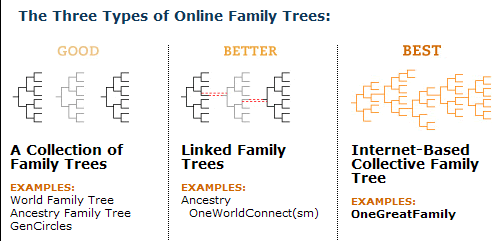
According to one competitor's website, Ancestry.com has a tree system called OneWorldConnect. See the detail from their website, below. Sorry, guys. There is no such tree system. One wonders if they were trying to reference OneWorldTree or WorldConnect. However, OneWorldTree is, to use their terminology, an "Internet-Based Collective Family Tree" (albeit read-only). And WorldConnect is "a collection of family trees."

A competitor examines Ancestry's non-existent OneWorldConnect

In my opinion, an example of a "Linked Family Tree" is GenCircles Global Tree and their SmartMatching. But this isn't meant to be an inventory of all Internet tree systems. Otherwise I'd take the time to show you an example of GenCircles SmartMatching for George Washington.

In conclusion, be assured that Ancestry.com has no OneWorldConnect and has no Linked Family Tree.

Tuesday, September 9, 2008

Ancestry Member Trees

Ancestry.com Dendrology 101: Ancestry Member Trees

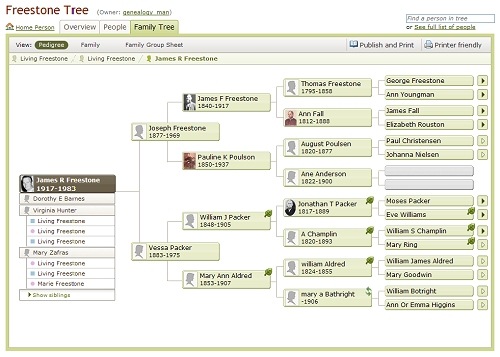
Ancestry.com's latest and greatest family tree system is Ancestry Member Trees, or, simply Member Trees. (I've never seen Ancestry Member Trees abbreviated as AMT, but hey, AMT and taxonomy seem to belong together. Besides, I'm capable of starting a precedent. Just look at the recent surge in usage of the phrase "but I digress" among genealogy bloggers. But I digress...) AMT was released in July 2006. AMT is a free collection of member-contributed family trees. Tree information can be modified online and accessed by web browser anywhere you have web access.

Ancestry Member Trees, pedigree view

An AMT can be Public or Private. Private Member Trees used to be called Personal Member Trees and can only be viewed by owners and invitees. Private Member trees, however, are included in search results. While no private information is revealed, Ancestry.com allows interested subscribers to anonymously contact private tree owners to request more information.

Ancestry Member Trees, individual view

After a long series of family tree systems that incremented the state of the art to a degree, I really like what Ancestry.com is doing with AMT. It's my opinion that AMT is the first online tree management software that is starting to approach the mature feature set of its desktop cousins.

With this article, we conclude our course on Ancestry.com Dendrology 101. By the way, I haven't forgotten my promise to talk about tree-based searches. Stay tuned...

Monday, September 8, 2008

OneWorldTree®

Ancestry.com Dendrology 101: OneWorldTree®

OneWorldTree (OWT), like FamilySearch's Ancestral File, was an attempt to build a single, unified pedigree containing all of the people and data from Ancestry.com's records. Computers were used to identify and merge records about the same person. When it was released in April 2004 it contained all the families that could be identified in the 1930 census plus trees submitted to Ancestry World Tree (AWT) through the Ancestry.com website. Initial plans were to merge in all of Ancestry.com's records, but as time passed, I believe the only other records added were AWT trees from RootsWeb and maybe family trees from World Family Tree (WFT).

The OWT database requires an Ancestry.com subscription to use and has two different modes: classic and read-only. The classic mode allows users to clean up their view of the OWT data, adding individuals and data, choosing among conflicting parents and spouses, linking additional Ancestry.com records to individuals and otherwise fixing mistakes. However, customers' customizations were visible only to themselves. Some of the initial messaging to customers said that user corrections and additions would periodically be incorporated into the globally-visible tree, but it was later discovered that the website Terms and Conditions did not give Ancestry.com the right to do so, so this plan was abandoned.

OneWorldTree classic mode

When Ancestry Member Trees became available, the ability to make changes in OWT was removed, rendering it read-only to new users. Classic mode was retained for those customers that had previously made customizations. Ancestry.com provided a migration path so these customers could move their OWT additions into a Member Tree. As far as I know, since that time Ancestry.com has ceased improving OWT.

OneWorldTree read-only mode
OneWorldTree read-only mode; compare to classic mode

In my opinion, like Ancestral File before it and New FamilySearch's Family Tree after it, OWT suffers from unmerged-duplicates, incorrect merges, endless loops and known inaccuracies. Still, Ancestry.com is able to use it as the basis for showing users' relations to famous individuals.

Friday, September 5, 2008

Correction to previous article

Yikes! As far as typos go, I committed a doozy in the last article, Details revealed about Ancestry.com Indexing Initative. Leaving out one letter, "r", changed "free" to "fee" and reversed the meaning of the sentence. Here's what the bullet point should have said.

Active participants in Ancestry's World Archive Project

  • Have free access to original images in the project's databases.

Both Ancestry.com's World Archive Project (WAP) and FamilySearch Indexing (FSI) seem to be using identical models. Everyone gets free access to resulting extractions and indexes. Active participants in either WAP or FSI also get free access to the images. Non-active participants in either WAP or FSI can get free access to the images through thousands of local libraries (public or FHCs, respectively). Non-active participants in either WAP or FSI can have home access to the images by "joining" the sponsoring organization. WAP is sponsored by a commercial organization, so joining is a commercial act. FSI is sponsored by a religious organziation, so joining is a religious act.

Both sponsoring organization are hated by some individuals. If you hate only one of the two, volunteer with the other. When one participates in either WAP or FSI, one is effectively giving the extracted indexes and data as free gifts to humanity. If you hate both, don't even worry about volunteer indexing. Depression runs in my family, so I'm serious when I suggest that if you hate both, you should have an extended talk to someone you trust. You're probably fine. But you'll be glad you had the talk.

Details revealed about Ancestry.com Indexing Initiative

Ancestry.com announced today additional details regarding the World Archives Project, their volunteer indexing initiative, including incentives for project participants.

I never know whether to cringe or be amused when people let irrational dislike for Ancestry.com lead them to irrational conclusions. One of my most thoughtful readers and active commenters once left this doozy.

[Ancestry.com indexers] pay to be subscribers and then work for them for free. Congrats to Ancestry for finding so many suckers.

Note my comment mainly has to do with indexing for Ancestry instead of for Family Search. At least FS will have a class of indexers who get access to images in return for their work. What do Ancestry indexers get? That's right. A pat on the back and next year's subscription bill with no discount.

Ancestry.com clarified today that

  • "All indexes will remain free to the public on Ancestry.com.
  • Ancestry.com will donate copies of record indexes and images from the project to partnering government archives and genealogy societies.
  • Images and indexes from the project will be available for free to patrons at thousands of subscribing libraries across the U.S.
  • Ancestry.com will provide free advertising to partnering genealogy societies. "

Further, active program contributors will receive the following benefits:

  • Vote on which records to index in the future.
  • Have free access to original images in the project's databases.
  • Receive a 10% discount off an annual U.S. Deluxe subscription renewal or
  • Receive a 15% discount off an annual World Deluxe subscription renewal.

To be classified as an active contributor one must index a minimum of 900 records per quarter. As the term record is somewhat ambiguous, I'm not certain if this means 900 record batches, 900 names or something else.

[Also see the follow up to this article.]

The full text of the press release follows:

ANCESTRY.COM LAUNCHES GLOBAL PUBLIC INDEXING INITIATIVE AND
ANNOUNCES FIRST COLLABORATION WITH THE FEDERATION OF GENEALOGICAL SOCIETIES
Ancestry.com Introduces the World Archives Project to Preserve and Provide Online Access to Historical Records

Philadelphia – Sept. 4, 2008 – Ancestry.com, the world's largest online family history resource, today launched the World Archives Project, a global public indexing initiative designed to give individuals everywhere the opportunity to help preserve historical records. The Federation of Genealogical Societies (FGS) is the first organization to partner with Ancestry.com during this beta phase of this new venture, enlisting genealogists and family history enthusiasts to help test the software and prepare it for a more public release.

Now in public beta, the World Archives Project allows individuals to transcribe information from images of original historical records and to create indexes that will remain accessible for free on Ancestry.com and on Ancestry's localized sites in the United Kingdom, Australia, Canada, Germany, France, Sweden, and Italy. Active contributors* will soon be able to access all original images that are part of the World Archives Project. Organizations can also partner with the World Archives Project and sponsor indexing projects. Ancestry.com will donate a digital copy of the sponsored index and images back to partnering organizations.

"As a global society, we are falling further and further behind when it comes to digitizing historical records," said Tim Sullivan, president and CEO of The Generations Network, parent company of Ancestry.com. "The World Archives Project allows us to work collectively as a community to preserve and to digitize records that will otherwise surely be lost to the wear and tear of time. By providing free access to these indexes on the world's most popular family history website, we will provide millions of people with access to records that might help them unlock new clues about their ancestors."

Already, several thousand individuals have joined the World Archives Project private beta, indexing Wisconsin Mortality Schedules and Nebraska State Censuses. Participants provided feedback and recommendations for this public beta release.

"We are thrilled to be a part of this cause and to help spread the world about this new initiative," said Wendy Elliott-Scheinberg, president of FGS. "The World Archives Project is a great way for enthusiasts and genealogical societies to directly impact and further family history research."

"FGS has been enormously helpful in the development of our vision for the World Archives Project," said Sullivan. "The 500+ genealogy societies that FGS represents are absolutely critical to the continued health and growth of genealogical research. We've been searching for years for the right way to partner with genealogy societies, and we think this project will allow us to help them attract new members by leveraging the popularity of Ancestry.com. We appreciate the encouragement and support FGS provides and look forward to continuing our relationship as this project marches forward."

For more information about the World Archives Project or to get involved, visit www.ancestry.com/worldarchivesproject.

*Specific guidelines must be met to be considered an active contributor. For more information, visit http://landing.ancestry.com/wap/learnmore.aspx.

About Ancestry.com

With 26,000 searchable databases and titles and nearly 3 million active users, Ancestry.com is the No. 1 online source for family history information. Since its launch in 1997, Ancestry.com has been the premier resource for family history, simplifying genealogical research for millions of people by providing them with many easy-to-use tools and resources to build their own unique family trees. Ancestry.com is part of The Generations Network, Inc., a leading network of family-focused interactive properties, including http://www.myfamily.com/, http://www.rootsweb.com/, http://www.genealogy.com/ and Family Tree Maker. In total, The Generations Network properties receive nearly 7.5 million unique visitors worldwide (© comScore Media Metrix, July 2008). To easily begin researching your family history, visit http://www.ancestry.com/.

About FGS

The Federation of Genealogical Societies links the genealogical community by serving the needs of its member societies, providing products and services needed by member societies, and marshaling the resources of its member organizations. FGS was founded in 1976 and represents the members of more than 500 genealogical societies. FGS links the genealogical community by helping genealogical societies strengthen and grow. To do this, FGS publishes FORUM magazine, filled with articles pertaining to society management and genealogical news. FGS also publishes an extensive series of Society Strategy Papers, covering topics about effectively operating a genealogical society.

###