Tuesday, August 9, 2016

RootsWeb Update as of 6 August 2016

RootsWeb by Ancestry logoAncestry.com let me know that they are in the middle of fixing RootsWeb.com. They thought they would be done last week and were supposed to get me an update. They’re not and they didn’t. By the time you read this, the situation may have changed. If so, I invite Ancestry to post a comment to this article.

Here are the most recent reports I’ve received of continued outages. Dave Woody said on Saturday morning:

FreePages FTP Server is still down. CS will not say if this problem will ever be corrected. As a subscriber to Ancestry.com World Service, Fold3, Newspapers.com and as a purchaser to 6 Ancestry DNA tests, I am deeply disappointed in this situation.

On 31 July 2016 Robert E. Sweeney, DA, MS said:

I plan to give them a few more days, then I will ask my contact at RW again when the file manager [freepages.rootsweb.ancestry.com/­fileman/file_manager.cgi] will be available.

On 30 July 2016 the RootsWeb product manager told me:

We are finishing up sometime next week.

On 27 July 2016 Bobango2 said:

I just heard back, finally, from RW Help Desk: "We are currently anticipating the work to be finished by the end of this week. We apologize for the inconvenience that this has caused you and appreciate your continued patience as these issues are resolved."

On 22 July 2016 Martin Beavis said:

Do you know what Ancestry is doing with the RootsWeb mailing lists which are currently inaccessible?  For example, http://archiver.rootsweb.ancestry.com/th/index?list=devon

fails to  connect, giving an Internal Server Error message, whereas http://archiver.rootsweb.ancestry.com/ does connect. But enter Devon in the search field or click on Devon in the D-list and you get the same error message.  And it’s not just the Devon list that I cannot access. Strangely, some old URLs from the archive do still display when entered.

The Devon list admin have been told these issues arise from an ongoing RootsWeb upgrade but do not know if that means hardware or software or both, nor how long that might take.  So could you perhaps ask questions with a view to reporting in your Ancestry Insider blog?

Are there any other outages that anyone knows about?

Monday, August 8, 2016

Steven Michael Law (1960-2016)

Steven Michael Law (1960-2016)Steven Michael Law, age 56, passed away July 28, 2016, with his family by his side. He struggled against complications of a severe case of gallstone pancreatitis for over 5 months. Steve was born to Scott Milan Law and Margarethe Elizabeth Myklebost, on January 22, 1960 in Neubrücke, Germany.

Graduating from Mesa Verde High School of Citrus Heights, California in 1978, he was called to the Munich, Germany mission and served from 1979 to 1981. He married to Connie Merryweather on September 17, 1982 and attended BYU, graduating with a Bachelor’s degree in German Literature. They moved to California, where he obtained a Master’s degree in Library and Information Science from UCLA. After working for the New York Public Library and returning to west coast to work in the Law Library for the State of California in Los Angeles, he moved to Provo, Utah with his family.

He worked for The Church of Jesus Christ of Latter Day Saints Family History Library in Salt Lake City for 25 years and the Provo City Library for 21 years. For over 2 decades he managed 55-60 hour work weeks, as well as a long commute, where he made many friends, on the bus and the train and at his work.

In high school he ran track and played tennis; later he ran the St. George Marathon at 24, qualifying for the Boston Marathon with an impressive time of 3:24:00. He enjoyed ping pong, hiking and camping, old movies, science fiction, and trivia. Throughout his life, he studied Mormon History, Family History, Philosophy and Theology.

He will be remembered for his enormous variety of interests, and as he used to say, “There are no uninteresting things, only uninterested people.” He loved puns and wordplay just like his Dad, and will be remembered for his wry sense of humor.

He is survived by his wife, Connie, and his 4 children, Mykle (Sarah), Keaton, Jennessa (Joshua) Fulton, and Connor, his sister, Glenda, and his two grandchildren, Lukas and Charlotte. He was loved by a great many people, and had friends all over the world from the Phillippines, Australia and Germany in his work for Family Search, the LDS Church’s website for family history research.

He was a practicing Latter-day Saint, and managed a calm, quiet, and stable approach to his curiosity that belied the sometimes difficult nature of the questions he researched. He was always available to help others with family history questions, and, when asked, provided mature perspective to his children on gospel matters.

He was a great resource to those around him, always knowing where to look for answers, when he didn’t know them himself. He was wise enough to suspend judgement, and he was well-read enough to reflect to others the important ideas they needed.

Memorial page at http://www.serenicare.com/notices/Steven-Law.

Friday, August 5, 2016

Darned Image Citations

We depend upon records to reveal the “truth” about the past. Yet sometimes records have anomalies. Some are amusing or humorous. Some are interesting or weird. Some are peculiar or suspicious. Some are infuriating, or downright laughable. Records say the darnedest things!

Let me briefly talk about two aspects of citations to online images.

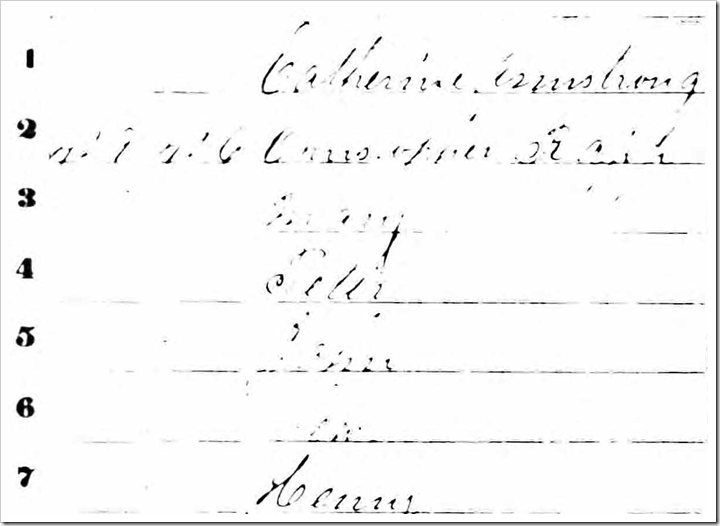
I have seen citations that consisted of a URL only. I’m guilty of it myself (at least in my working notes). Is a URL sufficient? Consider the following two examples, taken from actual source references to the U.S. census. Neither one still works! A naked URL is insufficient because links rot.

     1.  http://www.mocavo.com/1910-United-States-Census/126211/004973415/607
     2. http://www.ancestry.com/search/io/browse.asp?c=8&state=Vermont&county=Addison&township=Bristol&ed=&roll=M33_126&STAbrv=VT&startimg=30&endimg=42&rp=42&hash=1670352374&width=2877&height=5089&levels=5&colorspace=Grayscale

The U.S. Federal census is now ubiquitously available on major genealogy websites. If you viewed it online, is it necessary to specify the one you used? Consider the following example.

     3.  1860 U.S. census, Jackson County, Ohio, population schedule, Scioto Township, p. 62; NARA microfilm publication M634, roll 992.

Depending on which website you go to, you might see this

Image sample from 1860 census from Ancestry.com

or this

Image sample from 1860 census from Fold3

or this

Image sample from 1860 census from FamilySearch.org.

If you don’t specify the website, others may not be able to see what you saw!

Darned image citations!

P.S. For extra credit, create complete citations for these three sources. For citation 1, cite Robert Black; for 2, cite Pearis Raymond; for 3, cite Lewis Rapp on FamilySearch.org.

Thursday, August 4, 2016

FamilySearch Product Road Map by Brian Edwards – #BYUFHGC

At the 2016 BYU Conference on Family History and Genealogy Brian Edwards of FamilySearch presented “FamilySearch Past, Present, and Future (Product Road Map).”

Brian Edwards at the 2016 BYU Family History and Genealogy Conference

FamilySearch is experimenting with a personalized home page. To try it out, go to familysearch.org/lihp-arches. To permanently use the new design, go to familysearch.org/lihp/arches/1. The page will evolve over time. We’ll show different tasks to different people. We’ll look at what you do and give you tasks that match your skill level. Another section of the home page is “Recent Ancestors.” Another section is a To-Do List that you can create.

FamilySearch Experimental, Personalized Home Page

In the new Memories Gallery you can rotate photos. And now there is a list view, launched the week before the conference. It makes it easy to see photos without event dates or event places. In the future, they will allow you to make these changes in place. Today, it jumps to the photo page.

FamilySearch Memories Gallery List View

FamilySearch would like to do video. The challenge is reviewing it for appropriateness. FamilySearch pays a company to do that for photos. We don’t know how to cost effectively review videos to prevent people from using our site as their porn cache.

The plan is to limit photos to 5,000 per person, Brian said. But we are seeing good stuff, so we aren’t yet limiting the number.

FamilySearch is always asking, “How do we engage new people in family history?” One of their attempts is Family Discovery Centers. They are trying out new things. One is a station where family members can stand in front of a camera and get a photograph of them standing at various locations around the world. Another station allows you to replace the face on a historical photo with one of your own. Another is a “Are We Related” experience similar to BYU’s Relative Finder. You’ll see some of this migrate onto the web.

The current Family Discovery Center in the Joseph Smith Memorial Building in Salt Lake City has a lot of expensive equipment. FamilySearch is looking at ways to package it into a smaller, less expensive set of equipment for expansion into more places.

Coming very soon is a Helper portal. The portal would help step you through the process taught by Mike Sandberg at RootsTech for helping members of The Church of Jesus Christ of Latter-day Saints become engaged in family history and temple work.

It is now possible to send messages to the contributor of a GEDCOM in the Genealogies section, if the contributor is known. (If a person submitted a GEDCOM to Pedigree Resource File on the old website, but has never registered on the new website and claimed their old submission, the FamilySearch.org messaging system is not able to contact them.)

GEDCOMs have been added to the Genealogies section of FamilySearch.org from the Guild of One-Name Studies and from African Oral Genealogies.

FamilySearch is hoping to provide hints from more record types, even other websites.

A fairly new feature is that when you are about to change information for a person who is being watched, you are informed of the number of watchers.

Badges are relatively new. They indicate your ancestor belonged to a historical group around which FamilySearch did an email campaign. They appear along the right-side at the top of the person page.

Badges for membership in special groups are displayed on the person page.

FamilySearch decided delete person was too powerful. You can no longer delete a person unless you added the person and no one else has made changes to it.

We had built Family Tree on a system that was supposed to scale for a long time into the future, Brian said. We built a system for 10-time the traffic we were then experiencing. It ought to have lasted for decades. We since exceeded that by 20 times. We needed to build a new system that handled all that traffic. We’ve made the transition and the system is now out in the cloud. We can add servers as traffic changes. We moved all the data to a new Family Tree database. We’re still ironing out a few things. For the most part it should be pretty fast on Sunday. If you couldn’t merge before, for the most part you can merge now. With the new system we can add things that we wanted to but couldn’t because of capacity, Brian said.

FamilySearch is working on the future of the messaging system. They are looking at

  • Integrating with an address book
  • Allowing people to opt in to sharing more publicly
  • Adding new ways for people to form communities for sharing

Wednesday, August 3, 2016

FamilySearch Hinting by Robert Kehrer #BYUgen #BYUFHGC

Robert Kehrer addresses the 2016 BYU Conference on Family History and GenealogyRobert Kehrer presented a session titled “Using FamilySearch Hinting” at the 2016 BYU Conference on Family History and Genealogy. Robert is the senior product manager for research technologies. I’ve written previously about some of the information, which I won’t repeat here. (See “Searching for Sources at FamilySearch (Part 1)” and Part 2.) Here are some new information items:

When you make a change to someone in Family Tree, or add someone to Family Tree, it takes a little while for FamilySearch to check for new hints. Today hints are recalculated in less than 15 minutes, sometimes less than five. It is counterintuitive, but the busier the tree is, the faster the hints are recalculated. They are working on getting the latency between changes and new hints down to less than a minute, perhaps seconds. Until then, when you make changes to the tree, check back in about a quarter hour to check for new hints. When FamilySearch adds a new record collection, it works differently. About every 6 to 8 weeks they take all the records and search for new hints.

There are a couple of things Robert’s team is working on. They are reworking the SourceLinker attachment tool. There is a lot of work going on behind the scenes right now to make it better and faster and easier to use. Lastly, they are looking at something that might concern some people. FamilySearch has some high quality genealogies—trees—put together in a high quality way. FamilySearch doesn’t want to represent these sources as the same quality as FamilySearch’s historical records, but at some point they will let you know when they have a hint in one of these high quality datasets.

One change under consideration is the ability to change tree data while attaching a record. The difficulty is allowing users to do this while still exposing the sources already attached to that fact.

Robert showed an example demonstrating how powerful hinting is. The name Speak was misindexed as Sipelak in a family in Missouri in 1900. The hinting system was still able to match up the record to the tree because of everything else that matched between the family in the record and the family in the tree:

FamilySearch hinting found the misindexed Sipelak family was actually the Speaks.
(Click to enlarge) 

That’s impressive.

Tuesday, August 2, 2016

“FamilySearch Mobile Tree App” by Todd Powell #BYUgen #BYUFHGC

Todd Powell presented the topic, “FamilySearch Mobile Tree App” at the 2016 BYU Conference on Family History and Genealogy.Todd Powell presented the topic, “FamilySearch Mobile Tree App” at the 2016 BYU Conference on Family History and Genealogy held last week in Provo, Utah. Todd is the Product manager for mobile apps at FamilySearch.

Todd assigned us homework. Our first assignment was to go install the app. Check. I’ve done that. It is supported by Android or Apple in the Google Play Store or the Apple App Store. Our second assignment was take something that we learned today and teach it to someone else. With this article I’m putting a check in that box also.

There are two apps, Family Tree and Memories. FamilySearch makes a new release every two weeks (with rare exceptions). New releases were made the week before the conference. New releases will be made the week after the conference. Make certain you are getting updates. They are releasing new features all the time. The version number can be found on the setup screen. [I don’t think you need to check it. At least on iOS the app prompts me when I need to update. It also shows up on the list of apps needing to be updated.]

For the year ending 31 January 2015, 2 million sources have been attached using the app, 1.2 million persons added, and 9 million photos viewed. There have been 300,000 people who have created new FamilySearch accounts. About 100,000 people use the app each week.

Todd said that using the mobile app engages young people better than using a computer. If you have the chance to work with them, have them go out four or five generations. Take 10 to 15 minutes to find a photo or story they haven’t seen before.

If you prefer a typed story over recorded audio, rather than trying to type on the little keyboard, dictate the story. Use the microphone key on the phone keyboard. If you speak slowly and clearly, the phone does a good job of converting your speech to text.

To give you ideas of questions to ask an older relative, FamilySearch will soon release a feature that has suggested questions. They have just started working on this today, for release a couple of weeks out. Tap the question and it begins an audio recording using the question as a title.

Today you can use the app to search FamilySearch records. In the future they will add the ability to search Ancestry.com.

The app doesn’t current check for or merge duplicates. They will be adding the ability to check for duplicates, but they are hesitant to add the ability to merge duplicates. They are working through ideas on how to impede bad merges before they offer merging.

On the mobile app, you can see JPEG and PNG, but not PDF. They don’t separate photos and documents.

The system will not allow the same, exact photograph file to be uploaded multiple times. But if there are differences, even if it is the same original photo, the program will let you upload a duplicate.

The “Descendants with Tasks” screen will show icon tasks for three generations of descendants of the focus person. This works for record hints and temple opportunities but does not include research suggestions or data problems.

The “Ancestors with Tasks” is the killer feature of the app. Tap and the app lists persons with tasks for your ancestors, up through five generations, plus their children and spouses. It also checks anyone you visit in the mobile app. The first time you run this report, it takes a while because it downloads the list to your device. Subsequent runs will be faster.

This week on iOS you will see a new map feature. From a person view, you tap on a map icon next to a location, such as birthplace. The map will show pins for the locations of the events associated with that person.

The mobile app has become complete enough that you can do 85% of the top 100 tasks that you do on the web. What can’t you do?

· Check dups and merge

· View the change log

· See data problems and research suggestions (they will add these)

· Multiple tabs for research (they are looking at ways to facilitate this)

· Traditional, horizontal pedigree (they won’t change this as they like what they have)

· Miscellaneous things Todd didn’t enumerate

Monday, August 1, 2016

Insider Ketchup for 1 August 2016

Insider KetchupThe BYU conference has kept me busy and there are more articles coming all this week and next. Not much time to cover regular subjects! Time to ketchup.

FamilySearch tree bulletThe Salt Lake City Family History Library is holding a weeklong, free, United States research seminar. It will be held 22-26 August 2016 and is geared for beginning and intermediate genealogists. It will cover U.S. regions and records, techniques, strategies, methodology, FamilySearch resources, Family History Library collections, FamilySearch catalog, historical records, research wiki, and more. Seating is limited to 120 attendees, but all classes will be broadcast as webinars. Remote attendees will not be able to participate in hands-on activities nor will they receive the printed syllabus. You should register whether you are attending in person or online.

To learn more and to register, visit https://familysearch.org/wiki/en/United_States_Research_Seminar.

Bullet Ancestry.comAncestry.com has filed their SEC quarterly report. I would have liked to have read it and given you the highlights, but didn’t have the time. You can read a copy on the Ancestry corporate website.

FamilySearch tree bulletFamilySearch has issued their “What’s New” for the month of July 2016.

  • The Memories Gallery now sports a list view. I’ll say a little more about it on Thursday.
  • The Family Tree person page memories tab has a separate button for attaching a memory from the Gallery.
  • Once a memory is attached to a person, the person’s name will appear on the memory page as it appears in the Tree. Long ago I complained that persons in memories and persons in the Tree had separate names. You had to enter the name twice. This seems to be one step to unify the two name spaces.
  • In Memories, the closely related persons view is now the default and can be sorted by first or last name.

You can read the entire article on the FamilySearch blog.

Bullet Ancestry.comAncestry has announced that they will hold an Ancestry Day on 23-24 September 2016 in Tacoma. On Saturday presentations will be made by experts from Ancestry. The cost is $35 plus extra if you wish to purchase a box lunch. Friday presentations will be made by experts from the Washington State Archives, Washington State Library, Legacy Washington, and the Washington State Historical Society. The cost is $15 and seating is limited to 225 people. For more information and to register, visit the event registration page.

FamilySearch tree bulletThe Digital Public Library of America (DPLA) and FamilySearch have signed an agreement to allow FamilySearch’s book collection to be discoverable via the DPLA’s website. The DPLA is like a library catalog of freely viewable online documents, books, photographs, maps, and so forth from many libraries, archives, and museums across America. They call themselves a portal rather than a catalog because they have a rich search experience that includes timeline, map, format, partner, and subject. Other partners include the New York Public Library, the National Archives, and the University of Southern California Libraries. Read the full announcement on the DPLA blog.

Bullet Ancestry.comAncestry tells me that a lot of work will be done on fixing RootsWeb this week. I should have a status update for you next week.

FamilySearch tree bullet

Registration is now open for RootsTech 2017 hotels. The Salt Lake Marriott Downtown at City Creek, the Salt Lake Plaza Hotel, the Hilton Salt Lake City Center, and the Radisson Hotel Salt Lake City Downtown are offering reduced rates to RootsTech conference attendees. RootsTech 2017 is 8-11 February 2017 in Salt Lake City, Utah. Learn more on the lodging page of the RootsTech website.

Bullet Ancestry.comAncestry recently added new U.S. naturalization papers from 26 states. Search the citizenship and naturalization category on Ancestry.com. Read a seven page naturalization research guide from Ancestry.

FamilySearch tree bulletI received a message from bigfootpilot@familysearch.org telling me to update the Google Chrome Extension for the FamilySearch Pilot Tool. You should update it if you are experiencing long wait times after submission.

Bullet Ancestry.comAncestry has acquiesced to requests from some users who dislike the auto-generated histories that appear at the top of the LifeStory pages. You can now disable the histories for everyone in an entire tree. Tree owners had objected to the auto-generated histories because they were sometimes inaccurate and reflected poorly on the owner. Read the announcement on the Ancestry blog.

FamilySearch tree bulletFamilySearch announced in mid-June (yes, I am that behind in my news stories) “completion of the Freedmen’s Bureau Project, indexing the names of millions of African Americans collected directly following emancipation.” Nearly 19,000 volunteers indexed nearly 1.8 million names. Read the news release on the Newsroom page of The Church of Jesus Christ of Latter-day Saints.

Thursday, July 28, 2016

Nobody Told Me – #BYUgen #BYUFHGC

image“It’s the stories that we remember,” Paul Milner said. Paul delivered the Thursday keynote at the 2016 BYU Conference on Family History and Genealogy. Paul is a native of England and a noted expert on British Isles research. He has authored six books on English and Scottish research.

Paul began by quoting from the novel Birdsong, by Sebastian Faulks. One of the characters, Elizabeth Benson, was driving through the French countryside, trying to comprehend World War I. As she drove she saw something odd.

Through the fields to her right Elizabeth saw a peculiar, ugly arch that sat among the crops and woods. … it was made of brick or stone on a monumental scale. It was as though the Pantheon or the Arc de Triomphe had been dumped in a meadow.

She entered the huge structure and was struck to find that every surface was chiseled with names. She asked a man there who they were.

“These?” The man with the brush sounded surprised. “The lost.”

“Men who died in this battle?”

“No. The lost, the ones they did not find. The others are in the cemeteries.”

…

She looked at the vault above her head and then around in panic at the endless writing. … When she could speak again she said, “From the whole war?” The man shook his head. “Just these fields.”

…

“Nobody told me.” … “Nobody told me.”

clip_image002 The Thiepval Memorial names 72,000 men of the British Empire who died in the Battle of Somme whose remains were never identified.

“Why does it matter to me?” Paul asked. “Corporal Robert Finnegan, my mother’s uncle’s name is listed on that monument.” Paul related the story of the first day of the battle. It began 100 years ago on 1 July 1916. The battle resulted in the death of two of his granduncles. (See Paul’s blog article, “Remembering those who died on the First Day of the Battle of the Somme – 1 July 1916.”)

Paul encouraged us to find the soldiers on our trees.

“We all have stories to tell. They don’t have to be big and fancy,” he said.

Paul told us the story of his first 4th of July celebration in this country. (“That’s not a holiday I would normally be celebrating,” he joked.) It had snowed the day before. We all have family celebrations and traditions. Have we told those stories?

Paul told the story of how a northern English lad ended up living in America. “Have you told your children why you came to this place?”

Paul related his long faith journey. “Part of your mandate [as members of The Church of Jesus Christ of Latter-day Saints] is to find out about your ancestors. But do you tell your faith story as well?”

You all have stories and the Church is making it easy for you to tell those stories, he said.

“Do you tell those stories, or are your grandchildren going to be like Elizabeth. ‘Nobody told me. Nobody told me.’”

Wednesday, July 27, 2016

Turning the Model Upside Down #BYUgen #BYUFHGC

Steve Rockwood addresses the 2016 BYU Conference on Family History and GenealogyFamilySearch wants to turn upside down the usual order in which people engage in family history, said Steve Rockwood in his keynote address at the 2016 BYU Conference on Family History and Genealogy.

Steve is president and chief executive officer (CEO) of FamilySearch International. He is the managing director of the Family History Department of The Church of Jesus Christ of Latter-day Saints, which sponsors FamilySearch.

Steve said in the past we presented people with a chart or a computer to start them in family history. Those that were willing to stay with it long enough eventually experienced the positive emotions associated with family history. In the Church today, that amounts to 2% of the members.

“We want everyone to feel those emotions [they experience] through the act of doing family history,” Steve said. “We believe that this is primarily an emotional movement.” He said doing family history brings feelings of love, joy, peace and other strong positive emotions. (The Church ascribes these to the Holy Ghost, he said. He pointed us to Galatians 5:22-23 and Ephesian 5:9 in the New Testament.)

“We are concentrating on how everyone can experience and feel those emotions.” By giving them immediate, emotional experiences, FamilySearch hopes they then engage in family history. FamilySearch decided to concentrate on stories. “We are serious” [about this change]. Steve said. “We changed our logo, our entire branding.” The FamilySearch logo now looks like a set of picture frames. FamilySearch starts people with photos, audio recordings, anything that anyone can participate in. That makes it an exciting world of change. “Now, more and more people are getting involved in this thing called family history.” For example, FamilySearch has seen a 47% increase in young people involved in family history.

This change can be discomforting to existing genealogists. Steve likened it to the situation when society started shifting from agricultural to urbanized life. Our great-grandparents said things like “How can you learn how to live life if you don’t grow up on a farm?” And “How can you learn the law of the harvest?” Somehow we all turned out okay, even though we didn’t grow up on farms. The same will occur with this change in approaching family history.

Steve assured us that we were still valued and accuracy is still important. “We’re all standing on your shoulders. We honor you and thank you.” We will not compromise on the integrity of the genealogy, he said. It needs to be accurate. “Accuracy is paramount,” he emphasized.

Steve talked about five experience areas, as he did at the last RootsTech. (See “RootsTech is a Gathering of Heart Specialists” on my blog.) One of these is searchable records. “They have to be searchable,” he said. Most people are not willing to wade through microfilm or unindexed images. Steve said FamilySearch is doing all they can do to digitize the films in the vault and hope to be done in three years. But they still need to be made searchable. FamilySearch is doing so by pursuing three strategies: FamilySearch Indexing, commercial partnerships, and automation. If computers can be programmed to index the documents, let them do it.

The Memories experience area will continue to stay core to FamilySearch’s strategy. Steve pointed out that photos and stories that are valuable now will have “unbelievable power” for generations to come.

While we think of Family Discovery today in terms of brick and mortar Discovery Centers, FamilySearch is looking at opening it up to experiences that are less expensive to deploy to almost any family history center, or on your computer screen, or even on your phone. FamilySearch is looking at packaging Family Discovery in new, appealing ways. The idea is to package your tree in a way that gives others an engaging taste of it.

Steve gave some indication of the countries where FamilySearch may be expanding efforts. He said that Lehi in the Book of Mormon sent his sons back to Jerusalem to get a record of their genealogy. “We have to concentrate on the question, ‘Where’s your Jerusalem?’” If it is America or Scandinavia or England, then FamilySearch can give you a pretty good experience. But if your Jerusalem is China or Ghana or most other places, the experience is not as good. He said that because of a partnership with Ancestry.com, in five years the experience will be good for those whose Jerusalem is Mexico. Steve said if you ever want to know some places where we are diversifying, listen to the Church’s General Conference and see where the Prophet [Thomas S. Monson] is announcing temples. When that happens, opportunities open up for us, he said. Look where there are 27 temples still under construction. Steve said that 60% of visitors to Temple Square (across the street from the Salt Lake City Family History Library) speak Chinese. What kind of discovery experience can we provide for them?

Steve said that what FamilySearch is doing is trying to bring all of God’s children into family history and providing them records according to their Jerusalem.

Tuesday, July 26, 2016

That is Where the Love Is #BYUgen #BYUFHGC

image 
Credit: Ivan Majc, Adriatic North Mission
“As you talk about the ancestors, that is where the love is,” said Paul Cardall. “That is where the heart starts to turn.” Paul has learned this through multiple visits to Slovenia, the homeland of his wife’s family.

The 2016 BYU Conference on Family History and Genealogy opened this morning, Tuesday, 26 July 2016, with a keynote address by Paul Cardall, a pianist known for his hymn instrumentals.

“Literally, seven years ago I had a change of heart,” said Paul. That’s when Paul, who had suffered all his life from a congenital heart defect, received a transplanted heart.

After marrying Tina, a Slovenian-American, his heart turned to her ancestors. Paul talked to his wife about her family, but she only knew so much. Tina’s grandfather (I think it was her grandfather) was a freedom fighter during World War II, so he was forced to flee to the United States after the war. After scouring FamilySearch.org and subscription sites like Ancestry.com, Paul found there were no records online. He asked a friend, FamilySearch’s Suzanne Russo Adams, what to do. Suzanne connected him with Lidija Sambunjak, an expert in Slovenian genealogy. She informed him that, unfortunately, a lot of the Slovenian records are available nowhere else but in Slovenia.

When invited by Brigham Young University to write music about a documentary about the history of The Church of Jesus Christ of Latter-day Saints in Yugoslavia, he joked that he would love to do it if they would fly him to Slovenia.

He was delighted when he received a call from the Adriatic North Mission of the Church of Jesus Christ of Latter-day Saints inviting him to come and perform for church members in Slovenia. His wife was excited to accompany him and, being Catholic, asked why they couldn’t perform in a Catholic church. They asked and Father Jože Kokalj in Ljubljana agreed to host the concert at St. James Church.

At the same time, they reached out to the Slovenian Heart Foundation, an organization that helps children with heart defects. What had begun as a Mormon event was becoming something much bigger.

“All of this was happening as I was doing genealogy,” Paul said. Tina was not certain they would see any of her family, but when they arrived at the airport, they found many cousins waiting. Their hearts were turning.

Paul played for us the first several phrases of the opening number from the concert. (Listen to the song on Facebook.) At the concert family showed up that they didn’t know they had. “Just to be there and to feel the love of everyone [was amazing],” Paul said. “Just to be there with these people was wonderful.”

They visited Tina’s mother’s village and met more family.

Six months later Paul and Tina were on their way back to Slovenia for the Slovenian Heart Foundation's 25th anniversary charity concert. The Adriatic North Mission wanted two artists this time, so they invited David Archuleta to perform with Paul. This time he would perform in the Slovenian Opera Theatre and Ljubljana Archbishop Msgr. Stanislav Zore would attend.

Tina’s mother had declined going on the first trip because of lingering fears over the communist past. This time she wanted to come. She was able to visit her village for the first time in 43 years. They went to her own house and found cousins living there. She met family members she hadn’t seen in 43 years. “War tears families apart,” Paul said. “You [genealogists] help put the puzzle back together.”

They visited the archive where the parish registers are kept. Tina’s mother got to see the names of her ancestors. “These books are old,” Paul said. “They are older than the constitution of the United States.” Each book is the record of a parish for a couple of hundred years. “Each priest carefully wrote down the names, one by one. It is so powerful.” Paul told us that we, genealogists, understand. We also add the names, one-by-one, into “the book of life.”

I haven’t mentioned much of it, but religion was a big part of Paul’s presentation: His love for his wife’s church, the Catholic Church. His love for his church, The Church of Jesus Christ of Latter-day Saints. His love for the Savior. He finished his presentation by playing a recording of a new hymn. Elder David A Bednar, an apostle of The Church of Jesus Christ of Latter-Day Saints, and a grandson of Hungarian immigrants, asked Paul to help him write a song titled “One by One.” Paul played a recording of it for us. (Listen to it, read the lyrics, or print the sheet music at https://www.lds.org/new-era/2016/07/one-by-one.)

Monday, July 25, 2016

BYU Conference Center Handicap Parking Changes #BYUgen #BYUFHGC

BYU Conference on Family History and GenealogyAttendees of this year’s BYU Conference on Family History and Genealogy should be aware of the impact of construction at the conference center. The conference center address is

730 E University Parkway
Provo, Utah 84604

The normal parking lot—adjacent to the center on the west side—is still available, but the normal entrances to the building are closed. The remaining entrance for that parking lot is near the southwest corner of the building and “does not meet ADA requirements.” If memory serves correctly, you have to go up a staircase to get to the door.

Handicap parking has been provided near the main entrance on the south side of the building. That entrance does not involve any stairs and opens onto the main floor of the building where all the classes are held. The parking is southeast of the building, on 1550 North. This handicap parking is in lot 23A, which is normally closed to the general public. If all the handicap spaces are full, BYU says you can use any space in that lot.

Map of BYU Conference Center handicap parking during construction

Also, parts of University Parkway will be under construction at times during the conference. Give yourselves a little extra travel time.

BTW, if you haven’t yet registered (and the travel and parking problems haven’t driven you away), just show up and you can register onsite. The first keynote starts tomorrow (Tuesday) morning at 8:30am. I can’t find what time that registration begins, but I imagine it will be 45 to 60 minutes beforehand.

Saturday, July 23, 2016

BYU Conference on Family History and Genealogy #BYUgen #BYUFHGC

BYU Conference on Family History and GenealogyThe BYU Conference on Family History and Genealogy starts Tuesday, 26 July 2016. If you are thinking about your pioneer ancestors this weekend, then you should come. BYU’s Elizabeth Richards tells me you can register clear through the last day of the conference on Friday, 29 July 2016.

Registration is $185, including a syllabus on USB. There is a $50 discount for Family History Consultants for the full conference. Or Family History Consultants can attend the Consultant track on Friday for free. You may purchase a printed syllabus at the conference or anytime after the conference until the end of the year.
Paul CardallTuesday’s keynote speaker is Paul Cardall, a pianist known for his hymn instrumentals. His current album, 40 Days for Forty Hymns, débuted on Billboard’s New Age Album chart at #1 in May of last year and was still in the top 10 earlier this month. Paul is an avid genealogist with Eastern European roots. He is a heart transplant survivor, having suffered from congenital heart defects his entire life.
Steve RockwoodWednesday’s keynote speaker is FamilySearch president and CEO, Stephen Rockwood. He is the managing director of the Family History Department of The Church of Jesus Christ of Latter-day Saints. Prior to taking the helm he was the director of the International Division. He has continued a world-wide emphasis as president. Steve is a graduate of BYU with an MBA from the University of Colorado in Boulder.
Paul MilnerThursday’s keynote is Paul Milner. Paul is a native of northern England and while he now lives in the United States, he continues to focus on British Isles genealogy, resources, and methodology. He is actively engaged in the genealogical community and is a past board member of APG, FGS, and GSG. He is a professional genealogist, instructor, and lecturer.
The conference program includes many noted national and regional experts. Last year’s keynote speaker, Lisa Louise Cooke, is back, teaching five sessions (if I counted right). Paul Milner is teaching five sessions in addition to his keynote. Rick and Pam Sayre are teaching three and two sessions, respectively. And there are many more. FamilySearch and Ancestry.com both have tracks. To see a complete list of presenters and topics, visit http://familyhistory.ce.byu.edu/schedule.

Friday, July 22, 2016

Darnedest Political Obituary

We depend upon records to reveal the “truth” about the past. Yet sometimes records have anomalies. Some are amusing or humorous. Some are interesting or weird. Some are peculiar or suspicious. Some are infuriating, or downright laughable. Records say the darnedest things!

Faced with the prospect of voting for either Donald Trump or Hillary Clinton...

“NOLAND, Mary Anne Alfriend. Faced with the prospect of voting for either Donald Trump or Hillary Clinton, Mary Anne Noland of Richmond chose, instead, to pass into the eternal love of God on Sunday, May 15, 2016.”

Yes, records say the darnedest things!


Source: “Noland, Mary Anne,” obituary, Richmond (Virginia) Times-Dispatch, online (http://m.richmond.com/obituaries/article_c21b60bc-1153-5abd-b3c8-268cfd32eb57.html?mode=jqm : accessed 28 May 2016).

Wednesday, July 20, 2016

DNA Versus Extremism

Momodo DNA promotion videoI hear all the time about people testing ethnicity from different companies and getting different results. I’ve heard from a person or two with well documented trees that see some pretty obvious problems in DNA ethnicity results. The fact is, finding “pure” reference individuals upon which to base ethnicity calculations is a challenge. Consequently, ethnicity results are somewhat questionable.

Despite that, I recommend you watch a tear jerking video from Momondo’s latest marketing campaign. In light of recent world events, I found it particularly powerful.

“There would be no such thing as extremism if people knew their heritage.”


To view the video, click here: https://www.momondo.com/letsopenourworld/dna

(If the video won’t play, try this link.)

Monday, July 18, 2016

Monday Mailbox: City Directories and Newspaper Gaps

The Ancestry Insider's Monday MailboxDear Insider,

I am frequently frustrated by egregious gaps in ancestry.com's online  standard reference materials. The most recent case was the 1949 city directory for New Orleans, Louisiana. The online directory ends in the "P" section. The filmstrip has a final page: See Next Filmstrip for Part Two.

So why doesn't ancestry have Part Two? Or, for that matter, the New Orleans City Directories for 1950, 1951, and 1952? These books are easily obtainable, but the reason I subscribe to Ancestry is to have access to these resources at my desk.  I also find it maddening that Ancestry does not acknowledge these gaps, or have a simple way to report a problem. I have just spent 30 minutes searching for a way to email Ancestry.com about the New Orleans city directory gap and asking that they fill it.

And further: These unheralded, unexplained gaps are also a problem with online newspaper databanks. I often find huge lapses of 10 to 30 years. I have contacted newspapers.com but receive no explanation other than a wan, "We regret that you were inconvenienced," kind of non-answer.

Thanks v. much for your answer & the light you regularly shed on the genealogy world,

Sincerely,
Harriet Swift

Dear Harriet,

Thank you for your kind comment.

Ancestry and Newspapers.com work at scales with city directories and newspapers that don’t allow for attention to individual or small runs of issues. The cheapest way for a company like Ancestry to enter the City Directory or Newspaper market is to buy large, existing collections of microfilm or digital images. For example, Ancestry notes its copies of The Atlanta Constitution were scanned from microfilm. Peter Drinkwater, Newspapers.com product manager, says that all the historic newspapers being added to newspapers.com are from microfilm.

I don’t know if Ancestry or Newspapers.com has ever disclosed its sources, but ProQuest's microfilm newspaper collection, NewsBank’s microfilm newspaper collection, and Gale’s city directory microfilm collection are all potential sources. There are also large collections of digital images from some of these companies and others like NewspaperArchive.com.

These companies, in turn, have to work at large scales. They usually microfilm or digitize at institutions having large physical collections. When such institutions lack particular issues, those become gaps in their collections. It’s too expensive to track down missing issues, move equipment all over the country, and separate needed issues from duplicate issues. The holes in these collections, in turn, become the holes in Ancestry’s and Newspapers.com’s collections.

Ancestry is still adding to their city directory collection, so there is a chance they can fill in the gaps you need. It won’t do much good if you own the missing directory. “We don’t typically accept customer donations unless it is a substantial number of directories,” says Matthew Deighton, Ancestry spokesperson. Harriet, you mention that you know where to find the missing directories. If the owning institution has a large collection, perhaps they could be persuaded to lend their collection to Ancestry. I think Ancestry prefers an all-out gift, because they prefer to cut the spines off the directories. They can then be fed through high-speed, sheet-fed scanners. This is cheaper, faster, and provides better images. But don’t worry about rare directories. Matthew assures me, “We [Ancestry] only cut the spine on books where other copies exist.”

My guess is that Ancestry and Newspapers.com don’t go out of their way to solicit information about missing issues because they can’t usually do much about it. However, Ancestry spokesperson, Matthew Deighton says, “Send in a suggestion identifying the missing content and we will see what we can do to fill it.” You can send messages to Ancestry at https://support.ancestry.com/s/contactsupport. You can call them using the numbers on their phone support page. The previous option, support@ancestry.com, returns an automated message directing you to the support page. For Newspapers.com, select “Contact” at the bottom of their website.

Signed,
---The Ancestry Insider

Friday, July 15, 2016

Russian Serendipity

Illuminated world globeThis is my adaptation of a story shared by reader Brian Palmer. Thanks, Brian! (See his original here.)

Jennifer Low volunteered to serve a mission for The Church of Jesus Christ of Latter-day Saints. The Church, not the volunteer, decides where the missionary will be sent. Nevertheless, missionaries have their hopes. It is an exciting moment when a young man or young woman opens the ordinary envelope from Salt Lake City that contains extraordinary news: how far from home they will move, what country they will live in, and what language they will speak for the next 18 to 24 months of their lives.

Jennifer’s grandfather fled Russia during the revolution. How exciting would it be to return to the land of her forefathers! While learning a new language is a tough challenge for many new missionaries, Jennifer had studied Russian throughout her high school and college years.

When Jennifer opened her envelope, she found she was headed to Argentina.

Jennifer packed her bags and went to Argentina as assigned. One day Jennifer and a fellow missionary (the Church’s missionaries serve in pairs) were going door-to-door, trying to find someone willing to hear their message. At one house they found an old man who didn’t respond to their Spanish. They tried English, but again received no response. Jennifer, however, spoke another language.

The man was delighted to discover she spoke Russian and invited them in to visit. It was not long before they made a remarkable discovery: the man and Jennifer’s grandfather were brothers.

The two had been separated when they fled Russia and were never able to find one another. Reunification brought great joy to both families. And it brought genealogical records, including the family Bible. The man allowed Jennifer to copy it all.

That’s what we call, serendipity in genealogy.


Image credit: Adaptation of MathKnight, “A Gateway to the World: Globes art presentation in Rotschild Boulevards in Tel Aviv during September-October 2007,” photograph, Wikimedia Commons (https://commons.wikimedia.org/wiki/File:TelAviv2007Globes_%2825%29.JPG : accessed 28 May 2016). Used under license.

Thursday, July 14, 2016

History’s Future Depends on You - #TheWorldsRecords

FamilySearch Worldwide Indexing Event 2016I received the following announcement from FamilySearch:

From July 15-17, [2016] FamilySearch International and supporting organizations are coordinating the single largest gathering of volunteers online from around the world to help in the noble effort to save, and increase access to, the world’s genealogically significant historical records. With a target of 75,000 online volunteers for the weekend event and a stretch goal of more than 200,000, you and your network of friends and colleagues can make a real difference. Remember, every historic record tells the unique story of someone’s ancestor and helps make a personal connection. Until that record is easily discoverable online, that ancestor’s story and their place in the family tree, remains untold.

Please visit https://familysearch.org/worldsrecords for information on the world indexing event and how you can participate this weekend.

If you’ve ever used the historical records on FamilySearch.org, now’s your chance to pay back other volunteers who made that possible. If you haven’t, now’s your chance to pay it forward. Index some records you think others—or even yourself—will find helpful. If nothing else, check out the cute, interactive animation found on https://familysearch.org/worldsrecords. Look down the page for this graphic:

FamilySearch 2016 Indexing Event: History's future depends on you!

Wednesday, July 13, 2016

FamilySearch Family Tree Outage Minimal

FamilySearch Family Tree Now Overshadows NFSThe scheduled outage and system upgrade of FamilySearch on 27 June 2016 seems to have gone smoothly. The upgrade is an attempt to prevent performance problems. The upgrade provides “a new technology that should provide better scaling with traffic,” said FamilySearch’s Joe Martel. “That means as more people use the site it shouldn't bog down.” If the upgrade was successful, Sunday afternoon system failures should be a thing of the past.

The upgrade included breaking the synchronization link between FamilySearch Family Tree and the archaic New FamilySearch (NFS), said Ron Tanner, Family Tree product manager. The most touted benefits of the break are the ability to merge IOUSes (“Individuals of Unusual Size”) and the cessation of stupid data changes attributed to the FamilySearch or LDS Membership accounts.

Joe said that another benefit of the new system is that FamilySearch will be able to improve and enhance features faster.

“The cutover was a HUGE effort,” Joe said. “Hat's off to the engineering teams and planning that went into this.” According to fellow blogger Renee Zamora, the system was scheduled to go offline at 12:30 Monday morning. While FamilySearch had warned users the outage could go 24 hours, Holly Hansen reported on Facebook that it was back online by 6:00am.

I haven’t heard any reports of significant problems with the new system. “I'm guessing we'll see a few glitches but nothing monumental has turned up,” Joe said. I’ve seen minor issues. (There was a report that you can’t directly change a name from uppercase to mixed case. There was a report that %22 replaced quotation marks in custom facts.). I’ve seen comments about the system being faster. Joe has said that FamilySearch will need to tune the new system configuration.

There will still be situations where merging persons is not possible according to Ron, but the system will tell you the exact reason. “There are some restrictions we had to put in place for those with lots of relationships, etc.” A merge is not allowed if the combined person exceeded certain limits. According to Renee, these are the current limits:

  • Note length: 10,752 characters
  • Person notes: 50, characters 215,040
  • Relationship notes 12, characters 129,024
  • All person and relationship notes characters: 386,320
  • Conclusions: 200
  • Person source: 200
  • Relationship source: 50
  • Memories: 1000
  • Person not a match: 400
  • Discussions: 20
  • Couple relationships: 200
  • Sets of parents: 50
  • Number of children: 400

Ron says these numbers are changing as needed. I’ve already seen a report that the parent limit has changed to 100 and discussions to 50.

FamilySearch calls the new system “Tree Foundation,” according to FamilySearch engineer, Randy Wilson. It uses a database technology called Cassandra. “Our relational database just couldn’t be made to go much faster and so there was concern that Family Tree would tip over at some point soon,” he said. The new system can “scale horizontally.” That means that FamilySearch can easily add more computer servers to meet demand. “That doesn’t necessarily mean that response time will be faster, but, rather, that more people should be able to use it at once,” Randy said. He noted that this technology change will not magically fix all performance problems, but the change eliminates a fundamental bottleneck that was important to fix.

Monday, July 11, 2016

Monday Mailbox: Alternatives to RootsWeb WorldConnect

The Ancestry Insider's Monday MailboxDear Ancestry Insider,

RootsWeb/FamilySearch/Ancestry--I've worked 20 years on Ancestry.com and joined RootsWeb only to find entirely too much work involved updating families. I used GEDCOM to transfer info. My unsuccessful try at Family Search gave me much incorrect information I gave up on that site; that was a hassle, also. I'm up there in years and find genealogy exhausting for me. Should I continue RW or stay with FS? How can I make the transition easier?

Signed,
Vivian Newkirk

Dear Vivian,

If you are going to participate in FamilySearch's Family Tree, you need to buy into the objective of everyone collaborating to build a single tree reflecting mankind. It's more work than doing your own thing because you have to budget time for interactions with other genealogists and you must budget time for teaching people with less genealogical maturity than you (and perhaps learning from others as well, if you are wise). Without your assistance, other with less experience may corrupt the information you contribute.

FamilySearch also has a tree farm like RootsWeb's WorldConnect. It is called FamilySearch Genealogies and replaces the old Pedigree Resource Files offering. Expect it to take the same amount of work as RootsWeb to keep it up to date, plus the extra time it will take you to learn a new system.

There are a number of interactive, online family tree managers. I only follow FamilySearch and Ancestry, so I can't intelligently comment on others. I'm unclear as to whether you have an Ancestry Member Tree. That is another option. If you haven't used it, there will be a learning curve. Further, your tree will not be freely visible to everyone on the Internet. You decide if that is a good thing or a bad thing.

Fold your desktop family tree manager into the mix and things may change. What desktop program do you wish to use?

Signed,
---The Ancestry Insider

Friday, July 8, 2016

Darned Lazy Spouse

Reader Donna Toole shared this darned record. Thank you, Donna!

Wife stays in bed for a week to avoid housework.

EDITOR SUES FOR DIVORCE.
                  ------
Declares Wife Stayed In Bed to Avoid
          Doing Housework.
   LA PORTE,   Ind.,   Sept.  20.—Harry E
Galbreath, editor and publisher of the
Saturday Advertiser, today brought ac-
tion for divorce from Rose Wagner, mak-
ing the unusual allegation that his wife
persisted in staying in bed for a week
at a time to escape doing housework
Galbreath says he got tired of waiting
on her.

Dear Mr. Galbreath, The Insider has a message for you from most every wife on the planet: “Welcome to my world.”


Source: “Editor Sues for Divorce,” The Indianapolis (Indiana) Star, 21 September 1911, p. 4, col. 3; digital image, Newspapers.com (https://www.newspapers.com/clip/3551560/1911_sep_21_divorce : accessed 5 March 2016).