Showing posts with label genealogy. Show all posts

Monday, March 20, 2017

Don’t Let Your Research Be Flushed Down the Toilet

The Ancestry Insider's Monday MailboxThe Monday Mailbox, “17 Years of Research Being Flushed Down the Toilet,” drew lots of great suggestions on ways Larry—or anyone else—can preserve your research before you are gone.

Doris Wheeler suggested the many copies approach to sharing your tree online:

I still advocate also using GEDCOM to post my tree (without images) to Wikitree, RootsWeb WorldConnect, Ancestry, FamilySearch, MyHeritage, and any other place I can. The thought of losing the fruits of all that hard work is unbearable.

(Sarah V offered to help out if you wish to go the Wikitree route. Just reply to her message.) I said in my article that no one could see your Ancestry tree but subscribers. Barry M Spinner reminded me that Ancestry is available in many libraries, whose patrons will also be able to see your tree.

While some people are concerned about sharing, Carol Yocom said, “I've always shared my work gladly. There are mistakes, but most of it is well sourced.” She said posting several thousand images is “labor intensive, but I'll be damned if 45+ years of work ends up in a dumpster.” She hopes “it proves useful to others after I've collected my ticket outta town!”

Proofreader said, “It's hard to beat good old fashioned paper.” Plenty of people agreed, and again advocated the many copies approach. Mary Chamberlain said,

I think it's important to get hard copies of the tree and any source documents to as many libraries, historical societies, and genealogical societies as possible. Not just those in the area where Larry lives now, but those in areas where branches of the family once lived.

Jim Culbert said that some societies accept paper, some electronic, and some will not be interested at all.

Cat fan said,

If you can create a report with all your family research information and images,and save the document (MS Word or PDF); you can send it to the Allen County Library in Fort Wayne IN. They will print a copy for reference at the library and send you a copy.

For more information, see http://www.genealogycenter.org/Donate.aspx.

If you check with them beforehand, the FamilySearch Family History Library in Salt Lake City also accepts donations of books you’ve written. However, they are very picky. Books must be readable, very well organized family history books, rich in standard, genealogical information about people. The preferred format is electronic: a Word or PDF file. Next best is unbound, double sided printed pages. You must be the copyright holder and sign a document giving FamilySearch permission to freely make copies of your book. (I’m pretty sure this includes digital copies posted for free use on the Internet.) They do not accept family tree databases, nor collections of pedigree charts and family group sheets. (I assume that these can be elements of your well-written family history book.) Don’t think you can print out your GEDCOM, throw a hard cover on it, and send it to the Library.) Before donating, contact the donation staff at bookdonations@familysearch.org or call 1-801-240-1855.

I think if you produce a book of Family History Library quality, you should have no problem placing copies in several libraries of various types and town, county, and state genealogical and historical societies. Nancy Smith Gibson warned not to forget your local genealogical society:

I would suggest donating your research, both your tree(s) and back-up information to your local genealogical library or organization. Our local genealogical library benefits greatly from donated research, books, pictures, etc. Sooner or later, somebody either comes in, calls, or emails looking for information and we are so happy to be able to provide some detail that gets overlooked when the majority of information is digitalized. We have many volunteers who work one, two, or more days a month to organize and file. Don't forget your local organizations.

Nancy Smith Gibson
The Melting Pot Genealogical Society and Library
Hot Springs and Garland County, Arkansas

Joseph Martin additionally sent his books to some 65 family members and published about 30 articles in various genealogy magazines, “trying to assure that my 45 years of research will be preserved.”

Connie Moretti pointed out that if you qualify for membership in a lineage or heritage society like the DAR, SAR, Mayflower, and Jamestowne societies, they will preserve your application and all the documentation.


Regarding saving your photos and document images to FamilySearch.org: I had asked Legacy, “Does Legacy allow uploading source images to FamilySearch Family Tree?” Legacy responded: 

We would LOVE to see this but FamilySearch does not allow this, at least not yet.  We can only do what FamilySearch allows (they call the shots on what features we can have).  As soon as they give us the go ahead our programmers will make it happen.  For now, you have to upload photos manually on FamilySearch itself.

Signed,
Michele
Enhancement Requests
Legacy Family Tree

According to P Walker, Ancestral Quest is already doing it:

I imported my RootsMagic gedcom into Ancestral Quest (wasn't happy with how images were treated during the import, however, but maybe other imports, such as from Legacy and PAF would do better) and then synched those with FamilySearch Family Tree and it's really going quickly getting images up into FS and also downloading any new ones anyone has added.

It's taking longer for RootsMagic and Legacy to add this as it's not a priority of theirs right now…

The Ancestral Quest page on FamilySearch.org indicates P. Walker is correct.

As I reported last Monday, RootsFinder will soon (if they don’t already) have the capability to upload to FamilySearch Memories the photos associated with a GEDCOM.

Tuesday, February 21, 2017

Passionate Genealogist is Core - Tim Sullivan at #RootsTech

Tim Sullivan at RootsTechI had the opportunity during RootsTech to sit down with Tim Sullivan, president and CEO of Ancestry. One of the things we discussed was the dichotomy between giving experienced users powerful tools while giving new users an engaging experience. I’ve always felt they compromised the power of core tools by watering them down to suit the new user.

Tim said the passionate genealogist is still the core of their business. DNA is proving to be a phenomenal way to interest new people. While they will give some thought to making core genealogy tools accessible to new users, they are allowing themselves to shift back, improving tools critical to the experienced user. DNA is expanding massively and it is giving them the opportunity and personnel to do some improvements on functionality for the serious genealogist. He mentioned adding intelligent hint prioritization, and “using our big tree to really improve the quality and relevance of hints.”

Tim went on to explain more about their Big Tree. Big Tree is an internal term they use for an effort they’ve been engaged in for many years to stitch together the millions of member trees on Ancestry.com. They are applying machine learning technologies and authority systems and are getting more accurate every day.

“That has always been a little bit of a holy grail, to find that one tree,” Tim said. They are taking a different approach than FamilySearch, but then again, their purposes are different. The Big Tree is not intended to be a product, but something that allows them to develop “some pretty cool capabilities.” One application is their new We’re Related app.

The We’re Related app is a free, entertaining tool for engaging more people in genealogy. “It’s just another way to get a whole new group of people inspired,” Tim said. “What we hope that does is lead them to want to become serious researchers.” The challenge is getting people connected into the Big Tree. Something like 2/3 of people downloading the app are able to connect to the Big Tree, even though they may not have an Ancestry Tree. This is why a Facebook account is instrumental. It helps Ancestry build out  living persons and their relationships. The other necessary step is for Ancestry to add famous living persons to the Big Tree and making certain their branches are correct.

We Remember is another product Ancestry is developing to attract a new audience into genealogy. Just announced at RootsTech, We Remember will allow people to create memorial pages for loved ones. Tim said that We Remember is not a replacement for obituaries. But about the time a loved one passes away there is a lot of energy and motivation to memorialize and capture their life. About a year ago they realized there could be  a better experience for doing this, so they built one. It is social and it is free. “Our goal is that this be very, very broadly adopted,” Tim said. I was, unfortunately, not able to attend the class where it was introduced, so I don’t have any details. While he didn’t give a release date, he said it would be soon.

Thursday, January 12, 2017

Fee Increase for Immigration Records

Fee increase by USCISOn 25 December 2016 I received an email from the U.S. Citizenship and Immigration Services warning of an upcoming fee increase, to be effective 23 December 2016. Yup. Two days before they sent the email. That’s your government at work. The new fee schedule webpage states:

This chart lists USCIS' fees effective December 23, 2016. Applications and petitions postmarked or filed on or after December 23, 2016, must include these new fees or USCIS will reject your submission.   

Filing fees increased for most forms, and we published updated versions of the forms at uscis.gov/forms. We strongly encourage customers to download and submit these new versions, which are updated with the new fees and have an edition date of 12/23/16. We will accept prior versions of forms, with the exception of Form N-400, until February 21, 2017. However, all filings postmarked December 23, 2016, or later must include the new fees or we will reject them.

Immigration Benefit Request New Fee ($) Old Fee ($)
G–1041 Genealogy Index Search Request 65 20
G–1041A Genealogy Records Request (Copy from Microfilm) 65 20
G–1041A Genealogy Records Request (Copy from Textual Record) 65 35

That’s a pretty substantial increase. I’m glad they gave genealogists advance warning.

The email explained that:

Our agency is funded almost entirely by fees. By law, we conduct a fee review every two years to ensure that we recover the full cost of processing immigration benefits. The Genealogy program has not increased its fees since the program was created in 2008.

If you have any questions, please write to Genealogy.USCIS@uscis.dhs.gov.

Thursday, August 28, 2014

#FGS2014 Conference For Free

If you’re within striking distance of San Antonio, Texas, now’s the time to think about taking advantage of the free offerings at the 2014 annual conference of the Federation of Genealogical Societies.

The Ancestry Insider is an ambassador for the FGS 2014 annual conference

The exhibit hall is the place to go for free offerings and is open to the general public. The conference is hosting many free presentations. I’ve published a list in a separate article. Vendors and expert genealogists host presentations in their own booths. I’ve published schedules for one or more of those. Look for them in separate articles.

Discounts are often offered by vendors at the conference. At the FamilySearch booth you can get a free subscription to FamilySearch.org. (Wink, wink.) FindMyPast is offering a free, one month subscription worth $19.95. Stop by their booth to get that offer. JSTOR is offering a free trial. You can get $10 off society memberships for several societies. You can buy AncestryDNA kits for a 10% discount.

Of course, if you can spend a little money, that opens up your possibilities even more. See “FGS Conference for $49 Saturday – #FGS2014.”

See you in San Antonio!

#FGS2014 #Genealogy Conference Free Presentations on Main Stage

The Texas State Genealogical Society, a co-host of this year’s Federation of Genealogical Societies conference, is hosting several free presentations at the conference. These are open to the general public in an exhibit hall of the San Antonio Henry B. Gonzalez Convention Center. If you’re in the area, come on down.

Here is the schedule for the main presentations given on a stage at the rear of the exhibit hall:

EXHIBIT HALL STAGE, THURSDAY, AUGUST 28

  • 10:45-11:15, Michael J. Leclerc - Using Mocavo to Propel your Research
  • 11:30 – 12 PM, Lisa Louise Cooke - Evernote Extravaganza for Genealogists: Laying the Foundation
  • 1:15 – 1:45, Jen Baldwin - Top 10 things you need to know about “crossing the pond”
  • 2:00 – 2:30, Julia George, PhD - Top Ten Reasons to Join Your Local Genealogical Society
  • 2:45 – 3:15, Maureen A. Taylor - Eight Things to Know about the Civil War and Your Family Pictures
  • 3:30 – 4:00, Craig Roberts Scott, MA, CG - Pension Research: The Short Course
  • 4:15 – 4:45, Randy Whited - A Quick Guide to Going Paperless


EXHIBIT HALL STAGE, FRIDAY, AUGUST 29

  • 9:30 – 10:00, Mic Barnette - Free People of Color in Texas before the Civil War
  • 10:15 – 10:45,  Jen Baldwin - Exploring PERSI with Findmypast
  • 11:00 – 11:30, Order of Granaderos y Damas de Gálvez: San Antonio Chapter - Living History Presentation
  • 1:15 – 1:45, Michael J. Leclerc - Using Mocavo to Propel your Research
  • 2:00 – 2:30, Barbara Brixey Wylie - Habits that Breakdown Brick Walls
  • 2:45 – 3:15,  Thomas MacEntee - Google Books for Genealogists
  • 3:30 – 4:00,  Caroline Pointer - German-Texan Research Tips
  • 4:15 – 4:45, Los Bexareños Genealogical and Historical Society - Roadblocks and Wrong Turns in Researching Hispanic Families (English)


EXHIBIT HALL STAGE, SATURDAY, AUGUST 30

  • 9:30 – 10:00, Tony Hanson - No Scanner? Use Your Camera!
  • 10:15 – 10:45, Michael J. Leclerc - Using Mocavo to Propel your Research
  • 11:00 – 11:45, Los Bexareños Genealogical and Historical Society - Roadblocks and Wrong Turns in Researching Hispanic Families (Spanish)
  • 1:15 – 1:45, Jen Baldwin - Connecting to Ireland
  • 2:00 – 2:30, Sara Gredler, MS - Beginner Genealogy Strategies


For descriptions of these presentations, see “Exhibit Hall Presentations” on the FGS Conference Website.

Many vendors offer presentations as well, right in their booths. I’ve published the schedules for one or more of these in separate articles today.

See you in San Antonio!

The Ancestry Insider is an ambassador for the FGS 2014 annual conference

#FGS2014 Free Outside the Box #Genealogy Presentations

If you’re near San Antonio this week, heads up. Four respected experts have teamed up to do some free presentations at the 2014 annual conference of the Federation of Genealogical Societies. You’ll find them in the exhibit hall in booth #218. That’s a pretty small space, so come early to get a seat:

OUTSIDE THE BOX, THURSDAY, AUGUST 28

  • 12:00 – 12:30, Maureen Taylor – 5 Things You Need to Know About Daguerreotypes, Ambrotypes & Tintypes
  • 12:35 – 1:05, Janet Hovorka – 10 Simple Ways to Zap the Grandma Gap and Engage Your Family
  • 2:25 – 2:55, Lisa Louise Cooke – Ultimate Google Search Strategies
  • 4:30 – 5:30, Lisa Louise Cooke - Become an iPad Power User (60 minute class)


OUTSIDE THE BOX, FRIDAY, AUGUST 29

  • 9:40 – 10:10, Maureen Taylor – Your Perfect P.O.P—Photo Organizing Practices
  • 11:30 – 12:00, Maureen Taylor – Preserve Your Family Photos on a Budget
  • 12:15 – 12:45, Lisa Louise Cooke – Evernote Tips and Tricks for Genealogists
  • 12:50 – 1:10, Janet Hovorka – Beautiful Charts to Show off Your Family History
  • 2:25 – 2:55, Janet Hovorka – Earn Prizes—Genealogy Game Show and Pedigree Challenge


OUTSIDE THE BOX, SATURDAY, AUGUST 30

  • 9:40 – 10:10, Diahan Southard – Understanding my DNA Results in 15 Minutes or Less
  • 11:30 – 12:00, Lisa Louise Cooke – Google Earth Time travel for Genealogists
  • 12:05 – 1:10, Maureen Taylor - Google Images and Beyond (60 minute class)
  • 1:15 – 2:15, Lisa Louise Cooke – Tech Tools for Newspapers (60 minute class)
  • 2:25 – 2:55, Diahan Southard – Three Critical Techniques for Understanding Your Autosomal Test Results

Other vendors also give scheduled or ad hoc presentations about their products. Come by and see what you can learn at the free exhibit hall.

The Ancestry Insider is an ambassador for the FGS 2014 annual conference

Thursday, July 31, 2014

T. C. Christensen–“I Am Ready Now” #BYUFHGC

imageIn 1856, two Mormon pioneer handcart companies were caught in a perfect storm of unfortunate circumstances that culminated in actual storms leaving two companies of pioneers—nearly 1,000 people—stranded and dying in deep snow on the high plains of Wyoming. They were without food, shelter, or sufficient clothing to survive. Over 200 would die before reaching the safety of Salt Lake City.

The tragedy and their heroic rescue has served as the subject matter for several movies by LDS movie maker, T. C. Christensen, who gave the Wednesday keynote at the BYU Conference on Family History and Genealogy. Most recently, Christensen wrote, directed, and produced the movie Ephraim’s Rescue. His past accomplishments include the movies 17 Miracles, Testaments, and The Work and the Glory. He has made several films about the Prophet Joseph Smith, including Joseph Smith: Prophet of the Restoration. He also made a movie about another Church president, Gordon B. Hinckley: A Giant Among Men.

Christensen told about the pioneers and showed several movie clips. One depicted Elizabeth Bradshaw nearly drowning as she crossed the North Platte River. Christensen had to shoot the scene in the summer, even though it actually occurred in winter, in zero degree weather. It would have been too dangerous to shoot in the winter. Even in 90 degree weather, after several hours the medical staff advised getting the actress out of the water because she was in danger of hypothermia.

“We’re wimps!” he said. “We can’t do in a movie what they actually did.”

He showed a movie clip dramatizing events from the life of Ephraim Hanks. To quote from Ephraim’s own words:

I retired to rest quite early, and while I still lay wide awake in my bed I heard a voice calling me by name, and then saying: “The hand-cart people are in trouble and you are wanted; will you go and help them?” I turned instinctively in the direction from whence the voice came and beheld an ordinary sized man in the room. Without any hesitation I answered “Yes, I will go if I am called.” I then turned around to go to sleep, but had laid only a few minutes when the voice called a second time, repeating almost the same words as on the first occasion. My answer was the same as before. This was repeated a third time.

When I got up the next morning I said to Brother Brown, “The hand-cart people are in trouble, and I have promised to go out and help them;” but I did not tell him of my experience during the night.

I now hastened to Salt Lake City, and arrived there on the Saturday, preceding the Sunday on which the call was made for volunteers to go out and help the last hand-cart companies in. When some of the brethren responded by explaining that they could get ready to start in a few days; I spoke out at once saying, “I am ready now!” (See Ephraim Hanks, “Ephraim K. Hanks' Narrative,” Pioneer Overland Travel [http://history.lds.org/overlandtravels/trailExcerptMulti?lang=eng&sourceId=97569 : accessed 30 July 2014]; citing Andrew Jenson, “Church Emigration,” Contributor, 14 (Mar. 1893): 202-5.)

Christensen said that Ephraim’s whole life had prepared him for that moment. “Great things can happen when opportunity meets preparation,” Christensen said. Those moments can happen in our own lives. Ephraim did great things, even though he knew he was not a perfect man, just as we are not perfect. Yet he said, “I try.”

In paying tribute to those who suffered so much in the Willie and Martin handcart companies, Christensen asked their descendants, and the descendants of the rescuers, to stand. I think about a fourth to a third of us stood. He said that that happens even far away from Utah, in places like Massachusetts and Honolulu. He said that their faith has seemed to sink deeply into their souls, the souls of their children, and their children’s children. “We still benefit from these people who survived such hard things.”

I thought of my own ancestor, Elizabeth Robinson. It’s true. I still benefit from my knowledge that members of my family have, and still can, survive hard things.

Thursday, July 24, 2014

Pedigree Charts in Wikipedia

A coworker, Fran Jensen, pointed out to me that some biographical articles in Wikipedia include a pedigree chart showing the person’s ancestry. For an example, check out the pedigree of Francis Scott Key:

Wikipedia pedigree of Francis Scott Key

Click the Show button beneath the box labeled “Ancestors of Francis Scott Key” to show the pedigree.

Thanks, Fran.

Wednesday, July 16, 2014

Give Your Junk to the Family Genealogist

Photo of an old trunk, courtesy featurePicsI was amused at the quote my wife read from an article1 about baby boomers trying to dejunk their homes.

Bamlett is a proponent of “guilt-free” organizing. “If you’re holding onto something because you feel you should, don’t. Give it to a charity that speaks to your heart. Or find another relative, someone who’s interested in family genealogy.”

A closer look at the article had me singing a different tune. The article highlights the problem people face when parents die. Their descendants are often left with a large amount of stuff. Just when they are burdened with grief, they are burdened with the task of sifting and sorting through the evidence of their loved one’s existence. Some possessions were of value only to the deceased. Some are valued by multiple descendants who must navigate through fragile feelings. Inevitably, someone without the time to do so is left to sort all the belongings in-between.

That’s when priceless genealogical treasures often hit the trash heap.

After a bit of reading I found myself in complete agreement with the funny-sounding statement. Before you throw everything out, let the family genealogist have a shot at that old trunk of dusty documents and ancient photographs with unfamiliar names written on the backs.

The article also made a suggestion we should all take to heart. Gather together before their (or your own) death. Dejunk, divvy, and divide. Decreasing the amount of stuff that must be sifted afterwards decreases inadvertent losses. Identifying and locating genealogical gold nuggets beforehand increases the likelihood that they will pass to loving hands.

Read the entire article on the Sacramento Bee website.


Sources

     1.  Claudia Buck, “Personal Finance: Parents’ ‘Stuff’ Can Be a Burden for Boomers,” Sacramento Bee (http://www.sacbee.com/2014/06/29/6515858/personal-finance-parents-stuff.html : accessed 12 July 2014).

Tuesday, April 21, 2009

Someone Wanted Me to Go Through the Film Again

It's coincidence, hunch, synchronicity, fortuitous luck, guidance, paranormal, spiritual, karma, ESP, visitation, life-after-death, fate, divinity, genetic memory, providence, intuition, Deity, inspiration, psychic, revelation, subconscious reasoning, numeracy, vision, sixth sense, collective subconscious, dream, reincarnation, educated guess, inner voice, out-of-body journey, chance, non-mechanical reality, portent, omen or "the sheer cussed ... wonder of things."1

We call it Serendipity in Genealogy.

Serendipity in Genealogy

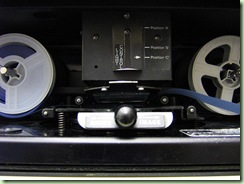
Copyright 2006, Benjamin Crowder. Used by permission. Carolyn Wright2 was working on a microfilm of a Norwegian parish record and things were not going well. New at genealogy, unfamiliar with the Norwegian language, struggling to read the handwriting, slaving to see the faded ink strokes, it was time for Wright to turn the film into the family history center staff worker for return to Salt Lake. Wright said of this moment,

I took the film to the librarian to have her prepare to return it. As I started to hand it to her, I had the most overwhelming feeling I should go through it again. I couldn't resist, the feeling was so strong.

She returned to the microfilm reader, remounted the film, and scanned again for the names of her family. As she reviewed the film, she found an error in her notes. One child, Edvard Emil, had a different birth date than she had written. Wright asked herself,

How could I have copied out a wrong date? I corrected the error, and now sure that I had completed my task, I took the film to the desk. Again, I could not do it. Something, someone, wanted me to go through the film again.

Back to the microfilm reader she went. Back the film went into the reader. And back through the film Wright went. On this third time through, she found Edvard Emil with the original birth date. Something weird was going on. She persevered and located both children with their separate birth dates. Confused, as she was new to genealogy, only later did Wright learn of the practice of giving a later child the same name as a deceased child.

Wright is convinced that it was a loving mother who wanted both her children remembered. Maternal instinct was strong in Wright herself, who was pregnant at the time. She was so moved by the experience that she named her child after the loving mother who wouldn't let Wright return a microfilm until all her children had been identified.


1. Henry Z Jones, Jr., Psychic Roots : Serendipity and Intuition in Genealogy (Baltimore: Genealogical Publishing Co., Inc., 1993), p. 81.

2. Carolyn Wright, "Family History Moment: Two lessons learned," LDS Church News, 14 March 2009, p. 16; online edition available (www.ldschurchnews.com : accessed 19 April 2009).

3. Benjamin Crowder, photographer, "Microfilm Reader," digital photograph, flickr (www.flickr.com : uploaded 15 November 2006, accessed 20 April 2009); some rights reserved.

Monday, April 20, 2009

Loretto "Lou" Dennis Szucs

This is another in a series of encyclopedia-like articles written by the Ancestry Insider. Some serve as extensions to my failing memory while others give me someplace to link to for information that may not be known by all readers.

Loretto "Lou" Dennis Szucs

 Loretto Lou Dennis Szucs A recent Utah Genealogical Association (UGA) press release included this biography of Loretto "Lou" Dennis Szucs.

Loretto Dennis “Lou” Szucs, FUGA, holds a degree in history, and has been involved in genealogical research, teaching, lecturing, and publishing for more than thirty years.  Previously employed by the National Archives, she is currently executive editor and vice president of community relations for The Generations Network.  She has served on many archives and genealogical boards, and was founding secretary of the Federation of Genealogical Societies.  Currently, she serves as a director on the Board of the Federation of Genealogical Societies.

She has edited newsletters and quarterly journals for several genealogical societies, including the Federation of Genealogical Societies’ FORUM.  She authored They Became Americans: Finding Naturalization Records and Ethnic Origins; Chicago and Cook County Sources: A Genealogical and Historical Guide; Ellis Island: Tracing Your Family History Through America’s Gateway; The Archives: A Guide to the National Archives Field Branches (with Sandra Luebking), and Finding Ancestors in U.S. Census Records (with Matthew Wright).

Since 1980, Lou has lectured at numerous genealogy workshops and national conferences.  She has presented at the American Library Association conference and has been interviewed for the Ancestors series, ABC News, CNN News, and most recently on the ABC show, The View.  In 1995, she was awarded the designation of fellow of the Utah Genealogical Association and has received numerous other awards. [Links added by the A.I.]

It was around Szucs dining room table in 1976 that the articles of incorporation for the Federation of Genealogical Societies was signed and rough bylaws were established. She was elected as one of the fledgling organization's first officers. She serves today as one of the organization's directors.

In 2006 Szucs was the first recipient of the International Society of Family History Writers and Editors (ISFHWE) prestigious Myra Vanderpool Gormley Award of Merit. Vice President of Publishing at Ancestry.com at the time, Dick Eastman called her, "highly respected and much loved in the genealogical community."

Earlier this year (2009) UGA honored Szucs as the Utah Genealogical Association (UGA) Silver Tray Recipient for her "untiring efforts as an author, compiler and editor of superior quality genealogical publications such as The Source [A Guidebook of American Genealogy]" (with Sandra Luebking). When initially created in 1973, this award honored scholarly contributions in any aspect of the field of genealogy, but since 1988 has highlighted special contributions in the field of publications.

WorldCat credits Szucs with 37 works in 41 publications in 1 language published between 1977 and 2007 with 5,659 library holdings among members of the WorldCat cataloging system. WorldCat includes Szucs' Family History Made Easy and additional publications not listed above.

Wednesday, April 15, 2009

Top 25 most popular 2009 genealogy blogs

Top 25 genealogy blogs award from ProGenealogists ProGenealogists recently announced their "25 Most Popular Genealogy Blogs for 2009" awards. We are very honored to be part of this group. A glance through the other blogs on the list is truly humbling. It's even more humbling to read ProGenealogists announcement, noting that "a Google search for genealogy blogs currently results in nearly half a million options, with over seven times that number for 'family history' blogs."

I'm not certain how to do a Google search that returns the number of blogs, but to search blog posts, try http://blogsearch.google.com . At the time I wrote this article a search for the word genealogy returned 857,000+ blog posts containing the word genealogy. A search for "family history" (including the quotes), returns 674,000+ posts.

Subscribe to new Google Search results

The search results page contains one of my secrets for uncovering news stories that you won't see on the other genealogy news sites. You can subscribe to the results of your blog search by clicking one of the options in the left margin under the heading, "Subscribe." This will give you an email or news feed of all the new results for your search. That's only 6,600+ articles you'll have to read each day to cover all blog posts with either the phrase "family history" or the word "genealogy."

Better yet, let your favorite genealogy news blogs shift through all those posts while you use the email option, called a Google Alert, to set up a Internet-wide sweep for new information on those ancestors you're trying to find!

First Dog, Bo, showing the president how to use the leashAnd thank goodness the President's choice for new First Pet is done. Several months ago Google changed their search algorithm. My Google alert for FamilySearch started returning results containing "...First Family searches for dog..." To prevent this behavior, include quotes around words you don't want Google to break into separate words.

But I digress...

Measurement Challenges

Choosing the 25 most popular genealogy blogs had special challenges not encountered when measuring the 50 most popular genealogy websites.

"Many people read blog entries through RSS feeds and other means and seldom actually visit the blog's website," according to Kory Meyerink, noted genealogist and vice president at ProGenealogist. Instead of website traffic, ProGenealogist turned to Technorati rankings. Even this alternative proved problematic, as Technorati doesn't include Dick Eastman's popular online blog/newsletters. This led ProGenealogist to include other factors:

Hundreds of genealogy blogs were evaluated based on their overall content, Technorati rating, and industry experience. Due to the ever-changing nature of the blogosphere and the authority basis of Technorati rankings, it is anticipated that this list will change frequently.

When I first started blogging years ago (has it really been that long?) I found my Technorati authority rating changed so erratically, I couldn't stand to follow it. Since I seem to be in widget-mode of late, here's a widget that displays my authority rating in real time:

View Ancestry Insider authority

Like other widgets I've posted lately, it is likely you won't be able to see it (adjacent to "View Ancestry Insider authority") if you read this article in your email or news reader. View this article online (click here) to see the widget.

The Technorati Authority of a blog is a count of the number of other blogs that have posted links to it during the previous six months. Since other winners of the most popular blogs award have increased my authority by posting the list of winners, I'm honored to return the favor. They are:

  1. About.com Genealogy (Kimberly Powell) 
  2. Eastman Online Newsletter* (Dick Eastman)
  3. Genea-Musings (Randy Seaver) 
  4. Creative Gene (Jasia) 
  5. DearMYRTLE (Pat Richely) 
  6. AnceStories (Miriam Midkiff) 
  7. Genealogue (Chris Dunham)
  8. footnoteMaven (Anonymous) 
  9. Genetic Genealogist (Blaine Bettinger) 
  10. Tracing The Tribe: Jewish Genealogy Blog (Schelly Talalay Dardashti) 
  11. GenaBlogie (Craig Manson) 
  12. Olive Tree Genealogy Blog (Lorine McGinnis Schulze) 
  13. Steve’s Genealogy Blog (Stephen J. Danko) 
  14. 24-7 Family History Circle (Juliana Smith)
  15. TransylvanianDutch (John Newmark) 
  16. GenDisasters (Stu Beitler) 
  17. Genealogy Insider @ FamilyTree (Diane Haddad) 
  18. Think Genealogy (Mark Tucker) 
  19. California Genealogical Society and Library Blog (California Genealogical Society) 
  20. The Genealogy Guys (George G. Morgan and Drew Smith) 
  21. CanadaGenealogy, or, 'Jane's Your Aunt' (Diane Rogers) 
  22. Ancestry Insider (Anonymous) 
  23. GenealogyBlog (Leland Meitzler) 
  24. Ancestor Search Blog (Kathi) 
  25. Genealoge (Hugh Watkins)                         /its a tie!/
    Legacy News (Legacy Tree Software)         /its a tie!/

Tuesday, March 17, 2009

Disturbing family secrets...

Did you see this comic in Sunday's funny papers?

Click for a larger, readable copy.

Click for a larger, readable copy of this Cul De Sac comic
© 2009 Universal Press Syndicate - All Rights Reserved. Courtesy GoComics.
Visit gocomics.com to share, subscribe, save, or print this and all your favorite strips.
This reduced-size, reduced-resolution, barely legible image is a fair-use copy and has no commercial value.

P.S. Happy St. Patty's Day!

Wednesday, October 29, 2008

Opinion piece: Ancestry.com / USGenWeb squabble

The well publicized squabble between Ancestry.com and U.S. GenWeb Project (USGenWeb), in my opinion, has hurt both. But perhaps the greatest damage has been suffered by USGenWeb and has been of its own doing.

USGenWeb is an unincorporated non-profit association of volunteers that maintain a set of geographically organized web sites. Separate, but linked, web sites exist for every county and state in the country. The binding philosophy among all these non-commercial web sites is, "Keeping Internet Genealogy Free." Many had made use of RootsWeb's free genealogy web site hosting service. When Ancestry.com acquired RootsWeb, they continued the program, despite dire predictions by some that Ancestry.com would discontinue it.

The squabble arose when Ancestry.com announced that the RootsWeb.com address was being automatically replaced with RootsWeb.Ancestry.com and that mandatory headers would be automatically added to the free genealogical web sites hosted by RootsWeb. For some sites, the headers were merely a change from the mandatory top and bottom advertisements that Ancestry.com added to the sites. For USGenWeb sites, the headers were new.

While the organization's bylaws allowed "a website [to] acknowledge any entities who may host their website (i.e., provide server space at no cost)" (Article IX, Section 2.), some web site coordinators feared the worst. (See this post or this for a couple of examples.) USGenWeb sites contain genealogical data gathered through thousands of hours of volunteer work. The mere specter of Ancestry.com assimilating these contributions led some web site coordinators to move their sites off RootsWeb. Even the national site made a quick decision to move off RootsWeb, temporarily using a private server donated by a member before moving the site to IX web hosting.

"After many years at RootsWeb, we made a quick move to another option for web hosting," Mike St. Clair, USGenWeb Advisor Board Member later reported. He advised the board that, "a more organized evaluation of the options available would be useful before we decide to confirm that quick decision for the longer term."

Those sites that have moved have spent focus and time on the task, and many are still not finished. (See for examples, ILGenWeb, Town of Essex and the Kidz Project.) Changing URLs have produced broken links, upsetting easy navigation among sites, and cutting off some outside traffic.

I just experienced a case in point

The Phillips Library of the Peabody Essex Museum Visiting the Peabody Essex Museum's web site, I found the Phillips Library page on featured collections highlighted Essex County (Massachusetts) genealogy. The web site referred interested persons to "RootsWeb" for more information. Don't bother clicking the link, it points to www.rootsweb.com/~maessex, a dead URL. I know because I clicked the link.

When I found the link was dead, I assumed the link was to the RootsWeb resource page for Essex County, so I searched RootsWeb and noticed a link to www.rootsweb.ancestry.com/~macessex. That URL, differing by just the letter "c" surely was related, so I followed the link.

The address was for the USGenWeb Project's Essex City, Essex County site, so the Peabody's bad link must have been to a USGenWeb site. According to the Internet Archive, it was. The site was active from as far back as 18 August 2000, when it was part of the RootsWeb Genealogical Data Cooperation or GenConnect, until as recently as 24 December 2007, when it was part of USGenWeb.

Well, I was sitting on the Essex City web site. It should have been a simple matter to get to the county. I just clicked on the link to the county and...

...I was back to the dead URL www.rootsweb.com/~maessex. I used a search engine to locate the Essex County site at http://essexcountymagenweb.com, although http://essexcountyma.net will work as well. There, I found the address of the Massachusetts state web site had changed from www.rootsweb.com/~magenweb to http://magenweb.bettysgenealogy.org.

What a mess. And so I suppose it goes across the width and breadth of the U.S. GenWeb Project.

Pages spurned, Lessons Learned

From what I think I've learned from this experience, I would offer the following advice to the U.S. GenWeb Project:

  1. Domain names should be uniform (http://cc.ss.usgenweb.org) and centrally controlled. State and county coordinators would still arrange for their own web hosting and the national organization would set the DNS address to resolve to the current host. A site could change web hosting services and one DNS change by the national organization would heal all links to the site.
  2. Keeping data free is easier than preventing commercial exploitation. Richard Stallman, founder of the free software movement learned this the hard way when firms commercialized free software he developed. This led to the development of such copyleft copyright licenses as GPL and Creative Commons. Scientists in the Creative Commons project have abandoned attempts to prevent commercial exploitation in order to achieve their primary goal of keeping scientific data free. USGenWeb should likewise reexamine the relative importance of making data available for free versus preventing commercial exploitation of that data.
  3. Copyright provides very little protection to USGenWeb data. While the documents as a whole on USGenWeb web sites and in the archives are copyrighted, it is by no means clear if the data in those documents are protected. There are plenty of legal justifications for anyone that wanted to "harvest" that data. The U.S. Copyright Office says, "What is not protected? ... Information that is common property [such as] lists or tables taken from public documents or other common sources." (Circular #1, p. 3.) See also, "Can You Copyright Your [Genealogy] Data," and "7th Circuit Rules that Extraction of Public Domain Data from Copyright-Protected Database Is Not Copyright Infringement." Ultimately, the decision would require judicial interpretation. An unfunded volunteer cooperative would be no legal match for a determined, cash-rich corporation. If USGenWeb is intent on preventing commercial exploitation of its data, it should seek the advice of a nationally recognized Intellectual Property (IP) lawyer. Law schools may be the place to find individuals sympathetic to their cause.
  4. The transition away from RootsWeb would have been a great time to convert the USGenWeb Project to wiki format. Site coordinators that were moving their sites anyway could have moved the content into wiki pages. Other coordinators who had to update links to the sites that moved, could have moved their sites or simply changed the links to point to the appropriate wiki pages. A consistent page naming scheme would allow all coordinator to know what the wiki page URL would be. For sites that didn't move, wiki pages could be created with links out to the appropriate web site. Site copyrights would become page copyrights. Or members could entertain placing the copyrights in the national organization. Editing rights could be restricted to current coordinators, or opened up to any registered member. Templates could be used to encourage uniform layouts by desired groups of coordinators.

In fairness, I should write about Ancestry.com mistakes in their relationship with the USGenWeb project. I envision a piece outlining how they should have engaged the entire free genealogy community from the moment they bought RootsWeb. That's going to take hours to write. And they still don't have it right. And it's late. And I'm off to bed, so if you have an opinion, leave a comment.

Friday, September 19, 2008

I *heart* your blog award

I *heart* your blog award People are so nice. Renee has awarded me an "I Love Your Blog" award. Thank you. And here's right back at you, Renee.

The rules for the award are:

1. Can put the logo on his/her blog

2. Must link to the person who gave the award

3. Must award 7 other blogs and link to them

4. Must leave a comment on each of the nominated blogs

I used to think that part of the service of my blog was to monitor a zillion Ancestry.com and FamilySearch related blogs so you wouldn't have to, passing the news about Ancestry.com and FamilySearch.org on to you. In practice, I've found I'm too opinionated and have too much to say to spend much time in the news amalgamation role.

But I still enjoy reading all those blogs. Let me share some favorites with you. These are the blogs I check everyday. There are hundreds more that I check more infrequently, depending on their Ancestry.com or FamilySearch coverage.

I hereby award the "I Love Your Blog" award to (in alphabetical order):

  1. 24-7 Family History Circle — Owned and hosted by Ancestry.com, editor Juliana Smith is the real draw here along with regular columnists: George G. Morgan, Michael Neill, Megan Smolenyak Smolenyak, Maureen Taylor, Paula Warren and Sherry Irvine. Also a good weekly wrap-up of new databases on Ancestry.com.
  2. All Things Kendall and Caroline — Ancestry.com director of product management Kendall Hulet and wife Carolina. She's a hoot. As for Kendall, he better keep his day job.
  3. Ancestry.com Blog — With a catchy title like that, you know it's the official, corporate blog.
  4. Ancestry.com Recent Genealogy Databases — This is a news feed version of Ancestry's What's New page. Why they don't offer an RSS feed of that page is beyond me. But someone figured out how to create one from the page.
  5. Arlene H Eakle's Genealogy Blog — Professional researcher. Pragmatic. Straight shooter. Knows her stuff. Often mixes in some good, western, rural philosophy.
  6. Cyndi's List — It's been forever since she posted, but it's nice to see news once and again about Cyndi's famous list.
  7. DearMYRTLE — DearMYRTLE, aka Pat Richley is a noted author, lecturer and genealogist. Her blog is an excellent news source. She's well connected in the industry. She's a great teacher and has a gift for mentoring. Her grandmotherly byline aside, "Myrt" is a technical pioneer, taking genealogy into emerging technologies from Q-Link, AOL and chat rooms to Internet radio, podcasting and the Second Life virtual world.
  8. DNA Ancestry.com — How does DNA get away with their own blog when everyone else has to use the corporate one? Don't ask; don't tell.
  9. Eastman's Online Genealogy Newsletter — The Johnny Carson of genealogy bloggers, he was doing it before it had a name.
  10. FamilySearch Labs Blog — "Future Tools to Dig Up the Past." Official FamilySearch blog.
  11. Genea-Musings — I want to be Randy Seavers when I grow up. I used to think that he could read my mind, because every time I thought of a good article subject, he'd write about it the next day.
  12. Genealogy and General Subjects Blog — She had me the minute she used "genealogy" and "gadgets" in the same sentence.
  13. Genealogy Insider — by Diane Haddad, et. al. Talented writers, all. I was devastated when I didn't make her top seven. <sniff>
  14. Genealogy Roots Blog — News about online vital records.
  15. Leland
  16. Megan's Roots World — While she's mostly over in Facebook-land, she occasionally comes back to the blog-o-sphere to update us.
  17. Nate Skousen — The Generations Network employee blogger. "I love my job." Go Nate!
  18. Paul Allen (the lesser) — Not a genealogy blog, per se, but Internet entrepreneurship. Founder of MyFamily.com/Ancestry.com. Thoughtful. Low quantity, high quality. Just the way I like it.
  19. Renee's Genealogy Blog — New FamilyLink/WorldVitalRecords.com employee. Excellent source for Utah Valley and LDS genealogy news. If the product managers for New FamilySearch and FamilySearch Indexing aren't hanging on every word of her "Adventures" series, they should be.
  20. Rootdig — Michael John Neill's genealogy site. Researcher, author and speaker.
  21. RootsWeb Newsroom — Official RootsWeb.com blog. Sorry—RootsWeb.Ancestry.com—blog.
  22. Shoebox Genealogy — Professional Salt Lake genealogist. Makes me so mad, I could spit. Subtitled "Genealogy with an attitude." That's putting it mildly.
  23. Taking Genealogy to the Common Person — Dan Lawyer, Product Manager at FamilySearch.
  24. The Genealogue — The Dave Barry of genealogy bloggers, Chris doesn't know it, but he gave me my first big break. My numbers were inconsequential until he quoted a story I published.
  25. Think Genealogy — "Mark Tucker is a software architect by day and a family historian on as many nights and weekends as possible."
  26. Upstate New York Genealogy Blog — Dick Hillenbrand is reason enough, but I'm also working a dead-end in, you guessed it, upstate New York.
  27. Utah Valley PAF Users Group - Press Releases — If you live in Utah Valley, a subscription will remind you of what's coming in the next meeting. If not, hope for one of Renee's detailed minutes/reports of past meetings.
  28. What a WONDERFUL Thing to live Today! — Someone who hopes to be a FamilySearch Missionary doing book scanning at Allen County Public Library. Very infrequent posts.

I guess I exceeded seven a little. Hey, at least it was a multiple.

Judging from the sudden eruption of high-school quality acne on my face, I've got a reunion to attend this weekend, so it may be a day or so before I fulfill requirement number 4. Can you do a favor for me? If you check out any of these blogs, leave them a comment. Mention I sent you and tell them they're winners in my book.

Meanwhile, I have some awards of my own to collect. Most hair loss... Most weight gained... Most likely to be laughed at...

Monday, September 15, 2008

Indexing Tora! Tora! Tora!

This is an inside joke for Orientals, mixing the Chinese word 'mediocre' and the Japanese 'Tora! Tora! Tora!' It was easy to cheer on both Ancestry.com and FamilySearch when I worked for Ancestry.com since Tim Sullivan continually reassured employees and the genealogy market that the two are not competitors. (One Ancestry.com employee is rumored to have asked human resources if that applied to the non-compete agreements that employees are required to sign. The employee was assured that insofar as non-compete agreements, FamilySearch is considered a competitor. I need to tell you someday about my situation, but for today's topic, I digress...)

I wondered if my multiple-competitor cheerleading days were over last week when FamilySearch reacted to Ancestry.com's indexing program announcement by issuing a statement titled, "FamilySearch Indexing is not affiliated with Ancestry's World Archives indexing program." Looking over it now, it doesn't seem quite as defensive as it did at the time. It must have been the timing, more than anything else that made it feel to me like FamilySearch was taking a hard, competitive stance against Ancestry.com.

Tim Sullivan then issued a message responding to the FamilySearch message reacting to the Ancestry.com announcement. Follow that? Anyway, apparently I wasn't the only one to interpret FamilySearch's message the way I did. Sullivan said that readers of the "message might get the impression that this is some big competition between Ancestry.com and the LDS Church."

"We definitely don't see it this way!" Sullivan again reiterated, saying there was plenty of work to go around. I hoped to include a table comparing the claims of the two organizations and my independent grade for each, but I've run out of time.

I can tell you from first hand experience that both organizations have strengths. FamilySearch used to be the undisputed leader in the genealogical industry. Its Family History Library, branch family history centers and extensive microfilming efforts put it on top. But today, when it comes to Internet genealogy, FamilySearch has been sitting on its Laurels (a little LDS inside joke, there). Ancestry.com has become the the undisputed leader in using Internet genealogy to produce profits and shareholder value. (See Making Sense via Motives.) In comparison, the FamilySearch Internet offering is mediocre. Ancestry.com has awakened FamilySearch to the possibilities for using the Internet for its motive of creating eternal families. While FamilySearch's response has been slow, its response and ongoing plan are massive.

Tora! Tora! Tora! Internet genealogy and Indexing has awoken two sleeping giants! The benefit of the "non-competition" competition between these two giants will be gigantic for genealogists.

Friday, August 29, 2008

Database review: Historic Land Ownership Atlases

Earlier this week I've reviewed two free, online map collections. See "The Marshall Historical Maps Collection" and "Maps online from the New York Public Library". Today, I'd like to examine two of the map databases in Ancestry.com's collections.

Historic Land Ownership and Reference Atlases, 1507-2000

The source information for the Historic Land Ownership and Reference Atlases, 1507-2000 database identifies the source of the original data as Historic Map Works, LLC. This is an excellent collection of high resolution, full color cadastral maps. Cadastral maps, sometimes called land ownership maps, list the owners' or residents' names on the maps. The card catalog gives a name count estimate of 42,855 names. I think in actuality, this is the number of maps in this collection. The number of names may be much more since each cadastral map contains many names. If you have ancestors living in New England around the time of our country's first centennial, there's a good chance they're named in one of the Beers atlases in this collection.

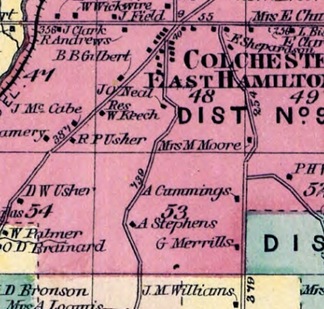
I also enjoy these maps for the handiwork in their production. The color in these atlases was hand water-colored, making each map in each atlases absolutely unique. I've reproduced below the same detail from the map of Hamilton Town, Madison County, New York that I showed earlier in the week from the New York Public Library. Compare the two and see if you can see differences along the color edges. Can you imagine what it would cost today to produce hand-colored maps? Wow!

MapAnc
Compare this detail from a Madison County atlas map to the one from New York Public Library.

I've only had a little experience with atlases of federal land states in this time period. My experience there has been that names are not included. You'll have to look up a land description of your ancestors' property separately and then consult the map to see your ancestors' property in context. I have no experience with the southern state atlases so I looked at an example or two. It looked like the map coverage of the collection is not as good, but owner names were included on the maps I checked.

I absolutely love this collection and I think you will too.

U.S. County Land Ownership Atlases, c. 1864-1918

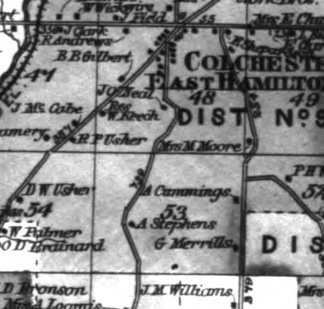
Prior to obtaining Historic Map Works' collection, Ancestry.com put together a similar map database from Library of Congress microfilm. The database, U.S. County Land Ownership Atlases, c. 1864-1918, is black and white since it is digitized from microfilm. This database is outclassed in pretty much every way by the Historic Map Works database.

MapAnc2 
This detail covers the same area as the one above.

It appears from the card catalog that this collection contains 33,404 maps, almost 25% less than the Historic Map Works collection. But that doesn't mean every map in this database can be found in the Historic Map Works database. If you find a map in this collection that you can find in color on the previously mentioned websites and databases, you'll probably find the color version to be aesthetically superior. But if you can't find your map in color, you may find the map in this database to be more than suitable for your genealogical needs.

Tuesday, August 26, 2008

Maps online from the New York Public Library

The New York Public Library (NYPL) website descriptions of its Image Collections include mentions of several with maps.

Image of title page, Atlas of Madison County, Beers.To uncover the maps across all these collections, one may wish to use search rather than browse. A subject search for "Maps" returns 834 subjects containing the word "Maps." Be warned that not all images have a subject assignment, so a keyword search or advanced search is the safer route.
New York State County and City Atlases

The NYPL recently digitized 43 state, county and city atlases covering New York and New Jersey prior to 1900. The NYPL map division has more than 420 titles from this period. I read somewhere on the NYPL website that many of these atlases were in response to the 1876 centennial. I had always assumed it was somehow an outgrowth of the end of the Civil War.

Many of these maps are cadastral in nature. That is, they contain the names of the owners. I imagine most of the cadastral maps for New York that one must pay to see on Ancestry.com can be viewed without charge on the NYPL website.

Detail from a Madison County atlas map showing location of dwellings and names of residents.

See this page for a list of digital holdings from this series. You might prefer viewing the maps with the LizardTech MrSID plugin using Internet Explorer.

Monday, August 25, 2008

The Marshall Historical Maps Collection

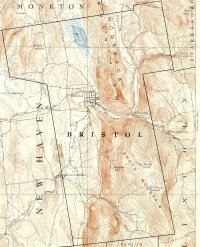
BristolTownship1905S Have you ever used historic United States Geological Survey (USGS) maps? I love maps anyway, but I think historic maps give me a better understanding of the environments my ancestors lived in.

Were I to do a doctorate in genealogical studies, I think my dissertation would be a comparison of historic migration routes and turn of the 20th century roads. My theory is that the further back in time one goes, the more our road system reflects the actual pathways used in earliest times. I figure just before the invention of the automobile... But I digress...

History

While current USGS maps are easy to obtain, historic USGS maps are not. Christopher Marshall, a railroad enthusiast in New Hampshire found this to be the case and started traveling around the state, digitizing USGS maps. Marshall's collection grew into the University of New Hampshire's (UNH) Dimond Library Government Documents Department Historic USGS Maps collection. First with statewide coverage, coverage grew until it covered all New England. New York came next.

By this time Marshall's Collection was extending beyond UNH's New England focus, and Marshall was looking for a new home. Through a fellow rail enthusiast, Marshall learned of Maptech, which agreed to host the growing Marshall Historical Maps Collection. Access the collection at

http://historical.maptech.com

The online collection now includes over 2000 USGS topographic maps and has complete geographical coverage of New England, New York, Pennsylvania, New Jersey, Delaware and Maryland from the 1890s to the 1950s. Much of Virginia, West Virginia and Ohio are covered. It is slowly being expanded as time permits through volunteer efforts. If you would like to help, contact Chris Marshall through Maptech's e-mail address: sales@maptech.com.

Quadrangles

Positions on the Earth are measured using latitude and longitude. Latitude is measured in degrees from 0 to 180 degrees east or west of London, England. Longitude is also measured in degrees from 0 to 90 degrees north or south of the equator. Can you see that in both cases, 360 degrees makes a complete circle around the Earth? And in both cases, smaller distances are measured by subdividing one degree into 60 minutes.

This extract shows the detail level a 7.5 minute series map.
This extract shows the detail
level of a 7.5 minute series map.

USGS maps cover a particular rectangle of the Earth's surface, or since the Earth isn't flat, it is more correctly called a quadrangle. Quadrangles are aligned by degree or fractions of a degree, sometimes cutting cities or other features of interest onto different maps. For example, Manchester, New Hampshire is cut up onto 4 different maps!

Each quadrangle was named by the USGS, generally from some significant feature within the quadrangle. Names are only unique within the state and map series. For example, both Vermont and Massachusetts have a Barre quadrangle. Sometimes the names were changed when new editions were created.

7.5 Minute Series

The series of maps that covered a 7.5 by 7.5 minute quadrangle are called 7.5 minute series maps. These are the most recent and the most detailed maps in the Marshall Collection. Most of the 7.5 minute maps in the collection are of southern New England and were published in the late 1930s until the mid 1950s.

15 Minute Series

This extract shows the detail level of a 15 minute series map.
Contrast the detail in this 15 minute series
example, which has been enlarged to match
the size of the 7.5 example. Ignore growth
in human features. Notice swamps,
contour lines and waterways.

The Marshall Collection contains complete coverage of New England in this series. The 15 minute series includes the oldest maps in the collection. The south was complete by 1900, but parts of Vermont and New Hampshire weren't complete until the 1920s and parts of Maine were later than that.

30 Minute Series

The maps in this series are the oldest and least detailed in the Marshall Collection. Very few appear to exist, as the USGS seems to have switched to publishing 15 minute maps around 1900.

Collection Finding Aids

Each state in the Marshall Collection includes an Image Map that shows the state divided into rectangles (er... quadrangles). Click on a quadrangle to link to a web page that lists available maps for that area of the state.

The collection also supplies an index by quadrangle name.  Since cities don't have dedicated quadrangles, the quad index is pretty useless for the casual user. A town index is supplied for each state to make it easier to locate towns/townships.

Most maps were scanned as four sections to keep the image size about 1.5 megabytes. That's big enough to make downloads slow, but small enough to make downloads reasonable.

(Sources: UNH's About Page and Maptech's About Page.)

Tuesday, August 12, 2008

Kodak's research trip tips

Kodak's newsletter at summer's dawn gave vacation photo tips that are just as applicable to genealogy research trips.

  • Use photos to tell the story of your trip, from the time of your departure to your return.
  • Capture the details. Take pictures of signs, ticket stubs, menus, local maps and more.
  • Take individual pictures of each member of your travel party with their favorite landmarks, rides, eatery or animal.
  • Carry a small notebook to jot down quick details to use later.